This week, the epicenter of the bodybuilding universe, Las Vegas, plays host to an unprecedented milestone in the history of the Olympia Weekend. For the first time since the inaugural competition held by Joe Weider in 1965, the IFBB Pro League will crown a champion in the "Fit Model" division.
To the old-school bodybuilding purists—those who measure success in fiber thickness and striated glutes—the addition might feel like another dilution of the sport. However, a deeper examination reveals that Fit Model is not just another category; it is a strategic, structural attempt by the federation to reverse the inevitable "creep" of muscularity that has redefined every single division in the history of the sport.
The Evolution of the Stage: From Larry Scott to the Present
Since Larry Scott secured the first Mr. Olympia title nearly 60 years ago, the landscape of competitive physique sports has undergone a radical transformation. What began as a singular pursuit of mass and symmetry has branched into a sprawling ecosystem of 12 distinct divisions, including Open, 212, Classic Physique, Men’s Physique, Bikini, Figure, Wellness, Fitness, Women’s Physique, Women’s Bodybuilding, Wheelchair, and now, Fit Model.
This expansion mirrors the broader evolution of the fitness industry itself. As the sport grew, so did the aesthetic standards. The introduction of new categories has historically functioned as a "correction" to the increasing intensity of existing ones. When bodybuilding became too extreme for the general fitness enthusiast, divisions like Fitness and later Bikini were introduced to provide a more accessible—and arguably more marketable—ideal.
Fit Model represents the latest, and perhaps most intentional, iteration of this correction. The division first appeared at the amateur level via the NPC in 2025, followed by the professional debut in 2026. As it takes its place on the Olympia stage from September 24–27, 2026, it is officially integrated into the prestigious Olympia qualification system, signaling that the IFBB Pro League is committed to its long-term viability.
Defining the Undefined: The Specificity of Fit Model Criteria
What makes Fit Model unique is the explicit nature of its judging criteria. Unlike the subjective "best physique" mandates of other categories, the IFBB has published remarkably rigid guidelines that prioritize a "softer" aesthetic.
The criteria are as follows:
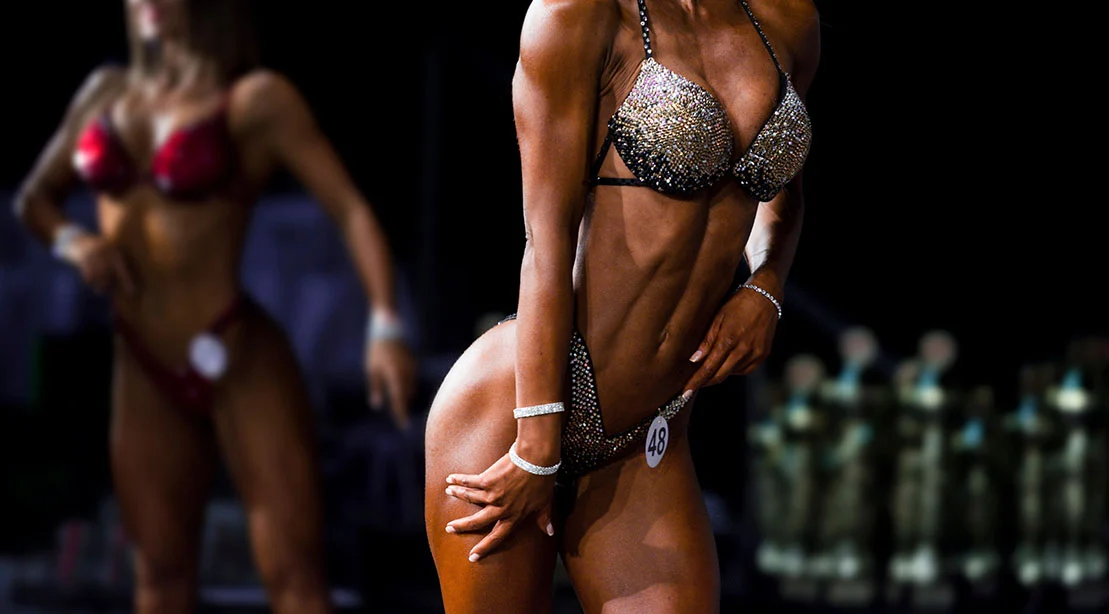
- Muscularity: Competitors must possess enough muscle to provide shape to the female frame, but strictly less than that of the Bikini division.
- Targeted Areas: The rules explicitly demand less development in the legs, glutes, arms, and deltoids. While a degree of "roundness" in the delts is permitted, capped, boulder-like shoulders are discouraged.
- Conditioning: This is perhaps the most radical departure. The midsection should appear fit, but should not possess the high-definition detail seen in other divisions. Furthermore, the hallmark of modern competitive bodybuilding—the visible glute-ham tie-in—is strictly prohibited. Any sign of hamstring separation is grounds for a lower placing.
By mandating "less" instead of "more," the league is essentially attempting to curate a specific "magazine cover" look. Notably, the federation has cited the 2015 physique of three-time Bikini Olympia champion Ashley Kaltwasser as the visual benchmark for the division. By using a past champion as a template, the league is signaling a desire to return to a level of conditioning that has, in the years since, been surpassed by modern competitive standards.
The Chronology of ‘Creep’: Why Divisions Change
To understand why Fit Model is necessary, one must look at the history of the other divisions. In the world of physique sports, "competitive evolution" has a singular, relentless direction: more muscle, harder conditioning, and increasingly extreme physical attributes.
- Women’s Bodybuilding: Over decades, the pursuit of mass led to physiques that, while impressive, drifted far from the mainstream ideal.
- Figure and Bikini: Originally intended to showcase a "softer" or more "athletic" look, both divisions eventually succumbed to the pressures of competition. Athletes, wanting to stand out, pushed their training and nutrition to levels that increased their muscularity and hardness, eventually requiring the creation of newer, even softer categories.
- Classic Physique: Designed to provide a nostalgic alternative to the massive, hyper-conditioned Open bodybuilders, even this division has seen a rapid escalation. The "classic" competitors of 2026 are significantly larger and more conditioned than the competitors who defined the look just a few years ago.
This cycle is the primary reason the federation is now forced to implement "reset" divisions. Fit Model is a formal acknowledgment that the Bikini division has, in the eyes of the federation, moved too far toward the extreme.
Implications for the Future of the Sport
The introduction of Fit Model carries significant implications for the future of the IFBB Pro League. The primary question is whether this division will successfully attract the "lost demographic"—the women who train hard, maintain a healthy lifestyle, and look incredible, but who have no desire to undergo the grueling, potentially unhealthy, and aesthetically harsh prep required for Bikini or Figure.
The Challenge of Judicial Consistency
The success of Fit Model rests entirely on the shoulders of the judging panel. They face a monumental challenge: protecting the standard. If the judges allow the winning physique in 2026 to be slightly "harder" or more muscular, the athletes competing in 2027 will inevitably adjust their preparation to match that look. If this happens, the division will simply become "Bikini 2.0," and the cycle of physical escalation will begin anew.
For the division to survive as intended, the judging criteria must be enforced with draconian strictness. Judges will need to penalize competitors who show up with too much quad sweep, too much glute separation, or "too much" overall conditioning. This requires a level of consistency that has been difficult to maintain in other divisions, where the "standard" often evolves based on the most impressive athlete on stage rather than the written rules.
A New Market for Competitors
If the standard holds, Fit Model could significantly expand the pool of competitive athletes. There is a massive global population of women who represent the "fitness model" aesthetic—the look typically seen in mainstream media and health publications. These women have historically been alienated by the bodybuilding-centric requirements of the IFBB. By creating a space where "less is more," the Olympia is essentially diversifying its product, making competitive fitness accessible to a broader range of athletic, healthy women who prioritize aesthetics over extreme muscle hypertrophy.
The Verdict: Watching the Trend, Not the Trophy
As the 2026 Olympia weekend unfolds, the focus should not just be on which woman lifts the inaugural trophy, but on what that woman looks like. Every competitor who enters the division in the coming years will be looking to the first champion as the blueprint for success.
The IFBB Pro League is essentially conducting an experiment in "aesthetic conservation." They are trying to hold back the tide of muscle growth and extreme leanness to preserve a specific, marketable look. It is a bold, necessary, and risky move.
If the judges choose wisely—if they reward the intended aesthetic rather than falling for the trap of "more is better"—Fit Model could become the most important, and most popular, entry point into the sport. If they fail, we will be looking at the inevitable introduction of "Fit Model Classic" within a decade, as the current iteration inevitably follows the trajectory of every other division that came before it.
For now, the stage is set. We are about to find out if the sport of bodybuilding has the discipline to stay small in a world that is constantly demanding more.