Introduction: Why Do Your Base Layers Fail?
During high-intensity exertion—whether you are ascending a steep alpine ridge or pushing through a multi-day trek—the human body acts as a biological furnace. To maintain core temperature, the body triggers an evaporative cooling response: sweat. When the rate of sweat production exceeds the rate of evaporation, liquid moisture begins to pool on the skin. It is at this critical juncture that the performance of your base layer transitions from a comfort feature to a survival necessity.
For years, the outdoor industry has relied on broad, often vague terminology like "moisture management" and "wicking" to describe how garments handle this liquid. However, these terms often fail to capture the nuanced reality of what happens beneath our shells. Does the fabric move water away, or does it simply hold it? Why do some garments marketed as "dry" feel clammy and heavy within minutes of departure?
To answer these questions, I initiated a rigorous, multi-stage testing protocol. Moving beyond the standard "marketing speak," I evaluated eight distinct base-layer fabrics to track exactly how liquid water moves—or fails to move—through a clothing system. By measuring moisture retention at the "skin," within the base layer, and in the secondary layer, we can finally quantify the invisible mechanics of moisture transfer.
The Chronology of Research: From Simple Fabrics to Complex Systems
The genesis of this study began months ago with a preliminary evaluation of three common base-layer types. While that initial effort identified performance gaps, it left a fundamental question unanswered: Where does the water actually go?
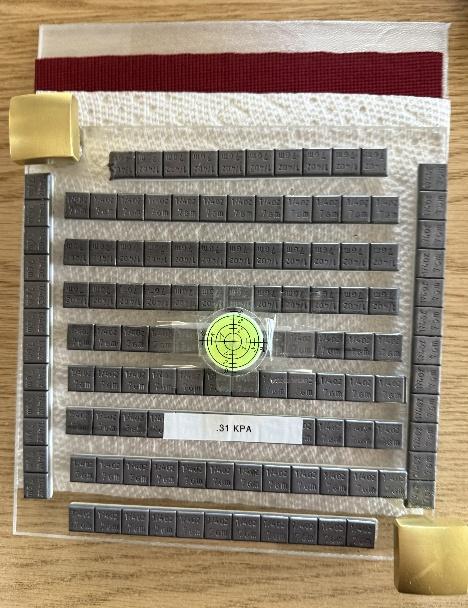
- Phase I (Baseline Analysis): I developed a standardized testing device (see Figure 1) to simulate the layering of clothing. This device allows for the precise measurement of water mass across three distinct "zones": the synthetic skin, the base layer, and the receiving layer.
- Phase II (Scope Expansion): Recognizing that three fabrics were insufficient to represent the diverse market, I expanded the study to eight unique textile designs. This expansion was vital; it allowed for the observation of consistent, repeatable patterns in how different fiber geometries and chemical treatments interact with liquid sweat.
- Phase III (Data Synthesis): By applying the foundational capillary physics established by Young and Laplace (1805) and further developed by Washburn (1921), I analyzed the "breakthrough pressure" of these textiles. This allowed for the conversion of abstract observations into a predictive framework for gear performance.
Supporting Data: The Science of Liquid Transfer
The Hydrophobic Paradox
Hydrophobic base layers—typically constructed from synthetic fibers like polyester or polypropylene—are frequently sold on the promise of "staying dry." While it is true that these fibers resist absorption, they are not impervious to water. As the testing data illustrates, hydrophobic garments are largely composed of "empty space."
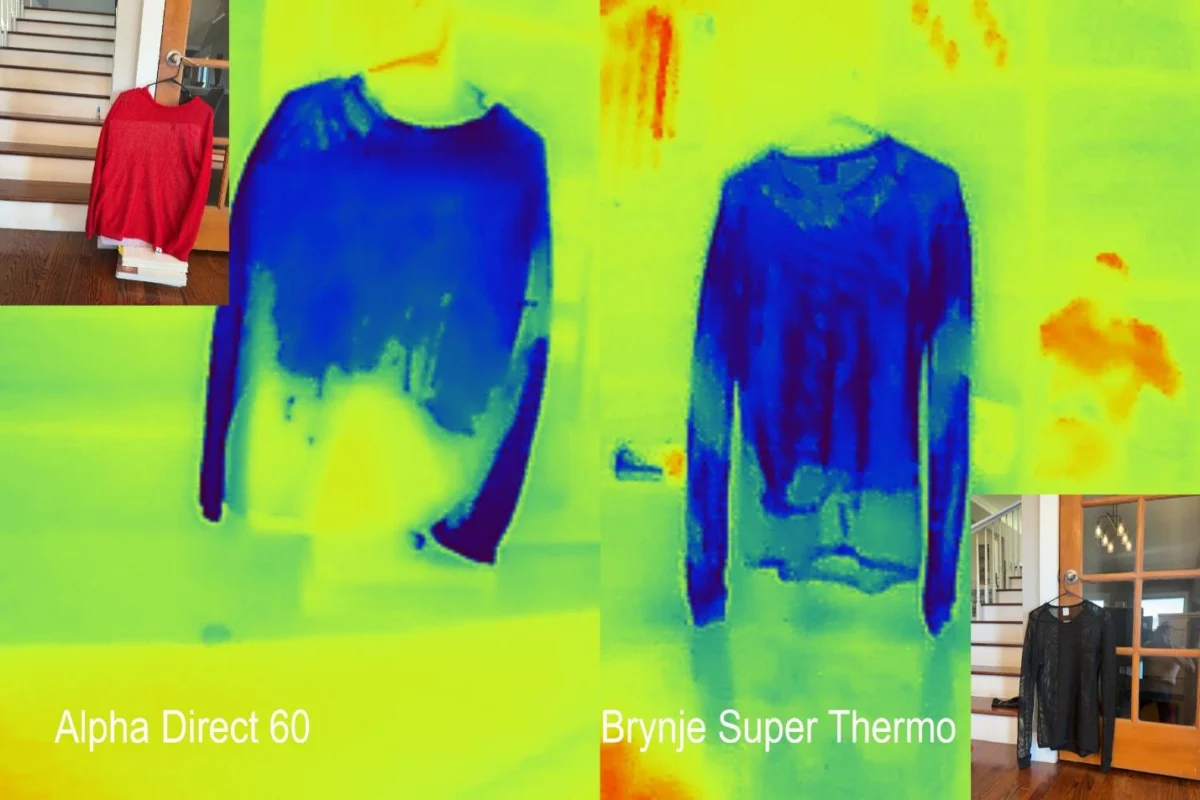
During periods of high exertion, liquid sweat does not disappear; it migrates into the interstitial voids between fibers. My infrared imaging (Figure 2) reveals a stark reality: garments like the Brynje mesh shirt retained 87g of sweat, while Alpha Direct materials trapped 62g. Despite the hydrophobic nature of the fibers, the fabric itself became a saturated sponge.
The determining factor here is breakthrough pressure. Because these fibers lack hydrogen-bonding sites, they do not "wick" water via capillary action. Instead, they require external pressure—generated by pack straps, body movement, or garment tension—to force water through the pores. If the rate of incoming sweat exceeds the fabric’s ability to facilitate this "breakthrough," the garment becomes a reservoir, leading to that familiar, heavy, and clammy sensation.
The Hydrophilic Trap
Conversely, hydrophilic fabrics (such as wool or treated synthetics) function through capillary attraction. They absorb moisture immediately, pulling it away from the skin. While this provides an initial sensation of dryness, it presents a secondary problem: retention.
Because hydrophilic fibers are chemically designed to attract water molecules, they are inherently "sticky" to moisture. Once the water is absorbed, the fabric holds it tightly. The transfer of liquid to a secondary layer becomes a competitive struggle. The receiving layer must have a greater "pull" than the base layer’s own internal capillary forces. If the receiving layer reaches even a moderate level of saturation, the transfer process stalls, leaving the base layer wet against the skin for the duration of the activity.
Comparative Analysis: The Performance Gap
The testing revealed a distinct divergence in behavior:
- Pore Structure Efficiency: Fabrics with larger, better-connected pore pathways consistently demonstrated lower breakthrough pressures, allowing for more efficient moisture transport under low-pressure scenarios.
- The Saturation Limit: In every test involving hydrophilic materials, the "transfer efficiency" dropped significantly as the receiving layer increased in moisture content.
- The Hydrophobic Advantage: Under conditions of high external pressure (simulated through compression), hydrophobic layers outperformed hydrophilic ones, as they effectively "pushed" moisture out of the system rather than absorbing it.
These results explain why two different base layers, both labeled "moisture managing," can offer entirely different experiences in the field. One is a passive absorber that eventually reaches a "capacity wall," while the other acts as a mechanical sieve that requires specific pressure thresholds to operate.
Official Perspective and Theoretical Framework
It is important to clarify that these findings are rooted in the established physics of fluid dynamics. As noted in the work of Washburn (1921), the dynamics of capillary flow are governed by the relationship between the liquid, the solid surface, and the geometry of the pore.
The "Contact Angle"—the measure of a droplet’s tendency to bead versus spread—serves as the primary indicator for how a base layer will behave. Materials with a contact angle below 90° (hydrophilic) will inherently pull water into their structure. Those above 90° (hydrophobic) will resist that uptake. However, this study serves as a necessary correction to the assumption that "hydrophobic" equals "dry." In the context of active mountaineering, "hydrophobic" simply means the fabric requires a mechanical stimulus to initiate the transition of water away from the skin.
Implications for the Modern Hiker
The implications of this research are significant for both manufacturers and consumers. For the hiker, the takeaway is clear: There is no "magic" fabric that eliminates sweat. Instead, there is a trade-off between:
- Absorption Speed: How quickly a fabric pulls sweat from your skin (Hydrophilic).
- Transfer Efficiency: How easily a fabric lets go of that sweat (Hydrophobic/Mechanical).
If you are a high-exertion athlete who generates significant sweat, you may find better success with hydrophobic layers that have open-pore structures, provided you wear them under a shell that allows for sufficient moisture vapor transmission. If your pace is slower and your sweat rate is moderate, a hydrophilic base layer may provide superior comfort by acting as a temporary storage buffer.
Final Summary for the Field
- Hydrophobic fabrics do not "wick" in the traditional sense; they require mechanical pressure to push water through the garment.
- Hydrophilic fabrics excel at initial absorption but are susceptible to becoming "saturated traps" if the secondary layer cannot draw the moisture away.
- Pore geometry is just as important as chemical treatment. A well-designed, open-pore synthetic will consistently outperform a tightly woven, dense synthetic in liquid transport.
This study raises the bar for our understanding of apparel. By recognizing that we are essentially managing the physics of liquid transport, we can make more informed decisions about our gear, selecting the right tool for the specific intensity and environmental conditions of our next objective.
For further analysis, including the full data tables and individual fabric rankings, refer to the appendices in the premium member section of this report.