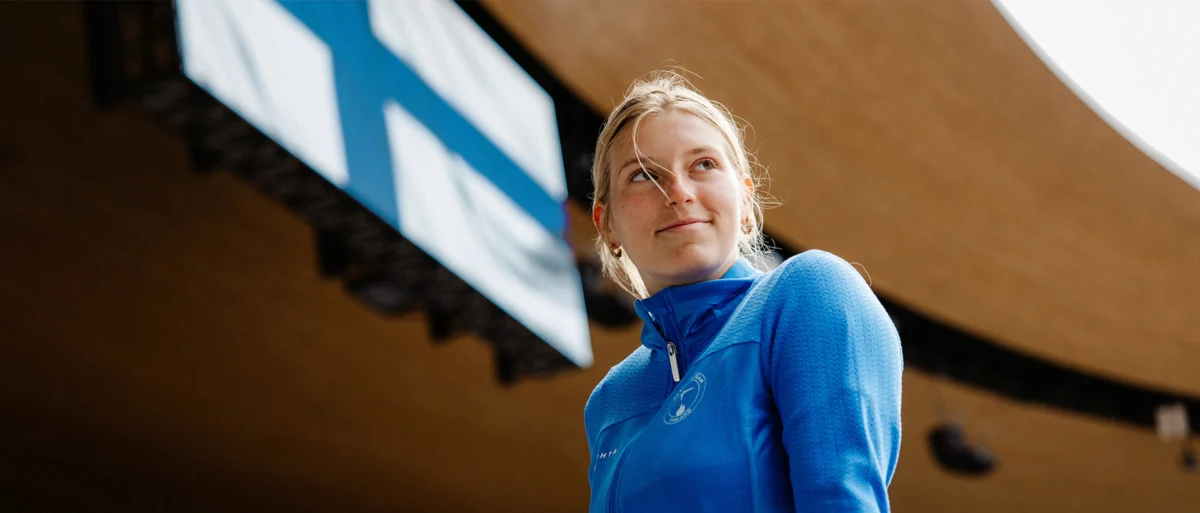
At the age of nine, while attending a summer camp, Sofia Hämäläinen first stepped onto a beginner’s windsurfing board. With a modest three-square-meter sail and no prior experience, her early attempts were clumsy at best. Yet, as she balanced on the water, feeling the warm breeze and the board’s first hesitant glides, a profound connection was forged. Watching the adults carving through the water with seemingly effortless speed in the distance, the young girl didn’t just see a hobby—she saw a future.
Today, that same sense of freedom drives Hämäläinen as she navigates the cutting-edge world of the iQFoil class. As one of Finland’s brightest prospects in professional sailing, Hämäläinen’s journey is a testament to the blend of high-octane adrenaline, technical precision, and the grueling physical demands required to compete at the absolute pinnacle of sport.
The Evolution of a Discipline: From Hobby to Olympic Quest
Hämäläinen’s path to professional athletics was not linear. A native of Helsinki who spent the vast majority of her formative years in Tallinn, she explored a variety of disciplines, including figure skating, competitive acrobatics, and football. However, windsurfing—a sport that demands an intimate understanding of the elements—eventually eclipsed all others.
"Windsurfing won out because it was the most challenging and the most rewarding," Hämäläinen explains. "At top speeds, you’re hitting over 50 kilometers per hour. It’s not just sailing; it’s like flying low over the surface of the water. That feeling is unmatched."
In 2022, Hämäläinen made a strategic pivot to the iQFoil class, a move dictated by the sport’s shifting Olympic landscape. The transition was necessary for her long-term career aspirations, as iQFoil has become the standard for modern Olympic windsurfing. The class is characterized by its use of hydrofoils—underwater wings that lift the board out of the water to reduce drag—creating a faster, more visually dramatic, and technically demanding racing environment.
Chronology of a Rising Star
Hämäläinen’s trajectory has been marked by steady international progress:
- Early Childhood: Initial exposure to the sport at a summer camp, sparking a lifelong passion for the sea.
- Formative Years: Balancing traditional sports like figure skating and football while honing her skills on the water in Tallinn and Helsinki.
- 2022: A pivotal transition to the iQFoil class to align with Olympic standards and professionalize her training regimen.
- 2024: A breakout year on the international stage, culminating in a bronze medal at the Youth World Championships.
- Present Day: Competing in senior-level international circuits, including European Championships, with a career-best 25th-place finish to date.
- The Road Ahead: Targeting the 2028 and 2032 Olympic Games as the ultimate realization of her athletic potential.
The Economics of Speed: The High Cost of Excellence
Professional windsurfing is as much a contest of engineering as it is of athleticism. In the iQFoil class, the equipment is the lifeblood of the competitor. Hämäläinen notes that the barrier to entry is high, both financially and technically.
"A high-quality board costs thousands of euros," she explains. "A single sail can run between 1,000 and 1,500 euros, and in a competitive year, I need two or three of them because major regattas demand brand-new equipment for peak performance. Then there is the foil mast and the foil itself—the most critical component—which is a masterpiece of engineering costing several thousand more."
The technical challenge is compounded by the nature of manufacturing. Even when products are built using the same templates, each board and foil is a unique piece. For the elite, this means traveling to factories to test and hand-pick the best equipment. For developing athletes like Hämäläinen, it often involves ordering from the factory and hoping for a "prime" unit.
"If you give up even a tiny percentage in equipment quality, you have no business being in the top 20," she says. Consequently, her annual budget hovers around 60,000 euros, covering gear, international coaching, and the extensive travel required to train with the world’s best.
Next Generation: A Structural Support System
Recognizing the immense financial and logistical hurdles facing young athletes, the Finnish Olympic Committee launched the Next Generation Team Finland program. Designed for athletes aged 15–22, the program aims to identify those with the highest potential and provide them with the resources to bridge the gap to the world elite.
Hämäläinen is one of the 21 inaugural members of this initiative. The program offers a personalized support package valued at over 10,000 euros, including direct funding, expert consultation, and logistical support. This collaboration between national federations and high-performance networks is the bedrock upon which Hämäläinen builds her campaign.
"I am incredibly grateful for the support from the national federation, the Next Generation program, and my personal partners," she notes. "Without this ecosystem, the dream of Olympic competition would remain just that—a dream."
The Science of the Start: Tactical Brilliance
When asked what defines a champion at the highest level, Hämäläinen points to the start line. A race is often won or lost in the chaotic, high-stakes seconds before the gun goes off.

"You have 60 boards fighting for the best path, all moving at nearly 50 km/h," she describes. "It’s a high-speed chess match. You have to be a mathematician, calculating routes and angles in milliseconds. You’re navigating rules, avoiding collisions, and reading the wind—all while keeping your heart rate in the red zone."
This "start-line intensity" requires a unique combination of cognitive processing and raw physical endurance. Once underway, the race becomes a grueling physical test. Athletes must engage in aggressive "pumping"—a technique where the sailor physically moves the sail to create extra propulsion—often in 20 to 30-second bursts that push the entire body to its limit.
Implications: Building a New Finnish Legacy
Hämäläinen’s ambitions extend beyond her own trophy cabinet. She is acutely aware of the "vacuum" that existed in Finnish windsurfing following the career of legend Tuuli Petäjä-Sirén. By documenting her journey, competing internationally, and pushing the boundaries of what is possible, Hämäläinen hopes to revitalize the sport in her home country.
"It would be amazing if I could inspire someone else to take up this sport," she says. "There is a beauty in the struggle, in the flow state you reach when the board is perfectly tuned and you’re flying over the water. It’s about freedom, and it’s about proving to yourself that you belong on that stage."
The path to 2028 is not without its pitfalls—ranging from the frustration of equipment failures to the environmental reality of debris in the ocean that can ruin a race. Yet, Hämäläinen maintains a pragmatic philosophy: "You can’t control everything, but you can control your next move. In this sport, like in life, you learn to process the setback, let go of the irritation, and focus on the next start."
As she continues to train in international squads and refine her craft, Sofia Hämäläinen represents a new generation of Finnish athletes who are not merely participating in global sports—they are actively engineering their way to the top. Whether she is carving through the Baltic waves or navigating a crowded start line in a Mediterranean regatta, she carries the weight of her country’s hopes, proving that with enough dedication, even the most daunting horizons can be conquered.