As the United Kingdom accelerates its transition toward a net-zero power grid, the integration of intermittent renewable energy with flexible storage has become the industry’s "holy grail." A landmark development in this sector has emerged with the announcement that Ørsted, the global leader in offshore wind, has selected the technology firm Arenko to provide the optimization, trading, and asset management software for its 300MW/600MWh Iceni battery energy storage system (BESS).
Scheduled to commence operations in the first quarter of 2027, the Iceni project is not merely another large-scale battery installation. It represents a paradigm shift in how the UK manages grid infrastructure, serving as a trailblazing model for the co-location of offshore wind and utility-scale storage.
Main Facts: A New Blueprint for Grid Efficiency
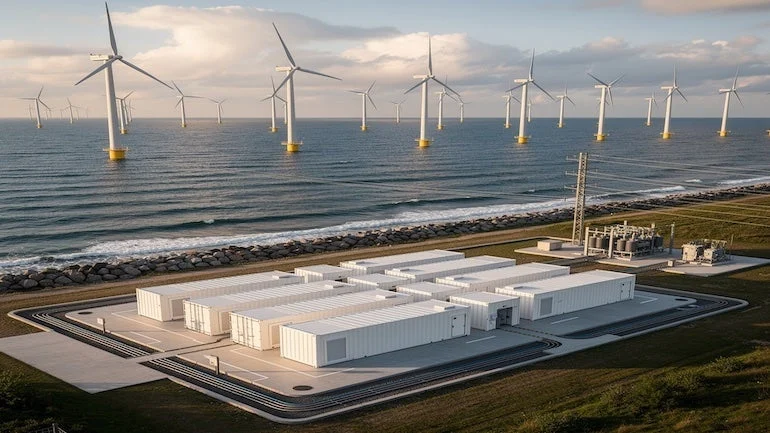
The Iceni project is defined by its strategic integration with the massive 2.9GW Hornsea 3 offshore wind farm. Rather than securing a standalone grid connection—a process that currently involves years of waiting and substantial capital expenditure—Iceni will share the onshore transmission infrastructure of the Hornsea 3 wind farm.
This co-location model is designed to maximize the utilization of existing grid capacity. By pairing the variable output of offshore wind with the immediate, dispatchable response of a 300MW battery, the project aims to stabilize the local grid and provide a buffer against the volatility inherent in renewable energy generation.
To navigate the technical and commercial complexities of this arrangement, Ørsted has turned to Arenko’s "Nimbus" platform. Nimbus is an advanced, AI-driven software suite designed to handle the multi-layered task of asset management, market participation, and real-time optimization. With the system set to go live in 2027, the industry is closely watching to see how Nimbus balances the competing interests of a massive wind farm and a significant energy storage asset under a single grid connection point.
Chronology: The Road to the Iceni Launch
The journey to the Iceni project reflects the broader evolution of the UK’s energy strategy under the Offshore Transmission Network Review (OTNR) pathfinder programme.
- Early 2020s: As the UK government committed to ambitious offshore wind targets, the limitations of the national transmission network became apparent. Congestion and long connection queues for new projects prompted the government to launch the OTNR to explore more efficient ways to connect generation and storage.
- Mid-2024: Planning and engineering phases for Iceni gain momentum as Ørsted finalizes its technical strategy for the Hornsea 3 connection.
- August 2026: Ørsted officially confirms the selection of Arenko’s Nimbus platform, marking a critical milestone in the project’s digital infrastructure development.
- Q1 2027 (Projected): The Iceni battery energy storage system is scheduled to reach its commercial operation date (COD), coinciding with the integration of its operations into the broader Hornsea 3 network.
Supporting Data: The Scale of Ambition
The Iceni project is significant not only for its operational model but also for its raw technical capacity.
- Capacity: 300MW / 600MWh. This provides two hours of full-power discharge, a duration sufficient to participate in various ancillary services and energy arbitrage markets.
- Interconnectivity: The project is tied to the 2.9GW Hornsea 3 development, one of the largest offshore wind projects in the world.
- Software Deployment: Arenko’s Nimbus platform is already a proven entity, having been deployed on 14 large-scale co-location projects, providing a robust track record that gave Ørsted the confidence to adopt it for this pioneering initiative.
- Operational Context: The project is part of the UK’s effort to handle the forecasted doubling of electricity demand by 2050, requiring a massive increase in both variable generation and rapid-response storage.
Official Responses: Aligning Strategy and Technology
The collaboration between Ørsted and Arenko highlights the growing importance of software in managing physical energy assets.
Katinka Hussmann Palbo, Ørsted’s Vice-President for Global Trading and Revenue, emphasized the strategic importance of the software choice: "What makes Iceni interesting for us isn’t just the scale of the battery, but how it works alongside Hornsea 3. We are aiming to optimize two very different assets—wind and storage—through a shared connection point, while ensuring that both deliver significant value to the grid."
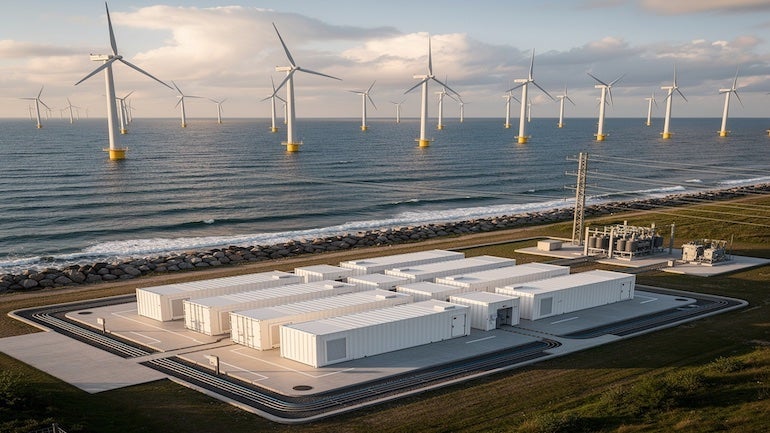
For Arenko, the challenge is to bridge the gap between high-frequency wind data and the economic requirements of battery trading. Rupert Newland, CEO of Arenko, noted the sophistication required for such a deployment: "Iceni is a highly sophisticated project, coupling a grid-scale battery with one of the UK’s biggest offshore wind farms. This creates significant opportunities but also operational and trading challenges, from forecasting and deciding how and when to allocate capacity in real time, to the technical, data, and controls integrations between the two assets."
John Kinsella, Iceni Director at Ørsted, echoed this sentiment regarding the software’s necessity: "Iceni is the first of its kind, and that demands a platform built for genuine complexity. Nimbus delivers that."
Implications: The Future of Grid Infrastructure
The implications of the Iceni project extend far beyond the immediate partnership between Ørsted and Arenko. The project serves as a "pathfinder" for the entire UK energy industry.
1. Solving the Connection Bottleneck
The UK’s grid is currently struggling with a significant backlog of projects waiting for connection. By demonstrating that storage can effectively "piggyback" on existing or planned wind farm connections without compromising stability, Iceni provides a replicable template. If this model succeeds, developers may be able to secure faster grid access by co-locating, rather than waiting for new transmission lines to be built.
2. Market Participation and Revenue Optimization
Traditionally, wind farms and batteries have operated in silos. Iceni changes this by treating them as a unified virtual power plant. The Nimbus platform must navigate real-time market prices, grid demand, and weather forecasting to decide when to store wind energy, when to release it to the grid, and when to bid into frequency response markets. This level of optimization could significantly improve the Internal Rate of Return (IRR) for co-located projects.
3. Strengthening Grid Resilience
As the UK retires fossil-fuel-based spinning reserves, the grid requires more "synthetic inertia" and fast-frequency response services. A 300MW battery connected at the same point as a 2.9GW wind farm can provide immediate response to grid frequency fluctuations, acting as a "shock absorber" for the massive amounts of energy flowing from Hornsea 3.
4. Setting Global Standards
The success of Iceni will likely be exported. As countries like the United States, Germany, and Japan face similar challenges regarding grid congestion and the integration of renewables, they will look to the UK’s OTNR pathfinder projects for evidence of how to scale. Ørsted and Arenko are essentially writing the "how-to" manual for the next generation of renewable energy infrastructure.
Conclusion
The Iceni project is more than just a battery; it is an intelligent extension of the grid. By synthesizing the power of 2.9GW of offshore wind with the agility of 600MWh of storage, Ørsted is taking a bold step into the future of energy management. With Arenko’s Nimbus platform serving as the "brain" of this operation, the project is well-positioned to demonstrate that complexity, when managed by advanced technology, is not a barrier to progress but a catalyst for a more resilient, efficient, and decarbonized energy system.
As 2027 approaches, the energy sector will look to Iceni as the standard-bearer for a new era of grid-connected innovation.