For decades, Tyler Mane has been the man you fear on screen. Standing at a formidable 6’8”, he carved out a legacy as a pro-wrestling heel who traded blows with the legendary André the Giant and icons like Sting and the British Bulldog. Transitioning into cinema, he utilized his imposing physicality to become the definitive Sabretooth in the X-Men franchise and Deadpool & Wolverine, and cemented his place in horror history as the tallest Michael Myers to ever stalk the screen in Rob Zombie’s Halloween (2007) and Halloween II (2009).
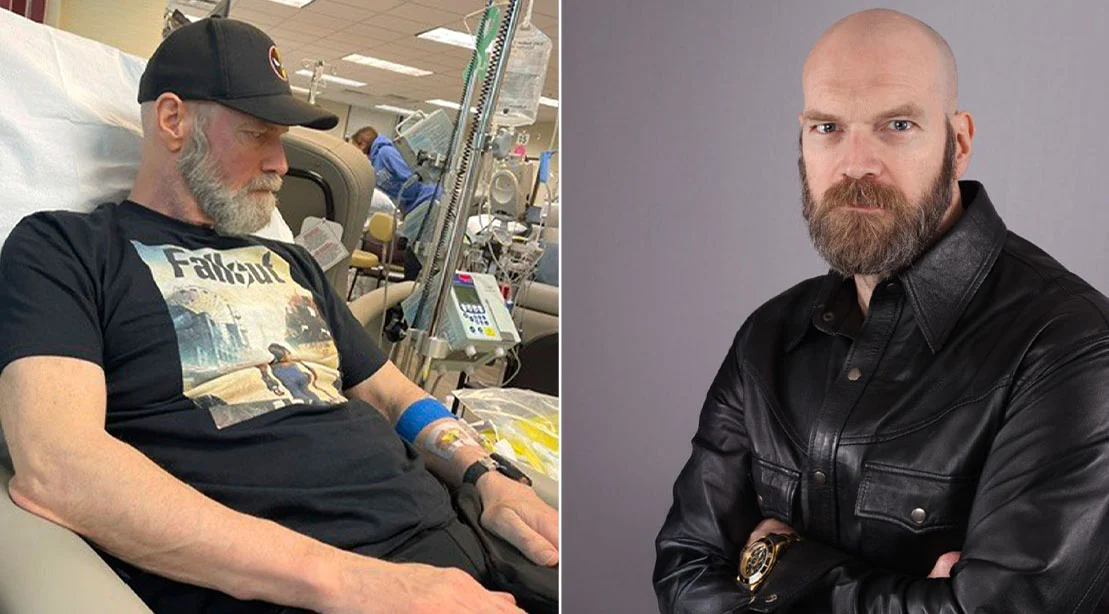
Yet, today, the man once known as “Big Sky” is facing a battle far more personal and poignant than any choreographed fight in the squared circle or high-budget film set. After being diagnosed with male breast cancer, Mane has pivoted from being a cinematic villain to a real-life superhero for thousands, using his platform to dismantle the stigma surrounding the disease and emphasizing the critical importance of early detection.
The Discovery: A Routine Lifestyle Change Leads to a Life-Altering Finding
The story of Tyler Mane’s diagnosis is one of vigilance. Throughout 2025, Mane had committed himself to a rigorous health overhaul. Seeking to drop excess body weight, he overhauled his nutrition, eliminated alcohol, and intensified his exercise regimen. It was during this period of physical transformation that he discovered a lump on the side of his chest.
“With losing that weight, I felt a lump,” Mane recalls. “Initially, my reaction was the typical masculine dismissal: ‘Oh, that’s just… I probably tweaked something. It’s nothing.’”
It was his wife, Renae, who provided the necessary intervention. Recognizing that a lingering, unexplained lump in the chest area is a red flag regardless of gender, she insisted he seek professional medical advice. Her persistence proved to be the defining moment in his journey. After a series of tests, the diagnosis was confirmed: invasive ductal carcinoma (IDC).
IDC is the most common form of breast cancer, accounting for roughly 80% of all cases. For men, who often assume breast cancer is exclusively a female condition, the diagnosis comes as a profound shock. “I was like, ‘How can that be? How could this be happening to me?’” Mane reflects.
Chronology of the Struggle
The path from diagnosis to recovery has been a test of endurance. Following the removal of the lump, Mane learned that he had a particularly fast-moving Oncotype, a genetic profile that underscores the necessity of aggressive treatment.
Phase 1: The Reality of Chemotherapy
Mane underwent four sessions of chemotherapy. He is candid about the toll the treatment took on his body. By the first session, he had lost his trademark beard. By the second, he was battling hives. By the final session, he struggled with physical mobility, specifically the ability to lift his arm. “I didn’t approach the first session right; I didn’t hydrate enough, so I cramped up,” he explains.
Phase 2: Radiation and Stabilization
With his chemotherapy sessions concluded, Mane is now entering the final stage of his primary treatment: four weeks of daily radiation therapy. These sessions are brief—lasting only ten minutes—but they are essential to ensuring that no residual cancer cells remain.
Phase 3: The Path to Recovery
As he moves toward the end of his radiation cycle, Mane is already looking forward to returning to the gym. Having lost roughly ten pounds during his treatment, the former pro-wrestler is focused on reclaiming his strength. With a laugh, he notes that his wife has dubbed this current phase of his life “the road back to the beard.”
Supporting Data: The Silent Crisis of Male Breast Cancer
While breast cancer is statistically rare in men, it is by no means nonexistent. According to the American Cancer Society, approximately 2,670 men in the United States will be diagnosed with the disease this year alone, with roughly 530 deaths attributed to it annually.
The mortality rate is disproportionately high not because the disease is inherently more aggressive in men, but because of the massive delay in diagnosis. Many men are unaware that they have breast tissue and are capable of developing the cancer, leading them to ignore early warning signs until the disease has reached advanced stages—often Stage 4.
Challenging the Masculine Narrative: Why Men Must Seek Help
The most significant barrier to treating male breast cancer is the culture of silence. Studies have shown that men are up to 50% less likely than women to seek medical attention for health concerns. This reluctance is often rooted in the “tough it out” mentality, the pressures of being a provider, and the misperception that health issues will simply resolve on their own.
Mane is vocally challenging this narrative. “Guys are like, ‘It’ll go away,’ ‘I gotta suck it up,’ ‘I’ve got to support the family,’” Mane says. “No, you’ve got to be your best and biggest advocate for yourself.”
He recounts an experience at a recent convention where a fan approached him, sharing a heartbreaking story about his father. The man’s father had discovered a lump but waited too long to address it. By the time he sought medical help, he was at Stage 4. He eventually passed away—a tragedy that, according to Mane, could have been avoided with early intervention.
Mane’s advice is absolute: If a doctor tells you a lump is “probably nothing,” you must demand further testing. “If the doctors say, ‘Oh, it’s probably nothing,’ say: ‘No, I want the tests,’” he urges.
Implications: The Role of Advocacy and Science
Mane is channeling his experience into proactive advocacy through his new podcast, Mane AF with Tyler & Renae, launching August 27, 2026. The platform will serve as a hub for discussions with medical professionals, celebrity guests, and survivors to provide factual, science-backed information.
In an era of rampant health misinformation, Mane is positioning himself as a voice of reason. He stresses that while holistic therapies can play a role in overall well-being, they should never replace evidence-based medical treatment. “See your doctor, because that’s where the science is. That’s where the training is,” he asserts. “If chemotherapy is recommended, or radiology is recommended, do what you have to do to keep healthy.”
His message is underscored by sobering statistics: there is a 40% chance that any individual will encounter some form of cancer in their lifetime. By treating the condition with transparency, Mane is attempting to normalize the conversation around male breast health.
Conclusion: A New Chapter for the Screen Legend
Tyler Mane’s journey from the wrestling ring and the horror movie set to the oncology ward has changed his perspective on what it means to be strong. For years, he played characters that thrived on violence and physical dominance. Today, he recognizes that the greatest strength is found in vulnerability—in the courage to admit when something is wrong and the persistence to pursue a cure.
As he prepares to return to the gym and his professional endeavors, Mane remains a towering figure, but his legacy has expanded. He is no longer just the man who played Sabretooth or Michael Myers; he is a man who turned a personal crisis into a public service, reminding men everywhere that their health is not a sign of weakness, but their most valuable asset.
For those interested in following his recovery and hearing more about his journey, the Mane AF with Tyler & Renae podcast will be available on all major platforms beginning August 27, 2026.