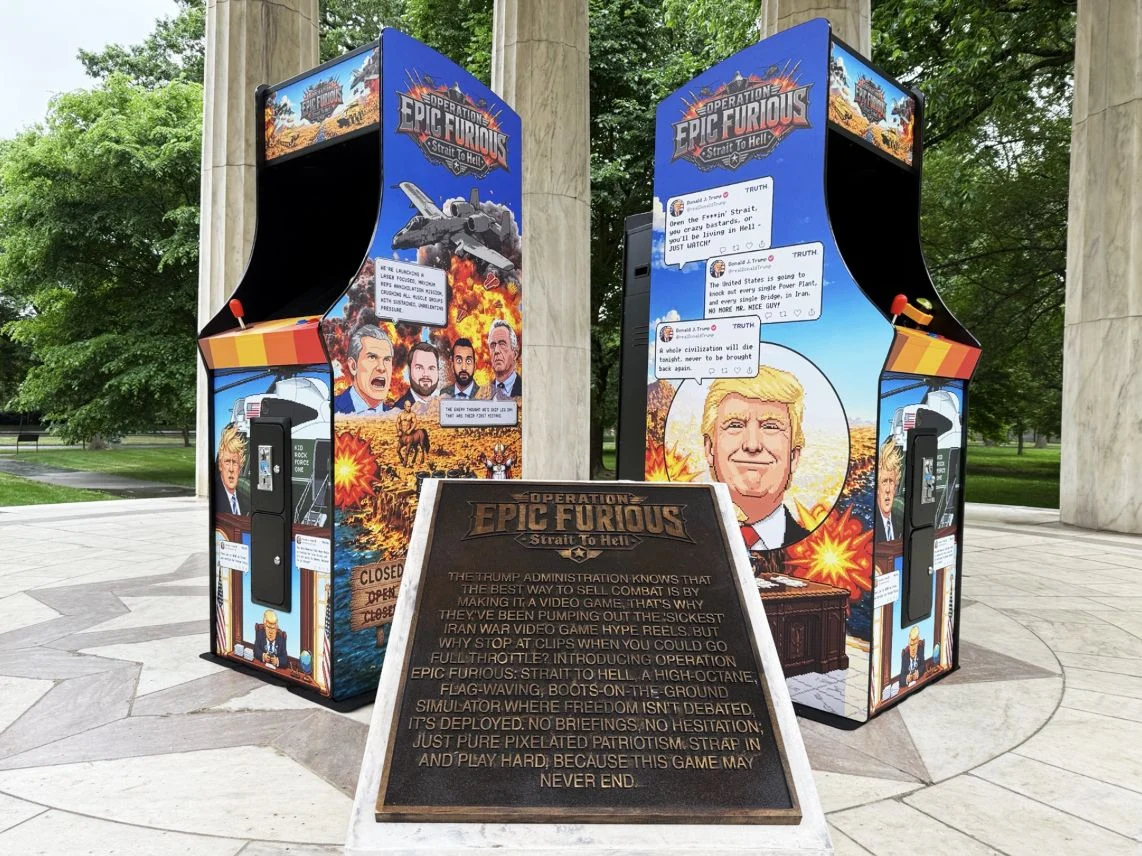
In a surreal intersection of digital art, political protest, and classic gaming aesthetics, an anonymous collective known as “Secret Handshake” has launched a project that is as much a psychological experiment as it is a video game. Titled Operation Epic Furious: Strait to Hell, the game serves as a scathing, interactive critique of the Trump administration’s aggressive rhetoric surrounding potential conflict in Iran. While the game is available to the public online, the group recently made headlines by installing three fully functional, retro-styled arcade cabinets at the Washington, DC, War Memorial, inviting passersby to participate in a simulated, never-ending war.
The game is, by design, an exercise in futility. Players control President Donald Trump, navigating a world that blends geopolitical tension with the absurdity of modern social media culture. The core mechanic—collecting oil barrels and drafting posts for Truth Social—is loop-based and inherently unwinnable. For Secret Handshake, the game’s inability to reach a satisfying conclusion is the entire point.
The Genesis of a Digital Protest
Secret Handshake is no stranger to provocative public displays. The group previously garnered national attention for installing a life-sized gold statue of Donald Trump and Jeffrey Epstein on the National Mall. That installation, which depicted the two figures in a pose reminiscent of the iconic bow-of-the-ship scene from the film Titanic, set the tone for the group’s methodology: using high-visibility, satirical art to force uncomfortable conversations about power, corruption, and the legacy of the Trump administration.
Operation Epic Furious represents a shift from static sculpture to interactive media. By utilizing the medium of a 16-bit, RPG-style game—reminiscent of classics like Chrono Trigger—the creators argue that they are mirroring the way the current administration "gamifies" war. The accompanying plaque at the DC War Memorial installation explains the collective’s thesis: “The Trump administration knows that the best way to sell combat is by making it a video game… [so] why stop at clips when you could go full throttle?”
Chronology of the Installation and Development
The development of the game has been shrouded in the same anonymity that characterizes the group’s other works. However, the rollout of the project followed a carefully orchestrated timeline:
- Mid-2024: Secret Handshake begins work on the pixel-art assets, modeling the game’s White House interior and its various international environments.
- Early 2025: The group refines the mechanics, focusing on the "Truth Social" post-generation system, which requires the player to constantly feed the game’s social media feed to maintain "political capital."
- Late May 2025: The group announces the launch of the game via a press release, detailing the web version and the surprise installation of arcade cabinets in the heart of Washington, DC.
- June 2025: The cabinets are opened to the public at the War Memorial, accompanied by a manifesto that labels the project a "high-octane, flag-waving, boots-on-the-ground simulator where freedom isn’t debated, it’s deployed."
The cabinets were designed to look like classic 1980s and 90s arcade machines, complete with bright, flashing marquees that lure in tourists and policy makers alike, providing a stark visual contrast to the solemnity of the surrounding monuments.

Gameplay Mechanics: A Descent into Absurdity
The gameplay loop of Operation Epic Furious is intentionally frustrating. As the player-character, Trump is tasked with "reopening" the Strait of Hormuz. To achieve this, the player must navigate a map filled with enemies that are caricatures of political figures and ideological concepts.
Key Game Features
- Combat System: Players can utilize special abilities, such as the "Mar-a-Lazer," to defeat enemies like the "Iranian schoolgirl" or the "DEIyatollah."
- The Support Cast: Throughout the journey, the player is assisted by members of the administration, including FBI Director Kash Patel, Secretary of State Marco Rubio, Vice President JD Vance, and Elon Musk. Each character provides specific, often useless, buffs that simulate the bureaucratic friction of the administration.
- The Social Media Loop: The game forces the player to stop and compose Truth Social posts. These posts do not affect the outcome of the war but are necessary to keep the game running. As the game progresses, the posts become increasingly frantic, mirroring the real-world tone of the administration’s online presence.
The "Epstein" Branch
Perhaps the most biting sequence occurs at the very beginning of the game. When the player starts in the White House, they are greeted by Melania Trump. In a scene that mocks the First Lady’s recent high-profile press conference regarding the Epstein Files, she abruptly announces, "I WAS NEVER ON THE EPSTEIN JET," and asks, "Did you burn the files yet?"
The player is presented with a binary choice: either confirm that the files are being burned or ask to hold her hand. If the player chooses to hold her hand, the game immediately ends—a meta-commentary on the political dangers of distraction and the fragility of the administration’s public image.
Supporting Data and Political Context
The game arrives at a time of heightened anxiety regarding US-Iran relations. Reports from Wired and other outlets have highlighted internal divisions within the Trump administration, with some advisors pushing for a diplomatic deal while others remain committed to a hardline, confrontational posture.
The "gamification" of foreign policy is a phenomenon that political scientists have studied extensively. By packaging combat as a "sickest hype reel," the administration creates a distance between the visceral reality of conflict and the digital imagery consumed by the public. Operation Epic Furious forces the player to engage with this distance. Because the game is unwinnable, it highlights the perceived lack of an "end game" in the administration’s actual foreign policy strategies. The resources spent on the game—oil barrels and social media posts—serve as a metaphor for the administration’s focus on optics over tangible diplomatic outcomes.
Official Responses and Public Reception
As of this writing, there has been no formal response from the White House regarding the arcade cabinets at the War Memorial. However, the presence of such a provocative installation in a high-security zone has raised questions about the boundaries of political speech and public art.

National Park Service officials have been monitoring the installation, though the group claims to have secured the necessary permits for a "temporary art installation." The public reaction has been polarized. Some visitors to the memorial have praised the project for its boldness and its ability to condense complex, often terrifying, political realities into a format that is accessible and digestible. Others have criticized the use of the War Memorial as a site for political satire, arguing that it diminishes the solemnity of the site dedicated to those who served in combat.
Implications: The Future of Political Satire
Operation Epic Furious: Strait to Hell is a significant marker in the evolution of political satire. In the age of digital misinformation and hyper-partisan media, traditional satire—such as editorial cartoons or late-night monologues—is often filtered through pre-existing ideological bubbles. By creating an interactive, playable, and public experience, Secret Handshake has forced a physical engagement with their critique.
The implications for political discourse are profound. When a video game becomes a primary vehicle for dissent, it suggests that the public is increasingly seeking mediums that allow them to "play out" the consequences of policy decisions. If the game truly is unwinnable, it serves as a cynical, yet poignant, reminder of the feeling of helplessness that many Americans report when viewing the current geopolitical landscape.
Furthermore, the integration of real-world events—like the Epstein Files controversy—into the game’s narrative demonstrates the speed at which art can now respond to the news cycle. The ability of the game to update its "narrative" as the administration’s policies shift ensures that Operation Epic Furious remains relevant, even if the game itself is destined to end in a "game over" screen every time.
Ultimately, Operation Epic Furious is not just a game; it is a mirror. It asks players to participate in the same systems of distraction and hyperbole that they criticize in their leaders. As long as the arcade cabinets remain in the shadow of the War Memorial, they will serve as a persistent, neon-lit reminder that in the game of modern politics, the house always wins—or, in this case, the game simply never ends.