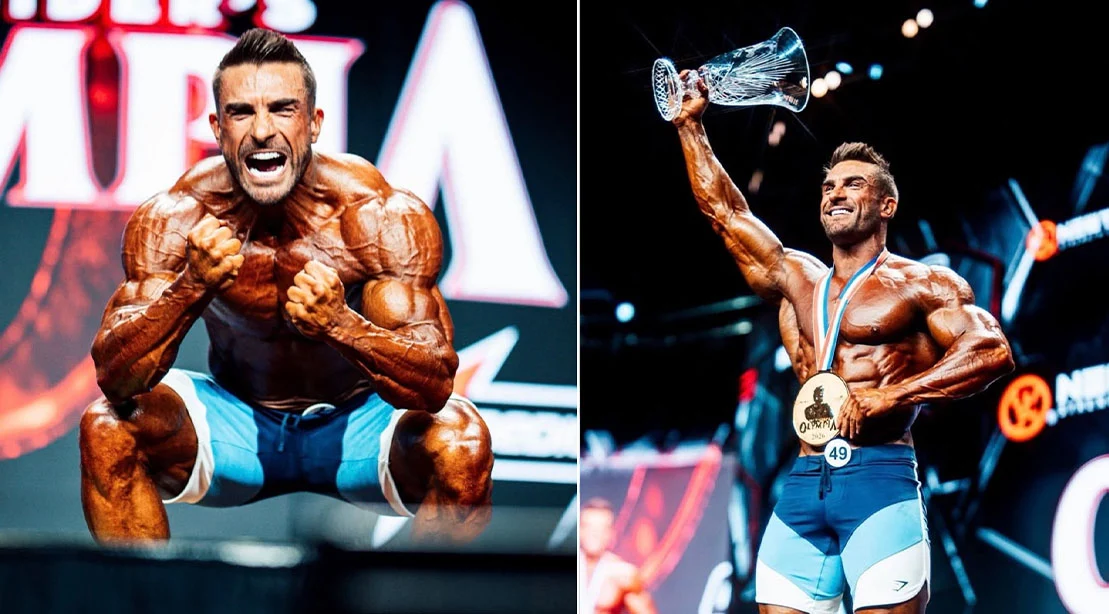
In the high-stakes world of professional bodybuilding, the Olympia stage is the ultimate proving ground—a place where the human physique is sculpted to perfection and tested under the brightest lights on the planet. For British icon Ryan Terry, the 2026 Olympia represented more than just another competition; it was a date with destiny. On September 26, 2026, Terry etched his name into the annals of the sport by securing his fourth consecutive Men’s Physique title, effectively equaling the legendary record held by Jeremy Buendia.
However, beneath the gold-medal shimmer and the perfectly tanned, symmetrical musculature lay a secret that nearly derailed the entire campaign. Less than 24 hours after his historic victory, at the Olympia Winner’s Seminar in Las Vegas, a vulnerable and candid Terry revealed that his path to the 2026 podium was paved with excruciating physical agony. A severe spinal injury had left him staring down the barrel of an early retirement, turning his fourth title run into the most difficult challenge of his storied career.
The Anatomy of a Crisis: The C5 Disc Injury
For the casual observer, Terry’s 2026 physique looked as flawless as ever. But for the man himself, the prep was a grueling exercise in pain management. Seven weeks out from the Olympia—the most critical phase for final conditioning—Terry suffered a herniated C5 disc in his neck.
The injury was not merely a localized issue; it triggered a cascade of neurological symptoms that threatened his ability to train, pose, and eventually, stand on stage. "We can talk about it now," Terry told the audience at The Palms, his voice thick with the gravity of the experience. "This has been the hardest prep I’ve ever gone through."
The herniation caused a trapped median nerve, a condition that results in debilitating numbness, weakness, and, in Terry’s case, persistent "pins and needles" radiating down his arm into his fingers. Even in the aftermath of his victory, the nerve damage persists, serving as a lingering reminder of the price he paid for his fourth crown.
Chronology of a Champion’s Fight
To understand the magnitude of Terry’s achievement, one must look at the timeline of his 2026 journey.
The Initial Momentum
Early in the year, Terry’s prep was proceeding with clinical precision. Known for his disciplined approach, the RT Fit Gym owner had publicly championed the power of a "positive mindset," focusing on mental clarity and present-moment awareness to drive his physical gains. He was on track to deliver his best package yet, feeling mentally bulletproof.
The Seven-Week Setback
The shift occurred just seven weeks before the show. A training mishap led to the C5 herniation. The immediate aftermath was characterized by despair rather than determination. Terry recounted moments of profound vulnerability, sitting in his kitchen with his wife, overwhelmed by the realization that his streak might end before he even stepped on the plane to Las Vegas. "There were times I was sat with my wife, in the kitchen, in tears, thinking I’m not going to make the stage," he admitted.
The Race Against Time
The final weeks were defined by a rigorous, unconventional recovery protocol. Unable to train with his typical intensity, Terry pivoted to a strategy centered on neural decompression and advanced healing modalities. He leaned heavily on MBST (Molecular Biophysical Stimulation Therapy), a cutting-edge approach using magnetic resonance to stimulate cellular repair. This was augmented by aggressive chiropractic adjustments, consistent acupuncture, and round-the-clock support from his best friend, a professional physical therapist who worked tirelessly to keep the champion mobile.
The Support System: The Unsung Heroes of the Victory
Terry’s victory was not a solo endeavor; it was the result of a specialized medical and support infrastructure. In the world of elite bodybuilding, the difference between placing first and failing to qualify often lies in the quality of the support team.
The champion was quick to deflect the praise, emphasizing the collaborative effort required to navigate the injury. By integrating physical therapy with advanced technology like MBST, Terry was able to manage the inflammation surrounding the nerve root just enough to perform his mandatory poses without collapsing. His gratitude toward his team was palpable, noting that without their intervention, the "pins and needles" would have rendered him unable to control his muscles during the high-tension environment of the Olympia stage.
Official Responses and Peer Recognition
The bodybuilding community, known for its intense rivalries, was united in its respect for Terry’s performance. The most significant acknowledgment came from the man whose record Terry equaled: Jeremy Buendia.
Buendia, a titan of the sport who dominated the Men’s Physique division in the early years of its inception, observed the event with a mix of professional scrutiny and genuine grace. Following the results, Buendia was among the first to extend his congratulations.
"Massive, massive respect to Jeremy," Terry stated during the seminar. "That must have been a hard thing to watch… for me to match his record, and he’s held that since the early days of Men’s Physique, it must have been a hard night and he took it so well. He was the first to congratulate me, and he genuinely meant it."
This exchange highlights the evolution of professional bodybuilding culture, where the pursuit of excellence now often transcends competition, fostering a mutual respect between those who have held the throne.
Implications for the Future of Men’s Physique
Ryan Terry’s 2026 victory does more than just cement his place in the record books; it fundamentally shifts the narrative of what is possible in the sport.
The Mental Game
Terry has proven that the "mental game" is not just a catchphrase. His ability to compartmentalize physical trauma and maintain a professional appearance while suffering from a neurological injury demonstrates a level of psychological fortitude that distinguishes champions from competitors.
Setting the Bar for 2027
Perhaps the most significant revelation to come out of the post-Olympia events was Terry’s confirmation that he has no intention of slowing down. With his fourth title secured and his legacy solidified, the British icon has set his sights on the 2027 Olympia.
This announcement has immediate implications for the division:
- The Target on His Back: The next generation of athletes, including top-tier contenders like Ali Bilal, Kyron Holden, and Erin Banks, now have a clear objective—to dethrone a man who is not only physically dominant but mentally battle-hardened.
- Medical Innovation in Sport: Terry’s use of MBST and alternative therapy will likely spark a trend in how bodybuilders approach injury management. Expect to see more athletes integrating long-term recovery tech into their off-season and prep cycles.
- The "Terry Standard": By winning in such a compromised state, Terry has established a new benchmark for professional conduct. The expectation for future Olympia winners will no longer be limited to their aesthetic, but to their ability to perform under extreme adversity.
Conclusion: A Legacy Defined by Resilience
Ryan Terry’s 2026 Olympia campaign was a masterclass in resilience. While the record books will show a dominant victory, the story of his fourth title is one of quiet suffering, professional sacrifice, and an unwavering commitment to his craft.
From the tears in his kitchen seven weeks out to the roar of the crowd at the Orleans Arena, Terry’s journey captures the essence of the modern bodybuilding champion. He has proven that the physique is merely the vessel; it is the spirit of the athlete that determines the outcome. As he looks toward 2027, the world watches with bated breath, wondering if this iron-willed Brit can surpass the legend he has finally matched. One thing is certain: Ryan Terry is no longer just a bodybuilder; he is a testament to the fact that when the body breaks, the champion’s spirit holds the line.