The barbell overhead press (OHP) is often described as a "truth teller" in the strength and conditioning world. Unlike the bench press, which offers the stability of a pad against your back, or the squat, which utilizes the posterior chain, the OHP is a raw, vertical test of shoulder strength and core stability. When the bar leaves your shoulders, there is nowhere to hide; it is simply you versus gravity.
However, the very tool that makes the OHP an unrivaled builder of strength—the rigid, fixed-path barbell—is also its primary structural liability. By locking both hands into a fixed, pronated position, the barbell limits the natural mobility of the human wrist. For many lifters, this restriction leads to chronic discomfort, hyperextension, and, eventually, a plateau in performance. If your wrists are the "weakest link" in your kinetic chain, you aren’t just missing out on gains; you are inviting injury.
The Anatomy of the Pain: Why the Barbell Fails Some Lifters
To understand why the OHP causes wrist pain, one must look at the mechanics of the "stacked" position. Ideally, the barbell should sit directly over the radius and ulna bones of the forearm. This creates a vertical column of force transfer. When this stack is compromised, the wrist is forced to bear the weight in an extended position, placing immense stress on the carpal ligaments and tendons.
The Core Culprits
- Improper Bar Placement: If the barbell rolls toward the fingers, the wrist is forced into extreme hyperextension to compensate. This not only saps your mechanical advantage but places the load on the delicate soft tissues of the wrist rather than the skeletal structure of the forearm.
- Loss of the Vertical Stack: When the wrists drift away from the line of the elbows, the force is no longer transferred efficiently. While a slight "break" in the wrist is common in the rack position, chronic failure to maintain a neutral or near-neutral wrist alignment under load is a primary driver of discomfort.
- The Grip Width Trap: A grip that is too wide forces the elbows to flare outward, creating an unnatural angle for the wrists. Conversely, a grip that is too narrow can cause the bar to drift forward, necessitating a compensatory lean that forces the wrists to tilt backward.
- The Limitation of the Fixed Path: The barbell requires both hands to remain in a fixed, pronated (palms forward) position. This rigidity ignores the fact that every human’s shoulder anatomy is unique. Some individuals simply lack the external rotation or forearm anatomy to press comfortably with a straight bar.
5 Essential Form Fixes to Salvage Your Overhead Press
Before abandoning the barbell, it is imperative to ensure that your technique isn’t the primary source of the problem. Many lifters attempt to "muscle through" poor mechanics, which only exacerbates the issue.
1. Master the Palm-Heel Placement
The bar must rest in the heel of the palm, as close to the wrist joint as possible. If the bar is sitting in your fingers, you have already lost the battle. By shifting the bar deeper into the palm, you align the weight with the forearm bones, essentially allowing your skeleton to support the load rather than your connective tissues.
2. Prioritize the Vertical Stack
From a front-facing perspective, your forearms should remain perfectly vertical throughout the entire range of motion. If your elbows are tucked too far in or flared too far out, the force vector is skewed. Visualize your forearms as pillars; they must remain perpendicular to the floor from the start of the movement to the lockout.
3. Re-evaluate Your Grip Width
"Shoulder-width" is a suggestion, not a law. For some, moving the hands an inch or two wider or narrower can be the difference between pain-free pressing and chronic wrist strain. Experiment with your grip width during warm-up sets using an empty bar. Find the position where your forearms naturally feel the most vertical and your wrists feel the most stable.
4. The "Knuckles to the Ceiling" Cue
This is one of the most effective tactical cues in strength training. Once the bar is positioned on the heel of your palm, focus on pointing your middle knuckles toward the ceiling. This forces a slight engagement of the forearm flexors, which naturally pulls the wrist into a more stable, neutral position and prevents the bar from rolling back toward your fingers.
5. The "Deload and Rebuild" Strategy
If your wrists hyperextend only at higher intensities, you are likely masking a technique deficiency with brute force. Drop your working weight by 20–30%. Rebuild your strength from this lighter starting point, ensuring that your wrist alignment remains perfect on every single repetition. Only add weight when you can maintain that perfect "stacked" position.
Choosing the Right Alternative: What to Look For
If you have optimized your form and still experience pain, it is time to pivot. A viable OHP alternative must satisfy three criteria:
- Shoulder Emphasis: The movement must prioritize the anterior and medial deltoids while engaging the upper traps and triceps to ensure continued growth.
- Natural Wrist Freedom: The tool must allow for a neutral or semi-neutral grip, enabling the wrists and elbows to move along a path that respects your unique anatomical structure.
- Preserved Pressing Path: While exercises like lateral raises are excellent for hypertrophy, they do not replicate the compound, vertical-pressing stimulus required to build significant overhead strength.
5 Wrist-Friendly Alternatives for Bigger Shoulders
If the barbell is off the table, these five variations will ensure you continue to build massive, powerful shoulders without the wrist tax.
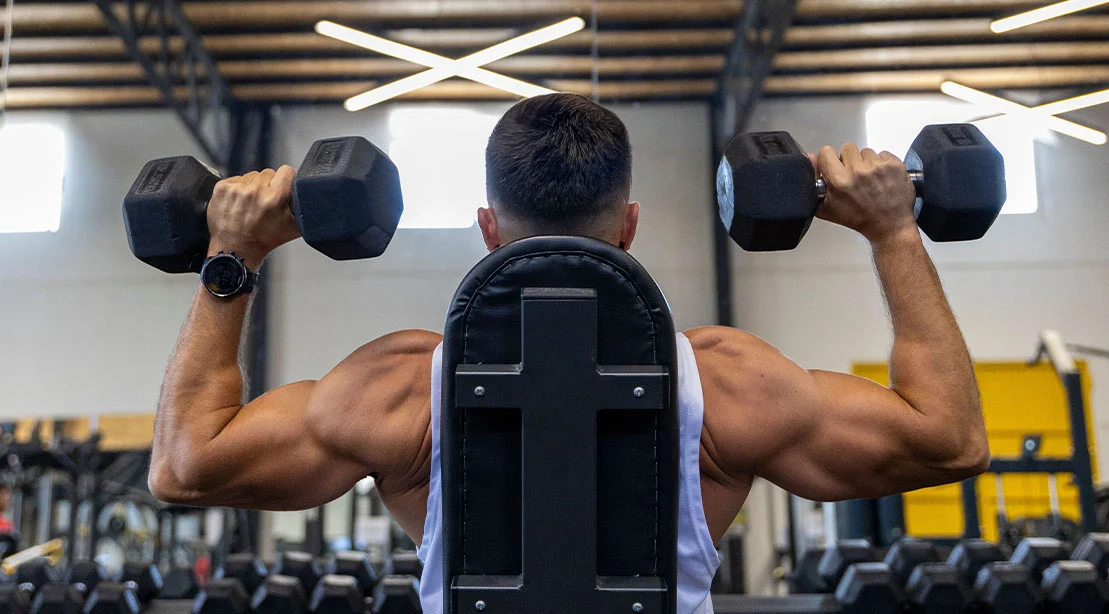
1. Neutral-Grip Dumbbell Overhead Press
The dumbbell press is the gold standard for those with wrist issues. By holding the bells with palms facing each other (neutral grip), you alleviate the torque on the wrist joint. This allows your shoulders to find their natural "groove," which is often a slightly angled path rather than a perfectly straight vertical line.
- Sets/Reps: 3–4 sets of 6–12 reps.
2. Half-Kneeling Landmine Press
The landmine press is a hybrid movement that sits between a vertical and a horizontal press. Because the bar is fixed at one end, you can move your hand into a comfortable, neutral position. The half-kneeling stance adds a layer of anti-rotation, forcing your core to work overtime to stabilize the load.
- Sets/Reps: 3–4 sets of 8–15 reps per side.
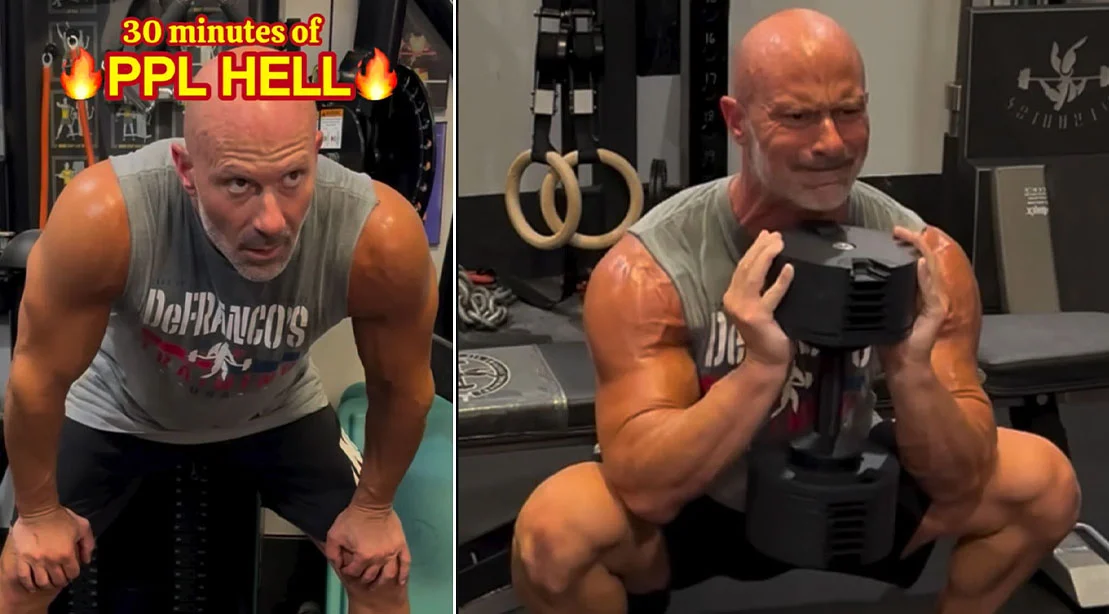
3. Bottoms-Up Kettlebell Press
This is the ultimate tool for "wrist education." By holding the kettlebell with the handle at the bottom and the heavy bell at the top, you are forced to grip the handle with maximum intensity. If your wrist is not perfectly stacked, the kettlebell will immediately tip, providing instant feedback. It builds incredible grip strength and reinforces perfect vertical alignment.
- Sets/Reps: 2–3 sets of 6–12 reps per side.
4. High-Incline Dumbbell Chest Press
By setting a bench to 60–75 degrees, you transform the standard incline press into a shoulder-dominant exercise. Using a neutral grip here mimics the overhead press but removes the instability of a standing position, allowing you to push closer to mechanical failure safely.
- Sets/Reps: 3–4 sets of 8–15 reps.
5. Neutral-Grip Machine Shoulder Press
There is no shame in utilizing machines. A neutral-grip machine press provides the ultimate stability, allowing you to bypass the technical nuances of a free-weight lift and focus entirely on muscular fatigue. It is an excellent way to safely accumulate volume for the deltoids.
- Sets/Reps: 3–4 sets of 8–15 reps.
Implications for Long-Term Training
The decision to swap the barbell for a more wrist-friendly tool is not an admission of defeat; it is a tactical adjustment in the pursuit of longevity. In strength training, the ability to train consistently over decades is what separates the elite from the injured. By integrating these alternatives, you allow your wrist tissues time to recover while still providing your deltoids with the stimulus they need to grow.
Remember, the goal of training is to build muscle and strength, not to prove your loyalty to a specific piece of equipment. If your wrists are holding you back, change the tool, not the goal. There can indeed be gain without the unnecessary pain.