For decades, the gym-goer’s definition of resistance training has been remarkably consistent: a cycle of dynamic, isotonic movements—think bench presses, squats, and rows—performed with high effort, specific volume, and unwavering consistency. We equate muscle growth with the shortening and lengthening of muscle fibers under load. However, this conventional wisdom often overlooks a powerful, albeit quiet, pillar of exercise physiology: isometric training.

While many associate isometrics exclusively with static holds like planks or wall sits—exercises often relegated to "core work" or injury rehabilitation—the scientific reality is far more compelling. Far from being a lesser cousin to dynamic lifting, isometric training offers a robust, scientifically backed pathway to building both strength and muscle mass. This article sets the record straight, exploring the mechanics, history, and evidence-based applications of isometric training.

The Taxonomy of Muscle Action: Beyond "Contraction"
To understand isometrics, we must first refine our terminology. In exercise physiology, we use the term "muscle action" rather than "contraction" to avoid the misconception that all muscle activity involves shortening.

- Isotonic (Dynamic) Actions: These are the gold standard of modern training, involving movement through a range of motion. They consist of concentric phases (muscle shortening, like the upward phase of a curl) and eccentric phases (muscle lengthening, like the lowering phase).
- Isometric Actions: These occur when the muscle-tendon complex maintains its length under tension. It is a common misconception that there is no change in length; in reality, while the overall joint angle remains fixed, microscopic changes occur within the muscle fibers and tendons.
- Isokinetic Actions: These involve performing a movement at a constant angular velocity, usually requiring specialized dynamometers. While invaluable in research and clinical rehabilitation, they are rarely seen in traditional gym settings.
A Brief History: From The Iron Samson to Modern Science
The history of isometrics is as much about folklore as it is about physiology. One of the most famous figures in this domain is Alexander Zass, a Russian strongman known as "The Iron Samson." During his time as a prisoner of war, Zass reportedly maintained his legendary strength by repeatedly applying maximal tension against his chains—essentially performing pushing isometrics.

Zass wasn’t just guessing; he was intuitively applying a principle that would later be validated by science. In 1953, Hettinger and Müller conducted what is widely considered the first formal study on isometric training, demonstrating that even brief daily bouts of static tension could lead to significant strength gains in untrained men. This landmark research served as the spark for seven decades of inquiry into how static force shapes the human body.

Pushing vs. Holding: The Two Faces of Isometrics
Current literature distinguishes between two primary forms of isometric action:

- Pushing (Overcoming) Isometrics: Here, you attempt to move an immovable object. The intent is concentric, but the load is insurmountable.
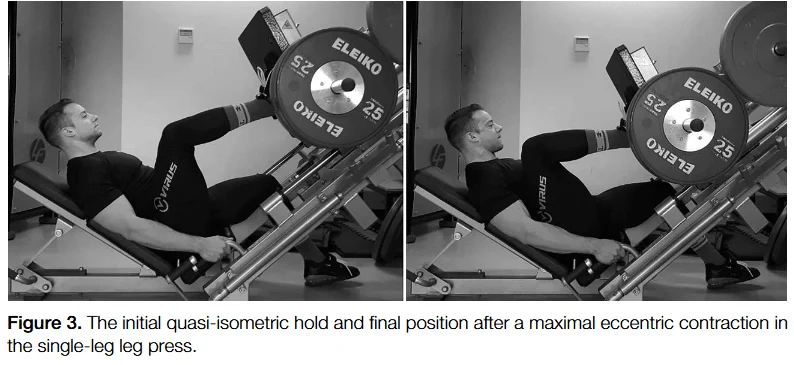
- Holding (Yielding) Isometrics: Here, you maintain a set joint angle against an external load that is attempting to force the muscle into an eccentric action.
Evidence suggests these two modalities are not functionally identical. Studies have shown that "holding" isometrics often result in a faster time to task failure, higher perceived exertion, and greater heart rate elevation compared to "pushing." This difference likely stems from the fact that holding actions require more complex neuromuscular control and afferent feedback, making them uniquely taxing.

The Evidence: Hypertrophy and Strength
For years, the conventional wisdom suggested that if you wanted to get big, you had to move weights through a full range of motion. However, meta-analyses and longitudinal studies have repeatedly shown that isometric training is a potent stimulus for hypertrophy.

The Role of Muscle Length
A recurring theme in recent research is the importance of "muscle length." It appears that performing isometric training at longer muscle lengths—where the muscle is stretched—results in superior hypertrophic outcomes compared to training at shorter lengths. This aligns with the "stretch-mediated hypertrophy" hypothesis, suggesting that high tension at long lengths triggers unique anabolic signaling pathways, potentially through the activation of mechanoreceptors like titin.

Progressive Overload and Volume
Isometrics are not exempt from the laws of progressive overload. While dynamic training uses weight as the primary variable, isometrics rely on:

- Total Time Under Tension (TUT): Accumulating a specific duration of contraction per session.
- Contraction Intensity: Percentage of Maximal Voluntary Contraction (MVC).
- Set Count: Number of bouts performed.
Research indicates that for hypertrophy, aiming for 80–150 seconds of total TUT per session is a solid target, while strength goals are better served by shorter, high-intensity bouts (1–5 seconds at near-maximal effort).

Tendons, Pain, and Rehabilitation
Perhaps the most universally accepted application of isometrics is in the management of tendinopathy. Isometrics provide a unique "analgesic" (pain-relieving) effect, allowing individuals to train around pain that would otherwise be exacerbated by the dynamic movement of an isotonic lift.

Tendons are viscoelastic structures that adapt to mechanical load by increasing in stiffness and cross-sectional area. Heavy, controlled isometric loading is often the first line of defense in rehabilitating damaged tendons, as it allows for the introduction of load without the repetitive mechanical stress of dynamic motion.

Practical Implications: How to Implement Isometrics
If you are looking to integrate isometrics into your current routine, consider these evidence-based strategies:

- Specificity is Key: If you have a sticking point in your squat, perform a pushing isometric at that exact depth against the safety pins of a rack.
- Don’t Ignore Length: Prioritize performing your holds at longer muscle lengths to maximize the architectural benefits, such as increased fascicle length.
- Be Mindful of Intensity: If strength is your primary goal, use 80–100% of your MVC for short, explosive durations. If hypertrophy is the goal, longer holds (10–40 seconds) at 50–70% MVC may be more effective.
- Complement, Don’t Replace: Isometrics are an excellent tool to supplement your training, but they should not necessarily replace your primary compound movements. Use them as an advanced technique at the end of a session or as a targeted tool to overcome specific performance plateaus.
Conclusion: A Tool in the Toolbox
The scientific evidence clearly refutes the idea that isometric training is ineffective. When programmed with the same attention to volume, intensity, and specificity as dynamic training, isometrics can drive significant improvements in muscle size, force production, and tendon health.

The future of research will likely provide more granular data on the ideal "dose" of isometrics for elite athletes. In the meantime, lifters should view isometrics not as a gimmick or a rehabilitation-only tool, but as a sophisticated, high-utility modality capable of breaking through the plateaus that dynamic training alone may struggle to overcome. Whether you are battling an injury, trying to improve your lockout strength, or simply seeking a novel stimulus for muscle growth, the "silent power" of the isometric hold deserves a place in your program.