For decades, the barbell back squat has held the undisputed title as the "King of Exercises" for lower-body development. It is a movement foundational to powerlifting, bodybuilding, and general athletic conditioning. However, the fitness landscape is shifting. As home gyms become more sophisticated and the demand for biomechanical efficiency grows, athletes are looking beyond the barbell for more targeted muscle stimulation.
Enter the "Somersault Squat"—a specialized dumbbell-based variation that is rapidly gaining traction in the bodybuilding community. Popularized by trainer Joe Daniels and recently thrust into the mainstream spotlight by Australian fitness influencer and bodybuilder Kwame Duah, this movement offers a unique approach to hypertrophy. By leveraging specialized positioning, the somersault squat challenges the quadriceps through an extreme range of motion that traditional barbell movements often struggle to replicate without significant technical risk.
The Mechanics of Growth: Understanding the Somersault Squat
At its core, the somersault squat is an advanced iteration of the goblet squat. While the standard goblet squat is a staple for beginners learning to hinge and squat, the somersault squat adds layers of complexity designed specifically to maximize knee flexion and quad isolation.
The Biomechanical Edge
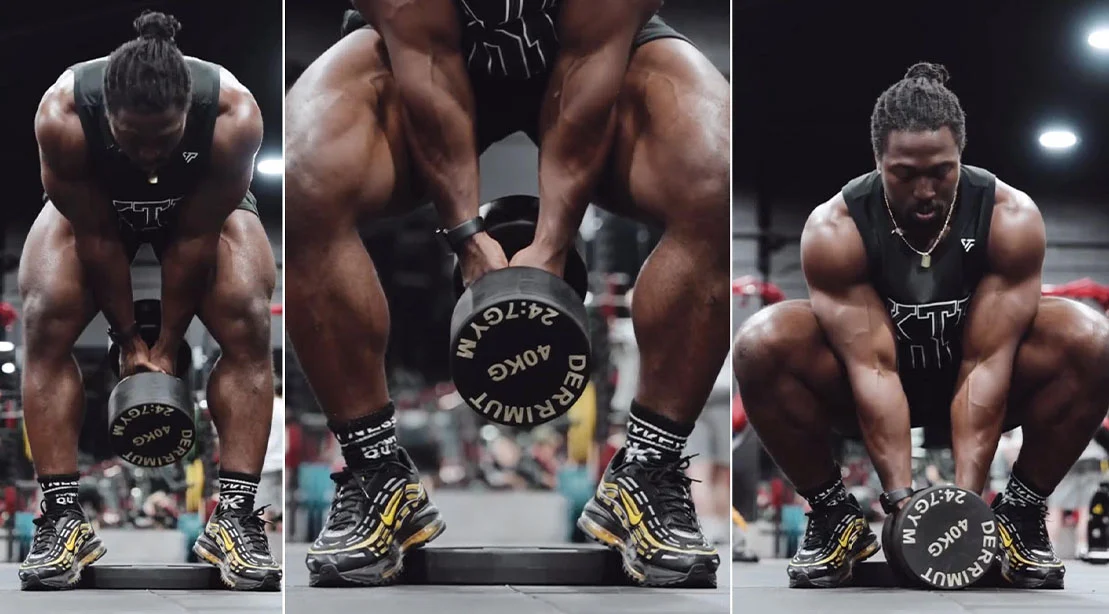
The primary differentiator in the somersault squat is the intentional elevation of the heels. By placing the heels on weight plates or a dedicated slant board, the athlete artificially increases their ankle dorsiflexion range. This allows the knees to travel significantly further forward over the toes than they would in a flat-footed squat.
When the knees travel forward, the quadriceps are placed under a greater mechanical disadvantage, forcing them to work harder to extend the knee joint against the load. By holding a dumbbell or kettlebell between the legs—rather than at the chest—the center of gravity shifts, allowing the lifter to maintain a more upright torso. This "verticality" minimizes the involvement of the lower back and glutes, effectively turning the movement into a quad-dominant powerhouse.
Chronology: From Niche Movement to Viral Sensation
The trajectory of the somersault squat is a testament to the power of digital fitness communities.
- The Origin: Originally coined the "Joe Daniels Squat" after the strength coach who first refined the technique, the move was initially practiced in the niche circles of kettlebell enthusiasts and home-gym aficionados who lacked the space for heavy barbell racks.
- The Refinement: For years, the movement remained an obscure "trick" used by trainers to help clients with poor mobility achieve depth. It was treated as a therapeutic drill rather than a primary hypertrophy tool.
- The Viral Inflection Point: The shift occurred when Australian bodybuilder Kwame Duah, a prominent voice in the fitness industry with a massive following across Instagram, TikTok, and YouTube, integrated the movement into his own programming. Duah’s IG reel, which showcased the fluid, controlled motion of the somersault squat, acted as a catalyst.
- The Modern Adoption: Today, the somersault squat is being integrated into high-level hypertrophy splits. It is no longer viewed as a "home gym alternative" but as a deliberate choice for advanced lifters seeking to carve out the "teardrop" (vastus medialis) and overall quad thickness.
Supporting Data and Anatomical Implications
To understand why this movement is so effective, one must look at the principles of muscle fiber recruitment. The quadriceps—comprising the rectus femoris, vastus lateralis, vastus medialis, and vastus intermedius—are primarily responsible for knee extension.
The Role of Knee Flexion
Research in sports biomechanics suggests that the greatest muscle activation for the quads occurs when the knee is in a state of maximum flexion. Traditional back squats, especially those performed with a "hip-dominant" or powerlifting-style technique, often rely heavily on the posterior chain (glutes and hamstrings). By elevating the heels and keeping the torso upright, the somersault squat removes the posterior chain’s leverage, isolating the quads.
The "Vertical Rise" Concept
As Duah explains, the movement requires the weight to travel in a specific trajectory. As the lifter descends, the weight moves between the legs, effectively "tracking" the knees as they move forward. As the lifter ascends, the hips drive forward, and the weight returns toward the starting position. This specific arc keeps constant tension on the quads, preventing the "rest periods" that occur at the top of a standard squat where the joints lock out and the tension shifts to the skeletal structure.
Official Perspectives: Kwame Duah’s Guide to Execution
In his recent breakdown for his followers, Kwame Duah emphasized that this is not a movement to be rushed. "Grab two plates and elevate your heels to improve ankle mobility and stability," Duah instructs. "Hold a dumbbell between your legs with a neutral grip. Lower down by bending through the knees and let them travel forward for that deep range of motion. Drive through the heels to power back up."
Training Frequency and Volume
One of the most common questions Duah receives is regarding training frequency. His response aligns with modern sports science:
"It really depends on how well you recover and whether you can fit it into your current training plan," Duah noted in a follow-up interaction with his community. "But I’d recommend training quads at least twice per week. You can also make your second leg day, which is typically more posterior chain focused, a bit more quad-dominant by prioritizing quad exercises or adding some extra quad volume."
This advice is crucial for those looking to implement the somersault squat. Because it is a high-intensity, high-flexion movement, it can be taxing on the patellar tendons. Therefore, incorporating it twice a week as a finisher or a secondary movement is often more sustainable than using it as a primary heavy lift at the start of every leg session.
Implications: The Risks and Rewards
While the somersault squat is a potent tool for muscle growth, it is not for everyone.
Prerequisites for Success
- Mobility: Ankle mobility is non-negotiable. If you cannot comfortably achieve a deep squat with elevated heels, you should spend time on mobility drills before attempting to add external load.
- Knee Health: Because the movement relies on extreme knee flexion, individuals with a history of meniscus issues, patellar tendonitis, or cruciate ligament injuries should approach this exercise with extreme caution. Always consult with a physical therapist before adding high-flexion movements to a rehab-focused program.
- The Goblet Baseline: Duah and other experts stress that you must first master the standard goblet squat. If your goblet squat lacks stability or you find yourself leaning too far forward, the somersault squat will only exacerbate those technical flaws, increasing the risk of injury.
The Future of Leg Training
The rise of the somersault squat signals a broader trend in bodybuilding: the move toward "intelligent training." Athletes are moving away from the "more weight, more reps" mentality and toward a "better stimulus, more control" philosophy. By prioritizing the way a muscle is loaded rather than the absolute weight on the bar, lifters can achieve greater hypertrophy with less systemic fatigue.
Conclusion: Is the Somersault Squat Right for You?
The somersault squat is a formidable addition to any leg day arsenal. It provides a level of quad isolation that is difficult to achieve with barbell variations alone, and it requires nothing more than a single dumbbell and two weight plates.
However, its effectiveness is entirely dependent on your ability to perform it with strict, controlled form. It is not an ego lift. If you are looking to break through a plateau in your quad development, or if you are training in an environment where heavy racks aren’t available, the somersault squat offers a pathway to elite-level growth.
As Kwame Duah continues to share his training insights, the broader fitness community is likely to see more of this movement in commercial gyms. When performed correctly—with heels elevated, a neutral grip, and a focus on the forward trajectory of the knees—the somersault squat is arguably one of the most efficient ways to build a balanced, powerful lower body.
Remember, the goal of bodybuilding is not just to move weight, but to stimulate tissue. The somersault squat does exactly that. Approach it with respect, master the mechanics, and be prepared for a level of quad soreness that only true, high-quality training can produce.