Introduction: The Unanswered Question of Moisture Transport
During periods of high-exertion activity—whether alpine climbing, trail running, or heavy-pack trekking—the human body acts as a biological furnace. To maintain core temperature, the body triggers an aggressive cooling mechanism: sweat production. Under extreme exertion, this production often outpaces the rate of evaporation, leading to the accumulation of liquid sweat against the skin.
For decades, the outdoor apparel industry has marketed "moisture-wicking" base layers as the panacea for this discomfort. However, many hikers have noted a persistent discrepancy: two garments, both marketed with identical moisture-management claims, often perform drastically differently in the field. One keeps the wearer feeling dry, while the other becomes a sodden, heavy layer that feels clammy against the skin.
A few months ago, I conducted a preliminary evaluation of three base-layer garments, revealing distinct performance variances. Yet, the fundamental question remained: Which fabrics are truly effective at moving liquid sweat away from the skin and into the subsequent layer? To answer this, I developed a specialized, multi-stage testing protocol designed to track liquid water as it migrates through a simplified clothing system. By measuring water retention at the "skin" interface, within the base layer, and in the secondary outer layer, we can finally map the journey of sweat.
The Chronology of Research: From Theory to Testing
The investigation began with a foundational review of fluid dynamics. To understand why fabrics hold or release moisture, I turned to the seminal work of Young and Laplace (1805) and the later formalizations by Washburn (1921). These scholars established the capillary physics that govern how liquids interact with fibrous materials.
My research evolved in three distinct phases:
- The Theoretical Framework: Establishing the difference between "hydrophobic" (water-repelling) and "hydrophilic" (water-attracting) fiber behaviors.
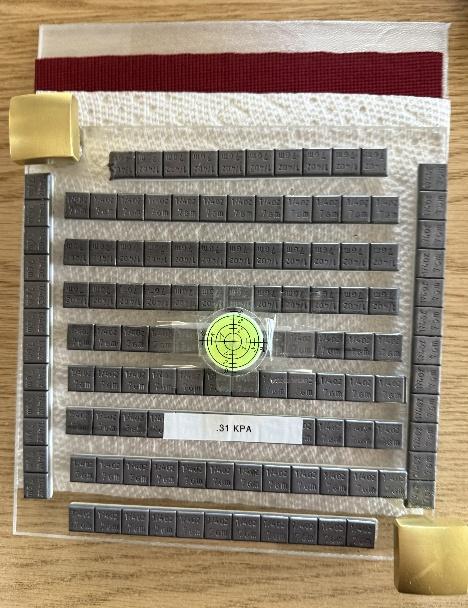
- Device Development: Constructing a liquid transfer test device (Figure 1) capable of simulating the pressure and contact dynamics of a human body in motion.
- Comparative Analysis: Expanding the study from an initial three fabrics to a robust set of eight, covering a diverse range of modern textile architectures.
Supporting Data: Why "Moisture-Managing" Labels Fail
The data collected during these trials suggests that the industry’s reliance on simple "moisture-wicking" terminology is scientifically insufficient. The tests revealed that the behavior of a garment is not merely a function of its fiber chemistry, but of its internal pore structure and the pressure exerted upon it.
Hydrophobic Fabrics: The Breakthrough Pressure Paradox
Hydrophobic base layers—often crafted from polypropylene or polyester treated with DWR (durable water repellent) finishes—are frequently advertised as "staying dry." While the fibers themselves do not absorb water, the fabric construction often contains significant "empty space."
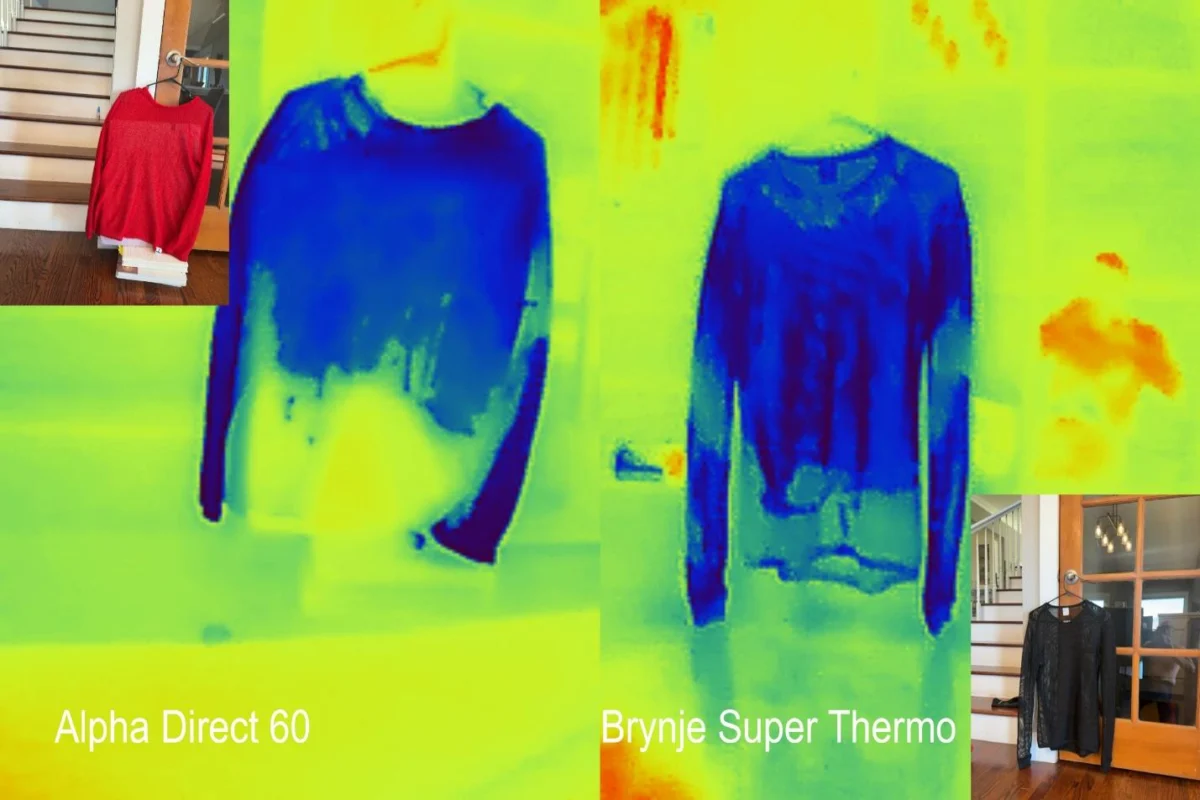
My testing indicates that hydrophobic fabrics do not necessarily stay dry. Instead, they act as reservoirs. If the rate of sweat production exceeds the rate of transfer, these pores fill with liquid. Infrared imaging (Figure 2) confirmed this: a Brynje mesh shirt retained 87g of sweat (65% of its dry weight), while an Alpha Direct shirt trapped 62g (55% of dry weight).
Crucially, these fabrics require breakthrough pressure to transfer moisture. Because the fibers resist water, liquid cannot move via capillary action. Instead, it requires external forces—such as the compression of a backpack strap, the friction of movement, or the weight of accumulated sweat—to force the liquid through the pores. If these pressures are absent, the moisture remains trapped against the skin, regardless of the fiber’s hydrophobic nature.
Hydrophilic Fabrics: The Trap of Capillary Wicking
Conversely, hydrophilic fabrics—typically natural fibers like merino wool or treated synthetics—operate via capillary uptake. They pull moisture into the fibers and spread it across the surface area. While this is excellent for initial sweat uptake, it creates a "retention trap."
Because these fibers are designed to hold onto water molecules via hydrogen bonding, they are inherently resistant to releasing that moisture to a secondary layer. The transfer process becomes a tug-of-war between the base layer’s affinity for water and the receiving layer’s capacity to pull it away. My data shows that as the receiving layer becomes saturated, its ability to draw moisture drops, leaving the base layer wet and heavy.
Official Observations and Key Findings
The testing highlighted several consistent patterns that define how base layers behave under stress:
- Pore Size Matters: Fabrics with larger, consistent pore structures generally exhibit lower breakthrough pressures, allowing for faster moisture movement, provided there is enough pressure to initiate the flow.
- The Saturation Threshold: Hydrophobic fabrics are superior at transferring water under pressure, but they offer little help in moving water when the wearer is stationary.
- The Wicking Limit: Hydrophilic fabrics excel at moving sweat when they are dry, but their performance degrades exponentially as they reach their saturation point, effectively stalling the transfer process.
Implications for Modern Gear Selection
What does this mean for the backcountry user? The implications for layering systems are profound.
1. The Dynamic System
If you are engaging in high-intensity, stop-and-go activity (such as ski mountaineering), a hydrophobic layer is often superior because it allows for rapid "flushing" of sweat when you are moving and generating pressure. When you stop, the lack of absorption means the fabric doesn’t stay sodden.
2. The Steady-State System
For activities with more consistent, lower-intensity exertion, hydrophilic materials remain a strong choice. Their ability to manage moderate levels of perspiration through capillary distribution prevents the "pooling" effect that can occur with hydrophobic fabrics when external pressure is minimal.
3. The Future of Fabric Design
The most effective garments identified in this study are those that combine a hydrophobic inner face (to keep skin dry) with a hydrophilic outer face (to pull moisture away). This "gradient" architecture utilizes the breakthrough pressure of the inner layer to eject moisture into the thirsty outer layer, effectively using the physics of both fiber types to create a one-way street for sweat.
Conclusion: Setting a New Bar for Performance
The goal of this study was to move beyond the marketing fluff that dominates the outdoor industry. By measuring the movement of liquid water—rather than relying on moisture-vapor transmission rate (MVTR) ratings, which only measure gas—we have gained a clearer picture of why certain base layers feel clammy and others provide consistent comfort.
Understanding that a fabric’s performance is contingent upon the interplay of fiber chemistry, pore structure, and mechanical pressure allows hikers to make more informed decisions. The next time you are shopping for a base layer, look past the "moisture-wicking" label. Consider the environment, your activity level, and the physical architecture of the textile.
While these findings apply specifically to the eight fabrics tested, the underlying physics—the same principles formalized by Laplace and Washburn over a century ago—remain the universal laws governing our gear. We are not just wearing clothing; we are managing a complex, thermodynamic system designed to keep us comfortable in the most demanding conditions on Earth.
For those seeking deeper analysis, the appendices of this report provide the raw breakthrough pressure data for all tested fabrics, as well as a detailed breakdown of the contact angle measurements for various synthetic and natural fibers. We encourage readers to review these findings to better understand the specific "tug-of-water" dynamics of their own equipment.