The challenge of environmental remediation is significantly magnified when the thermometer drops. Inland spill response—the act of containing and cleaning up oil or hazardous materials in rivers and waterways—is inherently complex. However, when those waterways are encased in ice and subjected to sub-zero temperatures, the operation shifts from a standard industrial task to a high-stakes, life-threatening endeavor.
For first responders, the combination of moving water, unstable ice sheets, and extreme wind chill creates one of the most unforgiving environments in emergency management. As climate patterns become more volatile, the industry is seeing an increased demand for rigorous risk management and specialized standard operating procedures (SOPs) for winter operations.
The Peril of Moving Water: Why River Ice Defies Standard Safety
While the public often associates ice safety with frozen lakes, river ice presents a fundamentally different set of hazards. On a lake, water is largely static; on a river, the constant, powerful movement of current under the ice creates structural inconsistencies that are invisible to the naked eye.
When a responder breaks through ice on a lake, the water is contained. On a river, however, the current can sweep a person under the ice sheet—a scenario that is almost universally fatal. Because of this, the "Golden Rule" of winter spill response is simple: Stay off the ice whenever possible. When working from the shore is not an option, the environment must be treated as a high-risk technical rescue zone rather than a standard work site. No personnel should set foot on river ice until a comprehensive, documented safety plan has been established, peer-reviewed, and communicated to every team member on site.
Chronology of an Ice Assessment: From Shore to Center
The transition from a planning phase to an operational phase on ice requires a methodical, step-by-step approach. Responders cannot rely on visual intuition; ice strength is a function of water chemistry, depth, current velocity, and thermal history.
Initial Size-Up and Risk Identification
The initial assessment begins at the bank. Before a single foot is placed on the ice, the Incident Commander must conduct a rigorous size-up. This includes:
- Hydrological Analysis: Measuring the current speed and water depth. Fast-moving water creates thermal erosion, thinning the ice from beneath.
- Structural Integrity Testing: Assessing ice thickness, consistency, and "quality" (clarity vs. opacity).
- Load-Bearing Calculations: Utilizing engineering formulas to estimate the capacity of the ice sheet.
A standard formula for estimating capacity is P = 50 × T², where P represents the load capacity in pounds and T represents the thickness in inches. However, these baseline numbers are deceptive. River ice must be treated with extreme skepticism: experts recommend reducing these estimates by at least 15% to account for current-induced stress and by up to 50% for "snow ice," which is structurally compromised by trapped air and inconsistent freezing.
The Procedural Drill
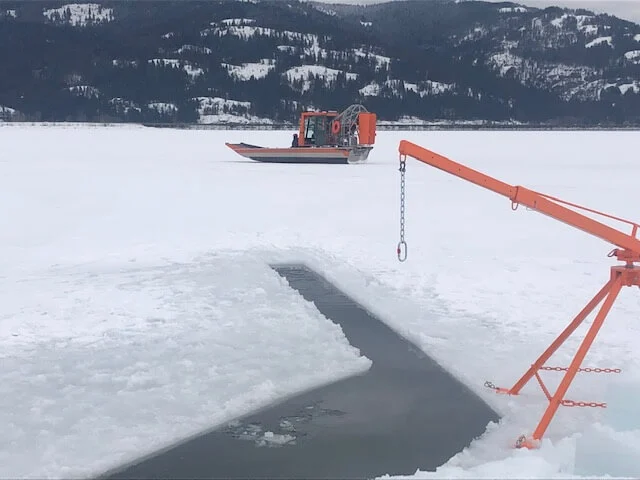
Once the risk profile is established, the team must begin testing. This should be performed by an ice rescue specialist, ideally while being belayed from the shore. The team should drill a series of test holes starting from the bank and working outward, progressively mapping the response zone. To distribute weight effectively, responders should utilize airboats or 4×8 sheets of plywood to disperse pressure across the ice surface. Throughout this process, an inflatable rescue craft must be pre-positioned and manned by a standby team, ready to deploy in the event of a breach.
Supporting Data: Understanding Ice Characteristics
Not all ice is created equal. Understanding the "Type" of ice is crucial for operational decision-making:
- Lake Ice: Often clear and reflective. It forms rapidly during temperature drops and is generally the strongest.
- Frazil Ice: Composed of disk-shaped slush. This represents the early, unstable phase of ice formation.
- Candled Ice: Characterized by a whitish-gray appearance and a honeycomb structure. Despite potentially being thick, it is critically weak and prone to sudden collapse.
- Snow Ice: Opaque or milky, this forms when snow saturates and freezes onto the surface. It is structurally inferior and often deceptive to the naked eye.
- Anchor Ice: Forms on submerged objects. In rivers, this is particularly hazardous as it can accumulate and create ice jams, which alter flow patterns and create unpredictable pressure points.
Official Operational Guidelines and PPE
Once the assessment phase is complete, the operational focus shifts to minimization—minimizing the number of responders on the ice and minimizing the time spent in high-risk zones.
Protective Equipment Requirements
Standard PPE for ice operations is non-negotiable and must include:
- Thermal Protection: Drysuits are mandatory to combat rapid heat loss.
- Personal Safety: Helmet, PFD, ice cleats for traction, and ice awls worn in an accessible location for self-rescue.
- Operational Gear: Proper saw protection (when cutting ice slots), impact-resistant gloves, and eye protection.
On-Site Operational Procedures
The "Buddy System" is the primary defense against catastrophe. No worker should ever be alone on the ice. Furthermore, the site must be prepared with "anti-slip" measures at entry and exit points on the riverbank. If the response requires cutting slots into the ice for skimming or boom deployment, those areas must be immediately cordoned off with high-visibility fencing.
Should conditions become unstable, operations must transition entirely to boat platforms. Throughout the duration of the response, weather forecasts must be monitored in real-time, as a shift in temperature or wind speed can degrade ice integrity within minutes.
First Aid and the "Warming Tent" Protocol
Environmental cold stress is a silent killer. As soon as a site is established, a climate-controlled warming tent must be operational. This station should be equipped with:
- Hypothermia Wraps and Blankets.
- Emergency Medical Kits (EMS), AEDs, and Oxygen.
- Portable Heaters and extra sets of dry PPE.
Responders working on ice will inevitably get wet or damp; having a surplus of dry boots and gloves is vital to preventing cold-related injuries like frostbite and trench foot.
Implications: The Impact of Wind Chill
Perhaps the most overlooked factor in winter spill response is the Wind Chill Temperature Index. The index is not merely a number; it is a measure of the accelerated cooling effect caused by moving air. As wind speeds increase, the body loses heat exponentially faster, dramatically shortening the time it takes for frostbite to set in.
At 15°F, with a wind speed of 30 mph, the air feels like -5°F. At these levels, exposed skin can freeze in under ten minutes. Incident Commanders must integrate the wind chill index into their site safety plan, implementing mandatory work-rest cycles that prevent prolonged exposure to the elements.
Self-Rescue: The Final Contingency
Despite the most rigorous planning, the possibility of a breach exists. If a responder falls through the ice, the survival plan must be reflexive:
- Combat the Panic: Panic leads to rapid energy expenditure and gasping, which increases the risk of water inhalation.
- The "Arms Out" Reflex: Immediately extend arms outward onto the ice shelf to prevent the body from being sucked under.
- Horizontal Kick: Attempt to swim horizontally, kicking the legs to bring the body into a horizontal position, making it easier to pull oneself out.
- Roll Away: Once out of the water, do not stand up immediately. Roll away from the hole to distribute weight until the responder reaches safer ice.
Conclusion: A Culture of Safety
Winter spill response is a discipline defined by its limitations. The success of an operation is not measured by how quickly the oil is removed, but by the safety of the personnel on the ground. By adhering to strict assessment protocols, respecting the volatile nature of river currents, and maintaining constant vigilance regarding wind chill and ice integrity, responders can effectively mitigate the risks of the frozen frontier. In this high-stakes environment, the most successful mission is the one where every responder returns to the shore safely.