For decades, the overhead triceps extension has been a cornerstone of hypertrophy-focused training. Whether performed standing with a dumbbell or seated with an EZ-curl bar, the movement is legendary for its ability to isolate the long head of the triceps—the largest of the three muscle heads—through a profound stretch. However, as training intensity increases, so does the risk of collateral damage.
For many gym-goers, the vertical load inherent in overhead movements can spell trouble for the lumbar spine. Recognizing this, fitness and transformation coach Travis Smith has championed a biomechanical shift that prioritizes spinal safety without sacrificing muscle recruitment: the Lying Triceps Cable Crossover. By moving from a vertical to a horizontal plane, athletes can achieve superior stability, allowing for greater mechanical tension and long-term joint health.
The Anatomy of the Dilemma: Why Overhead Extensions Often Fail the Spine
To understand why Smith’s modification is gaining traction, one must first analyze the biomechanics of the traditional overhead extension. When a lifter performs a standing triceps extension, they are essentially fighting a two-front battle. First, they must stabilize the weight through the range of motion. Second, they must maintain a rigid torso to prevent the lower back from hyperextending as the weight moves behind the head.
The Kinetic Chain Problem
As the weight on the bar increases, the kinetic chain—the interconnected system of joints and muscles—starts to break down. To compensate for fatigue or heavy loads, lifters often inadvertently arch their backs, transferring the stress from the triceps to the vertebrae. Even in a seated position, where the back is braced against a pad, the vertical load still compresses the spine. For those with pre-existing back issues or limited thoracic mobility, the overhead position is often more of a liability than an asset.
The Three-Headed Challenge
The triceps brachii consists of the medial, lateral, and long heads. The long head is unique because it crosses the shoulder joint, meaning it is most effectively stimulated when the arm is overhead. This is why trainers have historically pushed the overhead extension despite the risks. The challenge, therefore, is not the target muscle; it is the structural tax required to isolate it.
A New Paradigm: The Lying Triceps Cable Crossover
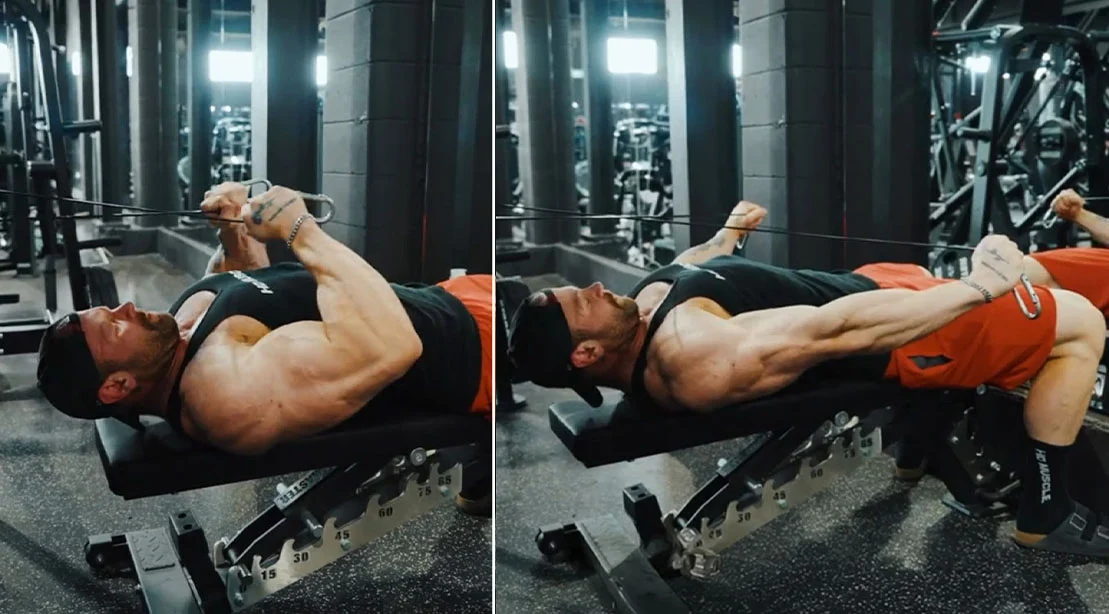
In a recent demonstration via his Instagram platform, Travis Smith unveiled a solution that effectively "locks" the body into a stable position. By transitioning to a supine (lying) position on a bench, the lifter eliminates the need for the core to act as a stabilizing pillar against gravity.
Chronology of the Technique
- The Setup: Place a flat bench directly in front of a cable station. The bench should be positioned so that the head is aligned with the cable pulleys.
- The Connection: Utilizing carabiner clips, attach handles to the cable system. The cables should be crossed over (left hand to right pulley, right hand to left pulley) to allow for a wider, more natural arc of motion.
- The Execution: Lie back on the bench. Start with the elbows bent and fists positioned above the chest.
- The Stretch: Extend the arms forward and slightly downward, allowing the cables to provide a deep, controlled stretch to the triceps.
- The Contraction: Drive the cables back to the starting position, focusing on the squeeze in the long head of the triceps.
Supporting Data: Stability as a Catalyst for Hypertrophy
Smith’s assertion that "stability is one of the most underrated variables for muscle growth" is supported by modern exercise science. In the world of bodybuilding and strength training, the concept of internal stability versus external stability is critical.
The Cost of Stabilization
When a lifter spends energy stabilizing their body, they have less "neurological bandwidth" to dedicate to the primary mover. By lying on a bench, the lifter removes the need to stabilize the core, pelvis, and feet. This allows the nervous system to direct maximal motor unit recruitment toward the triceps.
Constant Tension via Cable Loading
Unlike free weights, which provide a vertical resistance profile dictated by gravity, cables provide constant tension throughout the entire range of motion. In the Lying Triceps Cable Crossover, the resistance does not "drop off" at the top of the movement, nor does it become excessively heavy at the bottom. This continuous load forces the muscle to work through every degree of the extension, leading to increased metabolic stress—a primary driver of muscle hypertrophy.
Official Perspective: The Expert Stance on Joint Longevity
Travis Smith’s approach is not merely about growth; it is about the longevity of the lifter. Elbow health is a frequent casualty of traditional "skull crushers" (barbell extensions to the forehead), which often force the elbow into awkward, fixed positions.
Addressing Elbow Stress
"If regular skull crushers bother your elbows, this variation is the one for you," Smith notes. Because the cable crossover allows the wrists and elbows to move in a more natural, semi-supinated or neutral arc, it minimizes the shear forces that often cause tendonitis and lateral epicondylitis. By removing the rigid constraints of a barbell, the lifter can customize their hand position to suit their specific joint geometry.
Implications for Modern Programming
The integration of the Lying Triceps Cable Crossover into a standard arm routine has significant implications for how we view exercise selection.
Implementation Guidelines
For those looking to incorporate this movement, Smith recommends the following parameters:
- Volume: 2 to 3 sets per session.
- Repetition Range: 8 to 12 repetitions. This range is widely considered the "sweet spot" for mechanical tension and muscle fiber recruitment.
- Range of Motion: Do not over-reach past the shoulders during the release phase. The goal is a deep, controlled stretch, not a hyperextension of the shoulder joint.
Shifting the Focus from Ego to Efficiency
The move away from heavy, overhead, standing movements toward controlled, horizontal, cable-based movements represents a shift in modern fitness culture. We are moving away from an "ego-lifting" era—where the amount of weight on the bar was the only metric of success—toward a "hypertrophy-focused" era, where time under tension, joint health, and biomechanical efficiency take precedence.
The Future of Triceps Development
The Lying Triceps Cable Crossover serves as a reminder that innovation in the gym often involves looking at old problems through a new lens. By simply changing the orientation of the body relative to the resistance, we can unlock a more efficient path to muscle growth.
The implications for the average gym-goer are profound. By reducing the reliance on spinal stability, we decrease the risk of injury, allowing for more consistent training cycles. By increasing the mechanical efficiency of the exercise, we ensure that the triceps are actually doing the work, rather than the secondary muscles of the back and core.
As Smith demonstrates, the path to a larger, more defined arm doesn’t always require the heaviest weight or the most complicated setup. Sometimes, it just requires a bench, a set of cables, and the wisdom to lie down.
Summary of Key Benefits
- Spinal Protection: Eliminates vertical loading on the lumbar spine.
- Superior Isolation: Allows the triceps to become the sole focus of the movement by removing the need for total-body stabilization.
- Joint-Friendly: Offers a more natural range of motion for the elbows compared to traditional barbells.
- Constant Tension: Utilizes the cable’s resistance profile to maximize metabolic stress.
- Efficiency: A high-reward, low-risk movement suitable for both beginners and advanced bodybuilders.
In the final analysis, Travis Smith’s advice challenges us to rethink our relationship with gravity. Who says you can’t get an elite-level workout while lying on your back? With the right technique and the right equipment, the horizontal plane might just be the most effective space in the gym for building world-class triceps.
For more fitness insights and to follow Travis Smith’s ongoing demonstrations of safe, efficient training methodologies, you can find him on Instagram at travyjsmith.