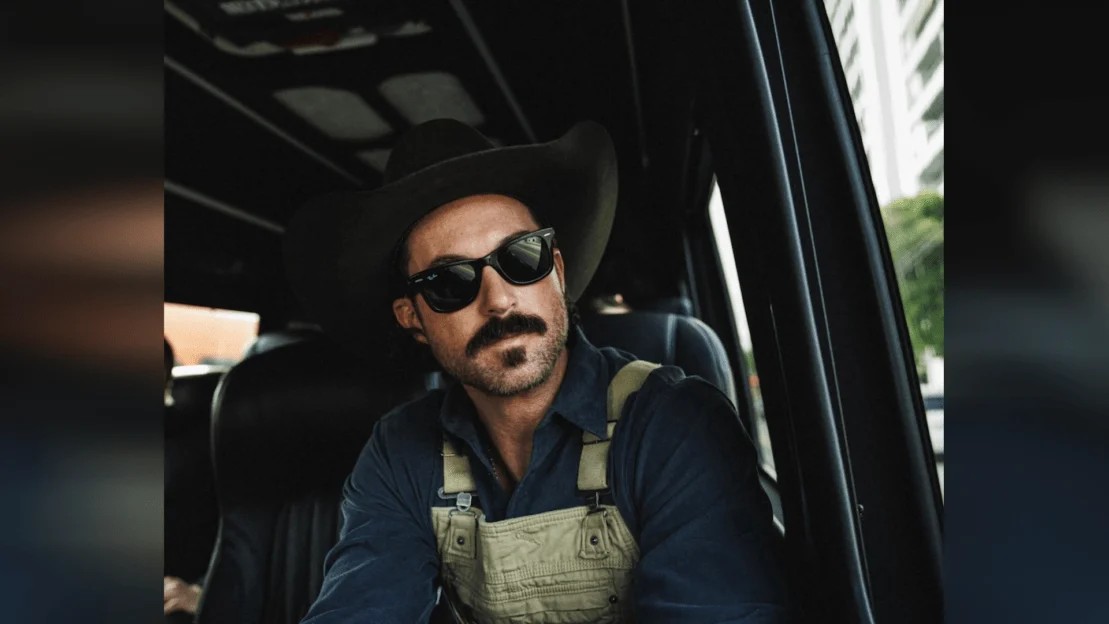
For most, a calendar featuring an international tour, a forthcoming album, a major television acting debut, and a high-profile coaching role on The Voice would be enough to induce burnout. For country music powerhouse Riley Green, it is simply Tuesday.
At 37, the "Worst Way" singer is operating at a pace that mirrors his days as a collegiate quarterback—calculated, intense, and profoundly disciplined. While he is currently in the midst of his sprawling 2026 Cowboy As It Gets tour, Green is defying the industry standard that suggests artists must eventually slow down. Instead, he is accelerating, proving that physical and professional endurance are not mutually exclusive.
Main Facts: The Multifaceted Ascent of a Country Icon
Riley Green’s current trajectory is nothing short of meteoric. Following a triumphant run of sold-out shows in Australia, the Alabama native has hit his stride in North America. His chart presence remains dominant; his hit single "Change My Mind" secured the No. 1 spot this past June, and his latest track, "Think As I Drunk," is already making waves across digital platforms.
Beyond the music, Green has effectively bridged the gap between Nashville and Hollywood. He recently wrapped his first major acting role in Taylor Sheridan’s Marshals, a transition that marks a significant expansion of his brand. This, coupled with a co-hosting role at the CMA Fest and a newly announced seat as a coach on NBC’s The Voice, places Green in a rarified tier of multi-hyphenate entertainers.
Yet, perhaps most remarkably, he has managed to maintain a "fitness gold standard." In an industry often defined by late nights and irregular habits, Green has cultivated a reputation as one of country music’s most disciplined athletes, maintaining a year-round six-pack and an unwavering commitment to his training regimen.
A Chronology of Consistency
Green’s journey to his current status was not an overnight success; it was built on a bedrock of manual labor and collegiate athletics. Before he was a multi-platinum headliner, he was a signal-caller for Jacksonville State University. That background provided him with the blueprint for his current lifestyle: prioritize the work, manage the recovery, and adapt to the environment.
- Pre-Fame (The Construction Era): Green notes that his early days in construction were perhaps his most physically demanding. "When I did construction work, I was sore every day," he recalls. "There wasn’t a day that I woke up and something didn’t hurt on me." This period forged his work ethic, teaching him that physical discomfort is often the price of progress.
- The COVID Pivot: The global pandemic provided a turning point for his physical infrastructure. Recognizing the need for consistency, Green invested in a home gym. This project transformed his approach, moving him away from the inconsistent "Planet Fitness" gym-hopping of his early touring days and toward a controlled environment where he could dictate his training intensity.
- The 2026 Expansion: Today, his routine is fully mobile. By outfitting a custom trailer with a Smith machine and essential equipment, Green has effectively removed the "excuse factor" from his touring life. Whether he is in a major city or a remote tour stop, the gym follows him.
Supporting Data: The Science of the "Bro-Split" and Core Focus
Green’s training philosophy is rooted in efficiency. He acknowledges that he cannot spend three hours a day in the gym like a professional bodybuilder. Instead, he relies on a high-intensity "bro-split" that allows him to exhaust muscle groups in 30 to 45 minutes.
"If I’m doing chest, I’m doing bench presses—flat bench, incline bench, and decline pushups—and I’m doing them all as quick as I can," Green explains. This circuit-style training ensures that his heart rate remains elevated, providing a metabolic conditioning benefit alongside hypertrophy.
However, at 37, the nature of his training has evolved. He now places a heavy emphasis on core stability and mobility to combat the "football damage" that has lingered since his youth, including two shoulder separations and recurring knee inflammation.
The Core Routine
To combat lower-back pain—often exacerbated by long hours on a tour bus—Green has implemented a specialized 20-minute core circuit:
- Hanging Leg Raises: For deep core engagement.
- Weighted Leg Lifts: For lower abdominal strength.
- Flutter Kicks: For endurance and stability.
- Bicycle Crunches: To target obliques and upper abdominals.
This routine, which he performs consistently on the road, has been described by Green as the "game changer" that allows him to remain mobile and pain-free during his performances.
Official Perspectives: The Athlete Turned Artist
Green is candid about the struggle to maintain this lifestyle. He admits to experiencing "lulls" where the travel schedule becomes so intense that his physical health takes a backseat. Yet, his perspective on motivation is uniquely pragmatic.
"I feel like 90% of the battle for me is motivation," Green says. "So if I’ve got something that’s here and it’s easy and convenient for me, I’m probably gonna work out."
His athletic identity remains central to his public persona. Whether he is taking batting practice with the Philadelphia Phillies, hitting home runs in MLB stadiums (with a goal to hit one in every park), or playing 18 holes at Sawgrass, Green refuses to shed his identity as an athlete. This isn’t just about hobbies; it’s about maintaining the mental sharpness that he believes is inextricably linked to his songwriting.
Regarding his songwriting, Green maintains a rigorous, DIY-focused workflow. His record of back-to-back solo-written No. 1 singles puts him in the same category as Taylor Swift—a feat he attributes to the sheer volume of his output. "If you write 30 mediocre songs, you’re gonna write one good song for about every 30," he says. This, he argues, is the same principle as his training: you have to put in the reps to see the results.
Implications: Navigating the Intersection of Fame and Physicality
The implications of Green’s lifestyle are clear: the "rockstar" trope of indulgence is being replaced by a new generation of performers who view their bodies as the primary instrument of their success.
His transition into acting—specifically the role of a former Navy SEAL in Marshals—has brought a new layer of pressure. "Acting probably made me more nervous than anything I’ve done in a while," he admits. By leaning on peers like Luke Grimes, Green has shown a willingness to be a student again, demonstrating the same humility he applies to his training.
Ultimately, Green’s story serves as a template for longevity. By prioritizing structural integrity—stretching, core work, and consistent, high-intensity training—he is ensuring that he can continue to perform at the highest levels for years to come.
As he prepares for the September 18 release of his new album, That’s Just Me, it is evident that Riley Green has found the rhythm that works for him. The gym gear is packed, the schedule is set, and the focus remains on the next challenge. For Green, the grind isn’t just a career requirement—it’s the only way he knows how to live.