In the pantheon of gym culture, few questions carry as much social currency as the ubiquitous, "How much can you bench?" It is the universal shorthand for physical prowess, a metric by which gym-goers of all experience levels are measured. Yet, beneath the bravado of the weight room lies a more nuanced reality: the bench press is a double-edged sword. While it remains the gold standard for building massive pectorals, powerful deltoids, and explosive triceps, it is also the leading cause of chronic shoulder injuries among recreational lifters.
To understand the bench press is to understand the balance between mechanical efficiency and anatomical safety. This article explores the evolution of the movement, the science of progressive overload, and the critical protocols required to ensure that your pursuit of strength doesn’t result in a lifetime of orthopedic rehabilitation.
The Anatomy of a Benchmark: Why We Bench
The bench press is a fundamental compound movement that recruits multiple muscle groups simultaneously. Unlike isolation exercises, which target specific fibers, the bench press requires the coordinated effort of the pectoralis major, the anterior deltoids, and the triceps brachii. Furthermore, when performed with proper "leg drive" and scapular retraction, it involves the entire kinetic chain.
Historically, the bench press rose to prominence in the mid-20th century, transitioning from a niche powerlifting move to the cornerstone of aesthetic bodybuilding. Its popularity is well-earned; it provides the highest mechanical load-bearing potential for the upper body. However, the very nature of this load—fixed, heavy, and pressing against gravity—places significant stress on the glenohumeral joint. When technique fails, the shoulder’s complex architecture becomes the primary victim.
Chronology of a Failed Set: The Anatomy of Injury
The decline of a lifter’s shoulder health rarely happens overnight. It is a slow, chronic degradation caused by repetitive, suboptimal movement patterns.
- Phase One: The Ego-Driven Start. A beginner enters the gym with the desire to mimic the "big lifters." They bypass foundational mechanics in favor of weight.
- Phase Two: Compensatory Mechanics. To move weight they aren’t ready for, the lifter begins "flaring" their elbows, pushing the shoulder blades out of a neutral, safe position, and bouncing the bar off the rib cage.
- Phase Three: The Inflammation Cycle. Micro-tears in the rotator cuff and impingement of the bursa begin to manifest as "nagging" pain. The lifter ignores this, opting for pre-workout stimulants or heavy bracing to mask the discomfort.
- Phase Four: The Injury Event. A sudden tear or chronic tendonitis forces the lifter out of the gym for months. The progress built over the previous year vanishes in weeks of inactivity.
This cycle is entirely avoidable. The professional approach dictates that we view the bench press not as a contest of strength, but as a discipline of precision.
Supporting Data: The Science of Tension and Load
Research in exercise physiology consistently highlights that muscle hypertrophy is driven by mechanical tension, not just the amount of weight moved. Studies published in the Journal of Strength and Conditioning Research suggest that "time under tension" is a more reliable predictor of muscle growth than the raw intensity of a single repetition.
When you "bounce" the bar off your chest, you are utilizing momentum. While this might allow you to complete one extra rep, it effectively removes the tension from the muscle fibers and transfers the force to the connective tissues and joints. To maximize growth, the eccentric phase (lowering the bar) should be controlled and deliberate, usually taking two to three seconds. This creates the micro-trauma necessary for the body to signal a growth response during recovery.
The Role of Progressive Overload
The fundamental principle of all strength training is progressive overload—the gradual increase of stress placed upon the body. Beginners often fall into the trap of "program hopping," switching routines every week based on social media trends. This is antithetical to progress. The body requires consistent, repetitive stimulus to adapt. A lifter should focus on adding small increments—as little as 2.5 pounds—to the bar over the course of several weeks rather than attempting to jump 20 pounds in a single session.
Official Guidelines: Best Practices for Safety
The following protocols, supported by strength coaches and physical therapists, are the "gold standard" for longevity in the weight room.
1. The Setup: The Foundation of Force
Before the bar even leaves the rack, your body must be braced.
- The Scapular Retraction: Pull your shoulder blades together and "tuck" them into your back pockets. This creates a stable shelf for the bar and protects the shoulder joint from impingement.
- The Arch: A slight, natural arch in the lower back is not only allowed but encouraged. It keeps the chest "proud" and optimizes the angle of the pectorals.
- The Grip: Ensure your wrists are straight. If the bar is resting in the palm and forcing the wrist backward, you are inviting wrist strain and reducing your ability to transfer force.
2. The Smith Machine: A Valid Tool
Purists often decry the Smith machine, but for the novice, it is an invaluable pedagogical tool. The fixed vertical path allows the trainee to focus exclusively on the engagement of the pectoral muscles without the instability of an Olympic bar. Once a lifter has achieved control and consistent range of motion, they can transition to the free-weight bench with a significantly reduced risk of injury.
The Role of the Spotter: A Professional Partnership
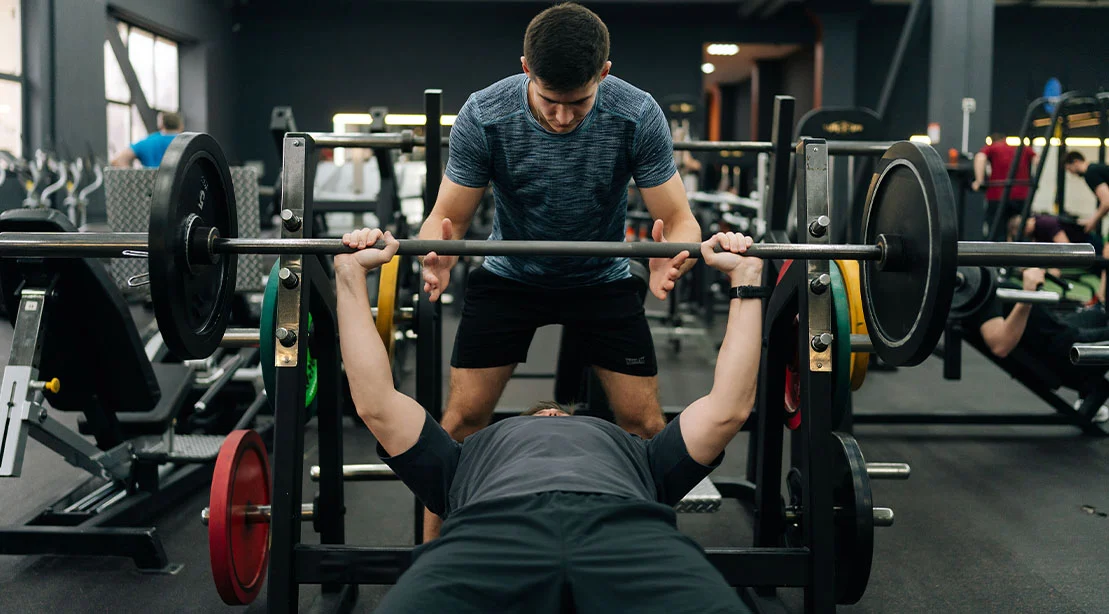
The inclusion of a spotter is not merely a safety precaution; it is a communication exercise. A professional spotter understands their role:
- Active Observation: Hands should follow the bar’s path, hovering inches away.
- Strategic Assistance: The spotter should only intervene if the bar’s velocity drops to near zero or if the bar begins to descend toward the lifter’s neck.
- The Lift-Off: A good spotter provides a countdown, ensuring the lifter is mentally prepared for the weight to leave the rack.
If you are training alone, the "Power Rack" is your best friend. By setting the safety pins at a height just below your chest, you ensure that even in the event of failure, the bar will rest on the rack rather than your rib cage.
Beyond the Bench: The "Balanced Program" Philosophy
A critical implication of long-term training is the need for balance. If you bench press three days a week but perform zero pulling movements (like rows or pull-ups), you are creating a muscular imbalance. The back muscles are the antagonists to the chest; if they are weak, the shoulders are pulled forward into a rounded, dysfunctional posture.
To maintain health, every "push" session should be balanced by an equal or greater amount of "pull" volume. This ensures the shoulder girdle remains centered and healthy. Additionally, incorporating rotator cuff exercises—such as external rotations—can act as "insurance" against the wear and tear caused by heavy pressing.
Implications for the Future of Training
The modern gym-goer is inundated with misinformation. The culture of "lifting until failure" is often misinterpreted as "lifting until form breaks." We must pivot toward a mindset of "intelligent intensity."
The strongest lifters are rarely the ones who post the most impressive "max-out" videos on the internet. They are the ones who have been training for twenty, thirty, or forty years. They are the ones who recognize that the bench press is a tool for longevity, not a tool for ego gratification.
Final Takeaways:
- Control the tempo: If you cannot control the weight on the way down, it is too heavy.
- Check your ego: Nobody in the gym is judging your weight as harshly as you fear.
- Respect the recovery: Muscle is built during rest, not during the workout.
- Prioritize the back: Strong posture is the key to safe pressing.
By mastering the movement, respecting the anatomy, and prioritizing consistency over intensity, the bench press will cease to be a source of injury and instead become the foundation of a lifetime of physical health. The goal is simple: be the person who is still hitting personal bests in their 50s, 60s, and beyond. That is the true measure of strength.