
By Mika Rantanen | August 10, 2026
For many Finns, the summer of 2026 has felt markedly different from the sweltering, record-breaking seasons that have characterized recent years. While the spring began with persistent warmth that hinted at another long, hot summer, the narrative shifted abruptly after the beginning of June. Since then, the weather has been defined by high volatility, a lack of sustained heatwaves, and a return to what climatologists consider "normal" levels. As we move through August, the data suggests that this summer will be remembered as the most moderate—and least heat-prone—season in nearly a decade.
Main Facts: A Return to the Mean
The defining characteristic of the 2026 summer has been the absence of "blocking" high-pressure systems over Scandinavia that typically usher in prolonged heatwaves. While the seasonal average temperature currently hovers very close to long-term historical norms, the subjective experience of the population has been one of coolness. This is largely because the extreme, stagnant heat of previous years has been absent, replaced by a rapid rotation of air masses.
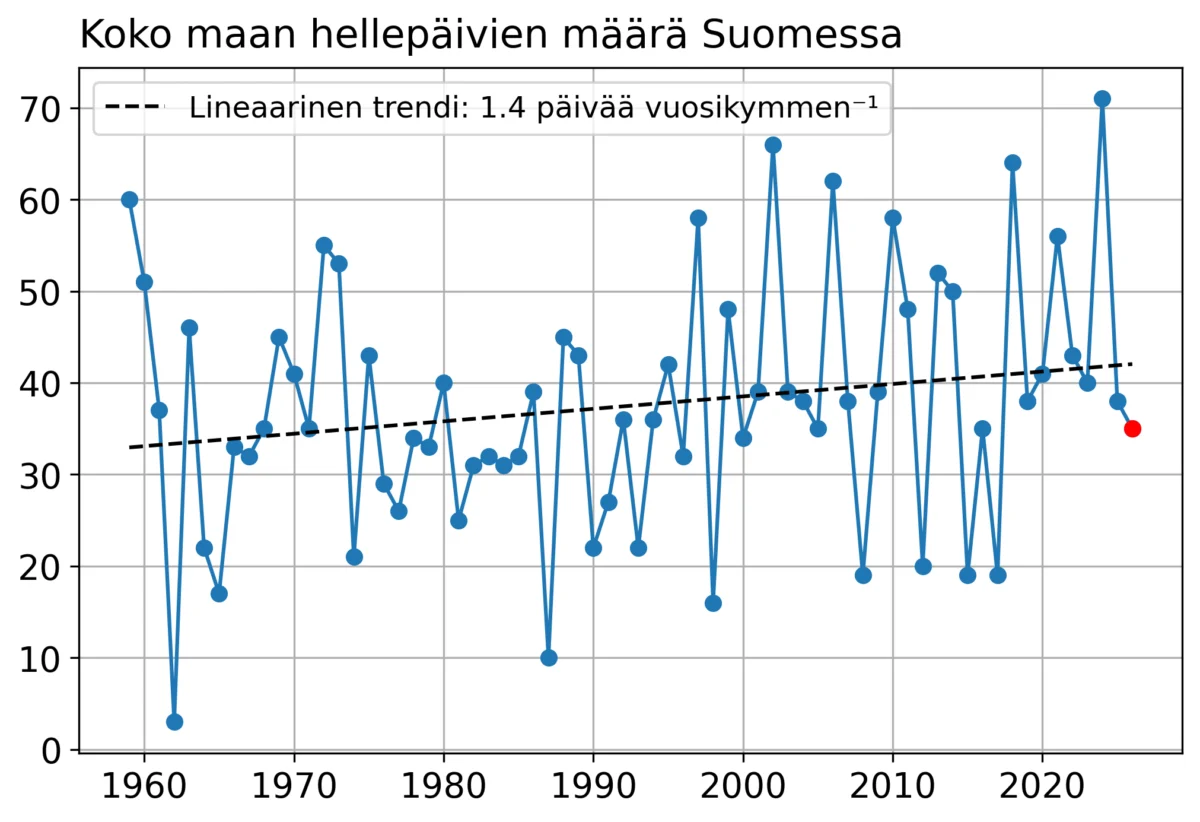
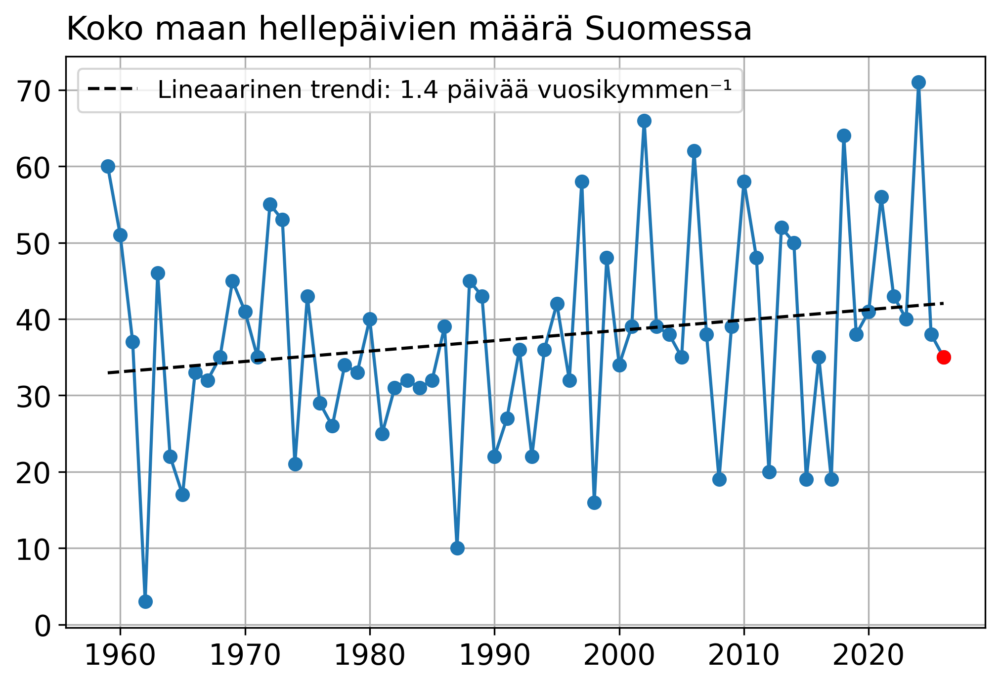
As of August 10, Finland has recorded 35 days classified as "hot" (where the daily maximum temperature reached at least 25.1°C). This figure is significant: it is the lowest count of hot days since 2017, marking an end to an eight-year streak of warmer-than-average summers. Compared to the median of 39 hot days observed over the last 30 years, 2026 sits slightly below the established baseline.
Chronology of a Variable Season
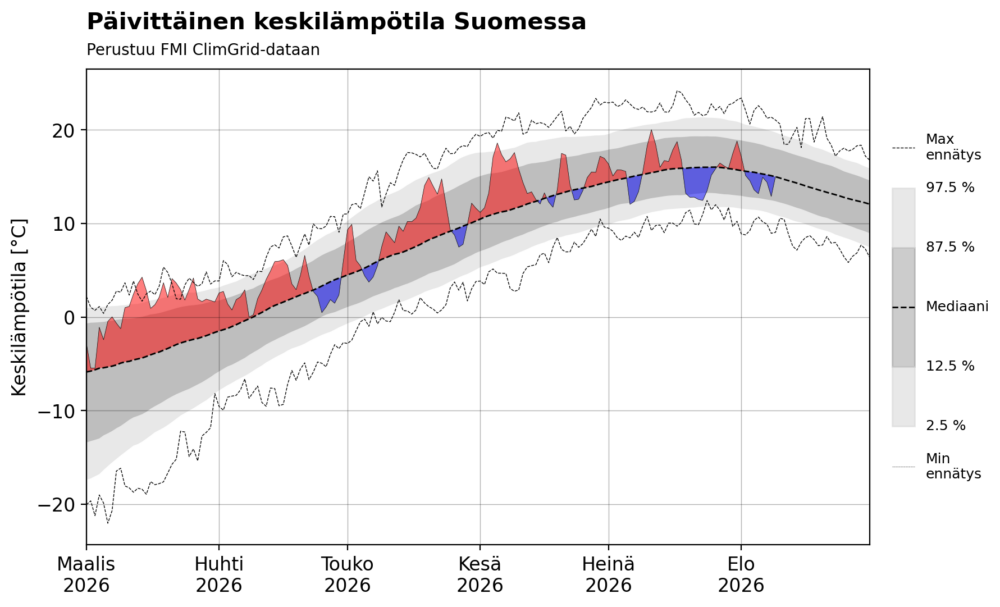
The meteorological story of 2026 began with promise. Spring temperatures were consistently above average, leading many to anticipate a continuation of the warming trends observed over the last decade. However, the pattern broke in late June.
- Late June Transition: After a warm start to the month, the atmospheric circulation shifted, introducing more variable, cooler air masses from the north and west.
- The July Chill: Mid-July was particularly notable for a sharp, unexpected dip in temperatures. On July 23, the national average temperature plummeted to a mere 12.5°C—a figure that flirted with historical cold records for that specific date.
- The "Heat Dome" Contrast: While Finland experienced relative instability, the rest of Europe was trapped under persistent, record-breaking heat domes. The contrast between Western Europe and Fennoscandia became a defining feature of the summer’s meteorological maps.
Dissecting the Data: The "Hot Day" Metric
A point of interest for meteorologists this year has been the discrepancy between official statistics and raw sensor data. The Finnish Meteorological Institute (FMI) currently lists 34 hot days for 2026. However, independent analysis suggests a total of 35.
The discrepancy arises from the specific technicalities of how weather data is recorded. For example, on June 22, the station at Porvoon Harabacka measured a maximum of 25.1°C. Because this reading occurred shortly after the 18:00 UTC cutoff used for daily reporting, it was indexed to the following day in some datasets, while the "official" daily maximum for the 06:00–18:00 UTC window fell just short of the threshold.
Regardless of the exact tally, the trend is clear: 2026 is the first summer in nine years to buck the upward trend of annual heat accumulation. While the long-term trend remains tilted toward warmer summers due to global climate change, 2026 serves as a reminder that natural variability—and global teleconnections—can still produce "cooler" interruptions in the warming signal.
The Global Driver: Is El Niño the Culprit?
One of the most intriguing questions surrounding the 2026 summer is why Finland remained relatively cool while Western, Southern, and Central Europe suffered through repeated, intense heatwaves.
The answer likely lies in the behavior of the upper-atmosphere jet stream and the positioning of high-pressure systems. Western Europe and the British Isles were locked under a "heat dome"—a high-pressure ridge that trapped hot air and refused to budge. This stagnation is rarely a local phenomenon; it is often driven by "teleconnections," or large-scale atmospheric drivers that influence weather patterns across entire continents.
The El Niño Connection
Evidence is mounting that an exceptionally strong El Niño event, which reached record levels during the summer of 2026, played a pivotal role. Historical climate data suggests that during strong El Niño years, Europe often experiences a specific dipole in temperature distribution. Typically, Western and Central Europe experience significant warming, while Scandinavia and Eastern Europe are pushed into a path of cooler, more unstable, and wetter weather.
This summer’s configuration fits the classic El Niño profile almost perfectly. The energy redistribution caused by the Pacific warming event appears to have forced the jet stream into a position that favored heat for the Mediterranean and the Atlantic coast, while acting as a barrier for the warm air masses attempting to push into the Nordic regions. While it is impossible to attribute the entire season to one factor, the correlation is too strong to ignore and will undoubtedly be the subject of academic research for years to come.
Implications for Future Climate Trends
The 2026 season provides a vital data point in the study of climate change. It underscores that even in a warming world, local weather patterns are subject to the influence of global phenomena.
1. The Resilience of Variability
The fact that 2026 remained close to the long-term average (1991–2020) suggests that the climate system still possesses the capacity for "normalcy," even if the statistical trend line is moving upward. It serves as a reminder that the "new normal" is not a uniform march toward heat, but rather an increase in the intensity and frequency of extremes, interspersed with years of high variability.
2. Infrastructure and Readiness
Because the heat was not as sustained as in previous years, the pressure on energy grids and agricultural systems was significantly lower. However, the volatility of the weather—the sudden swings from heat to cold—presents its own challenges for farmers and energy providers, who must now adapt to a climate that is becoming less predictable.
3. Public Perception vs. Meteorological Reality
There is often a disconnect between how the public perceives a summer and what the thermometers say. Because the summer of 2026 lacked the "sticky", oppressive heatwaves that defined the summers of 2018, 2021, and 2024, it felt "cool" to the average person. In reality, it was a season of equilibrium. This psychological framing is important for policymakers, as it highlights that "normal" weather can feel like a relief when compared to the recent barrage of extreme events.
Looking Ahead: The Remainder of the Season
As of mid-August, the long-range forecasts show no signs of a sustained, late-summer heatwave arriving in Finland. While the country may still see individual "pulses" of warm air, the window for a major, prolonged heat event is rapidly closing.
Most meteorologists expect the final count of hot days to land between 35 and 40, placing 2026 squarely within the average range for the last three decades. For the Finnish landscape—and for those who enjoy a more temperate climate—this summer has been a welcome respite. It has been a summer of balance, defined by the interplay between global oceanic drivers and the complex, shifting currents of the atmosphere.
As we look toward the autumn, the scientific community will begin the work of modeling the 2026 season in its entirety. The lessons learned from this year’s atmospheric blocking patterns and the influence of the record-breaking El Niño will be crucial in refining our understanding of how Northern Europe will navigate the volatile summers of the coming decade.
For those interested in the ongoing monitoring of Finnish climate patterns, further data, and in-depth environmental journalism, consider supporting the work of the Finnish Nature Association. Understanding our changing climate starts with robust, independent data.