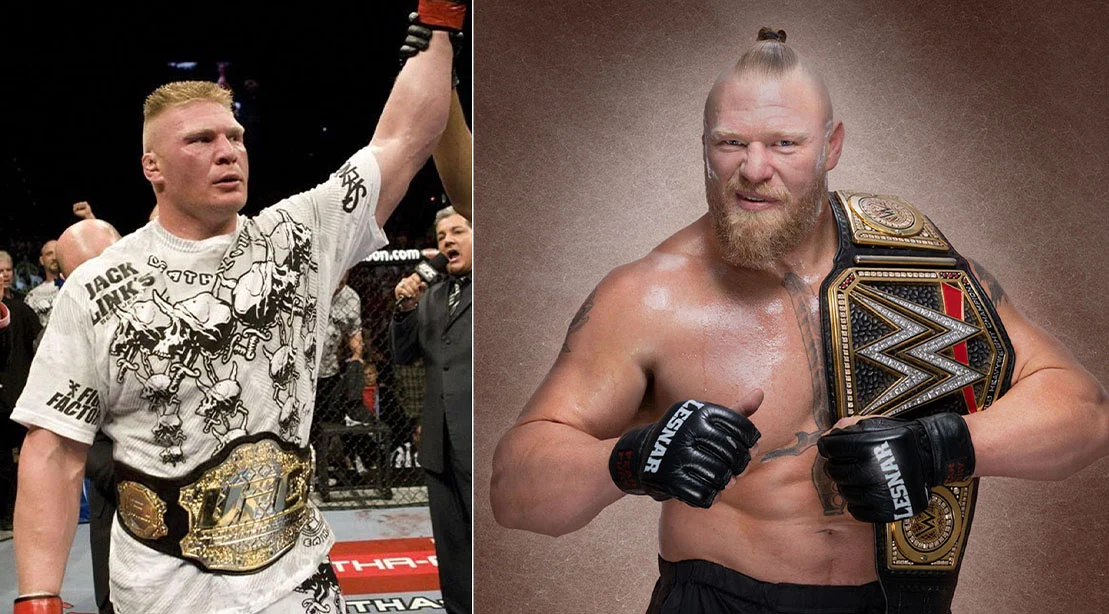
After a quarter-century of unparalleled dominance that saw him conquer the worlds of collegiate wrestling, mixed martial arts, and professional sports entertainment, Brock Lesnar has officially closed the curtain on his storied career. Appearing on The Pat McAfee Show on August 4, 2026, the man affectionately and fearfully known as "The Beast Incarnate" confirmed that his final appearance at SummerSlam was not merely a storyline—it was his definitive retirement from all athletic competition.
At 49 years old, Lesnar leaves behind a legacy defined by raw power, explosive athleticism, and a rare ability to transcend the boundaries between scripted entertainment and legitimate combat sports. For millions of fans, the news marks the end of an era.
The Legacy of a "One in a Million" Athlete
To categorize Brock Lesnar as a professional wrestler or a UFC fighter is to vastly undersell his footprint on modern athletics. Known by scouts and peers alike as a "one in a million" specimen, Lesnar’s physical profile—a combination of freakish strength, surprising speed, and a magazine-cover physique—made him a must-watch attraction for over 25 years.
His journey began on the collegiate mats, where he achieved two-time NCAA Division I All-American status and secured the Heavyweight Championship, a testament to his technical wrestling prowess. However, it was his transition to the WWE in the early 2000s that catapulted him to superstardom. At just 25 years old, Lesnar became the youngest performer in the company’s history to capture a world title, setting a standard for excellence that few have matched since.
His ambition led him to explore avenues outside of the squared circle as well. He famously signed with the NFL’s Minnesota Vikings, showcasing his athletic versatility, even if a formal game appearance remained elusive. Yet, his most impressive feat remains his historic run in the UFC. By defeating Randy Couture in 2008, Lesnar became the only individual to ever hold both the UFC and WWE Heavyweight Championships, effectively cementing his status as the most dangerous man in the history of crossover sports.
Chronology of a Career: From Mat to Octagon to Legend
The trajectory of Brock Lesnar’s career is a study in evolution. His path can be broken down into distinct phases that defined the landscape of combat sports:
- 1998–2000: The Amateur Foundation: Dominating the collegiate wrestling circuit at the University of Minnesota, Lesnar laid the groundwork for his future in professional combat.
- 2002–2004: The Rise of the Next Big Thing: Lesnar’s initial WWE run saw him dominate the landscape, defeating icons like The Rock and Hulk Hogan.
- 2004–2007: The NFL and Japan: After a brief and controversial foray into the NFL, Lesnar spent time in New Japan Pro-Wrestling, further honing his international appeal.
- 2007–2011: The UFC Dominance: Lesnar shocked the MMA world by transitioning into the UFC, where he became a massive pay-per-view draw and captured the Heavyweight gold, overcoming severe health challenges along the way.
- 2012–2026: The Beast Incarnate Era: Returning to WWE, Lesnar became a part-time attraction that carried the prestige of a world title. His bouts against stars like Roman Reigns, John Cena, and eventually Oba Femi redefined the "special attraction" model.
The Retirement Catalyst: Why Now?
The decision to retire did not happen overnight. According to Lesnar, the internal realization began to take root as early as April 2026. Following a grueling loss to the rising superstar Oba Femi at WrestleMania 42, Lesnar experienced a moment of clarity.
"When Oba Femi slammed me at WrestleMania, I was like, ‘I can’t do this again,’" Lesnar confessed to Pat McAfee. That initial loss was so physically jarring that Lesnar even signaled his departure to the crowd, leaving his gloves and boots in the center of the ring in Las Vegas.
However, the competitive fire still burned, leading to a brief, defiant return. The two men clashed again in Italy in May, where Lesnar delivered a punishing performance, hitting seven of his signature F5 finishers to secure a victory. With the score tied 1-1, a final "Hell in a Cell" match was set for SummerSlam on August 1, 2026.
In his home state of Minnesota, Lesnar put everything on the line, including a brutal tombstone piledriver on the exposed ring floor. Ultimately, the younger Femi emerged victorious, pinning the legend. In a final show of respect, Lesnar dubbed Femi "the future," effectively passing the torch and finding the closure he needed to walk away for good.
Debunking the Rumors: Is This Really the End?
In the world of professional wrestling, "retirement" is a term often used loosely. Skeptics point to the fact that Lesnar is arguably in better shape than many of his peers. While Lesnar is 49, he is significantly younger than some active roster members like R-Truth (54) and Rey Mysterio (51). Furthermore, in the context of pure MMA, Randy Couture held the UFC Heavyweight title at 45, proving that elite athletes can push past the half-century mark.
Despite this, Lesnar was categorical during his interview. "Saturday, for Brock Lesnar, that’s it," he confirmed. "That’s it for me in the squared circle, and for everything else." Unlike his previous departures, there is a finality in his tone that suggests the "Beast" has truly finished his hunt.
Post-Career Plans: Life Beyond the Squared Circle
What does a man who has spent 25 years fighting do with his spare time? For Lesnar, the answer is simple: family and the outdoors.
"I’ve got some hunting lined up," Lesnar shared, revealing a softer side of his personality. He expressed a deep commitment to his children, noting that his two sons are heavily involved in hockey, a pursuit he intends to support as long as possible. Perhaps most excitingly, he revealed that his daughter is currently training with eyes on the 2028 Olympic Games.
"I’m just going to spend some more time with the kids and in the woods, and just reap what I’ve sown," Lesnar added. "Just enjoy life."
Wisdom for the Next Generation
As he exits the spotlight, Lesnar left a poignant message for the aspiring athletes and entertainers who look up to him. Reflecting on his own humble beginnings as a "farm kid with a bunch of lint in my pocket," Lesnar warned against the modern trap of superficial success.
"I think a lot of people, nowadays with social media and platforms, athletes leave out the hard work," Lesnar said. "If kids just stay focused on work and putting the time in, good things will happen."
His advice serves as a stark reminder that beneath the pyrotechnics, the championships, and the fame, Lesnar’s career was built on the foundation of an unrelenting work ethic. It is the advice of a man who didn’t just play the role of a beast—he lived the discipline required to become one.
The Implications of Lesnar’s Exit
The departure of Brock Lesnar leaves a massive vacuum in the professional wrestling landscape. As an attraction, Lesnar brought a sense of legitimacy to every match he participated in. His presence alone commanded attention, driving viewership and ticket sales that few others could replicate.
For the WWE, the challenge now lies in elevating new stars—like the aforementioned Oba Femi—to fill the void. While the "Beast Incarnate" is irreplaceable, his departure signals a transition toward a new generation of talent who must now prove they can carry the weight of the company on their shoulders, much like Lesnar did for the better part of two decades.
For the fans, the finality of the SummerSlam loss is a bittersweet pill to swallow. Yet, as Lesnar rides off into the quiet of the woods, there is a collective sense of gratitude for a performer who never failed to deliver when the lights were brightest. The Beast has retired, but the legend of his work, his intensity, and his unrivaled career remains an indelible chapter in sports history.