In the high-stakes world of ultralight backpacking and alpine mountaineering, gear manufacturers often lean heavily on the "spec sheet" to justify premium price tags. Consumers are frequently inundated with impressive technical metrics: Dyneema composite fabrics with near-infinite tear strength, Cordura nylons boasting high-denier abrasion resistance, and DWR (Durable Water Repellent) coatings that promise to bead water like a freshly waxed car.
However, experienced hikers know that a backpack’s performance is rarely the sum of its fabric parts. The reality of a backcountry storm—where wind-driven rain seeks out the path of least resistance—often reveals a startling disconnect between the lab-tested fabric and the soggy mess inside a hiker’s main compartment. To bridge this gap, a new methodology has emerged, focusing not on the material itself, but on the integrity of the system.
The Myth of the "Waterproof" Pack
The industry often conflates "water-resistant materials" with "waterproof equipment." This is a dangerous simplification. A backpack is a complex assembly of panels, seams, zippers, hydration ports, and roll-top closures. Even when a pack is constructed from a non-porous, waterproof laminate, it remains a collection of holes held together by thread.
Water is remarkably adept at capillary action. It travels along stitching, accumulates in the crevices of poorly sealed zippers, and wicks through the nylon webbing of strap anchors. A pack may be made of the finest waterproof material on the market, but if the seams are not taped, or if the roll-top closure allows for even a microscopic gap, the gear inside will eventually succumb to moisture. This discrepancy between the fabric’s capability and the system’s reality is the primary focus of this new testing paradigm.
Chronology of a Controlled Shower Test
To move beyond subjective field impressions, we have developed a standardized, repeatable protocol: the "30-Minute Shower Exposure Test." This methodology serves as a comparative screening tool rather than a final verdict on gear performance.
Phase I: Preparation and Witness Material
The test begins with the "witness material" approach. To accurately gauge water ingress, the pack is stuffed with a large, dry cotton pillowcase. Cotton is chosen specifically because it is highly absorbent; it acts as a clear indicator of moisture, changing color and weight significantly upon contact with even small amounts of water. The pack is then packed to its standard volume to ensure that seams and closures are under the appropriate amount of structural tension—tension that often opens up small gaps in zippers or stitch lines.
Phase II: The 30-Minute Exposure
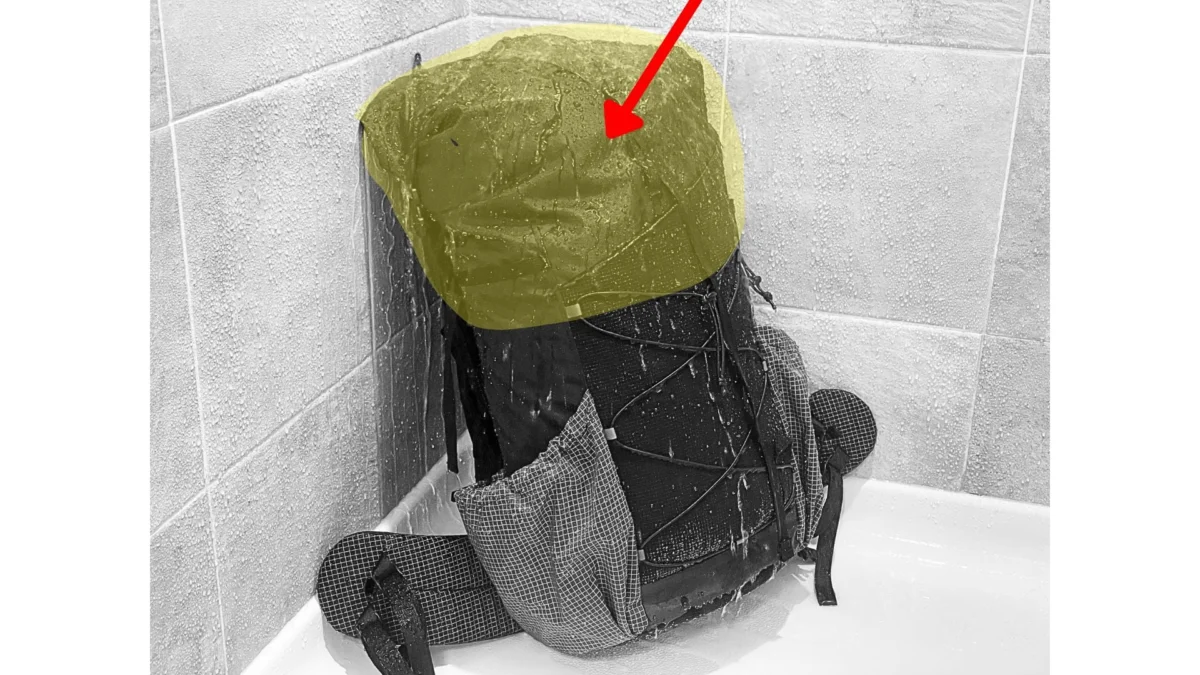
The pack is placed in a standard household shower stall. The water is set to a consistent, high-intensity flow, mimicking a steady, sustained downpour. The pack is positioned to ensure that water hits the most vulnerable areas—the top closure and the main vertical seam—for a duration of 30 minutes.
Phase III: The Inspection
Following the 30-minute duration, the pack is removed, shaken dry, and carefully unzipped or unrolled. The witness material is then removed and weighed. Any increase in the weight of the cotton pillowcase is measured against its dry baseline. This provides a quantifiable "leakage factor" that allows us to differentiate between packs that are "weather resistant" and those that are truly "storm ready."
Supporting Data: Why Standard Metrics Fail
Our preliminary testing reveals that traditional fabric metrics provide a poor correlation with real-world protection. In comparative tests, packs constructed from high-denier, DWR-treated fabrics often failed sooner than thinner, lighter packs that featured fully sealed seams and roll-top closures.
The data suggests three primary points of failure:
- The Zipper Paradox: Even YKK-branded water-resistant zippers are susceptible to leakage under prolonged, direct pressure. They are "resistant," not "proof."
- Stitch-Hole Wicking: High-tension areas, particularly where shoulder straps anchor to the pack body, are constant points of ingress. Without internal seam sealing or reinforcing patches, these holes are essentially funnels for rain.
- Closure Mechanics: The roll-top closure, while popular, relies entirely on the operator’s precision. If the fold is not perfectly aligned or if the material is too stiff to create a tight seal, water ingress is almost guaranteed during heavy, wind-driven events.
Official Responses and Industry Stance
Manufacturers have historically been hesitant to label their products as "waterproof" for legal and liability reasons. When reached for comment, representatives from several leading outdoor brands noted that they prefer the term "weather resistant" to manage consumer expectations.
"We design for durability and weight," said one lead product designer at a major pack manufacturer. "If a customer requires total protection, we recommend the use of an internal pack liner or dry bags. A backpack is designed to carry weight comfortably, not to function as a submersible dry bag. We recognize the value of testing protocols like the shower test, but we emphasize that the pack system is only one layer of a hiker’s moisture-management strategy."
This sentiment underscores a shift in industry philosophy: the pack is the container, but the system must include secondary protection.
Implications for the Modern Hiker
What does this mean for the gear-obsessed hiker? It suggests that the "waterproof" spec on a hangtag should be treated as a suggestion rather than a guarantee.
1. The Death of the "All-in-One" Solution
The days of assuming a pack will keep your down sleeping bag dry in a torrential monsoon are over. Hikers should stop relying on the pack fabric as a primary defense. Instead, the focus must shift to internal organization. The use of sil-nylon dry bags or a robust pack liner (like a heavy-duty trash compactor bag) is the only way to ensure gear integrity in the field.
2. The Need for Proactive Maintenance
The shower test highlights that seams are the first to fail. Hikers who invest in expensive, high-spec packs should look for seam-taped construction. If a pack is not seam-taped, the user must take the initiative to apply seam sealer to high-stress areas. Furthermore, DWR coatings are not permanent; they require periodic reactivation through heat or re-application of spray-on treatments.
3. Understanding the "Screening" Mindset
The shower test is not a certification. It is a tool for the consumer to understand the limitations of their equipment. By performing this test at home, hikers can identify whether their specific pack model has a design flaw (such as a weak zipper or poor seam overlap) before they are miles into the backcountry.
Conclusion: A Shift in Gear Culture
The industry’s reliance on fabric specs has fostered a culture of misplaced confidence. By stripping away the marketing jargon and focusing on empirical, repeatable testing, we gain a clearer picture of what our gear can—and cannot—do.
While the "30-Minute Shower Test" might seem simple, its implications are profound. It encourages a shift from passive consumption of marketing specs to active testing and understanding of gear mechanics. As climate patterns become more volatile and backcountry storms more intense, this shift toward objective, system-based testing is not just a luxury for gear enthusiasts—it is an essential component of modern outdoor safety.
When you pack for your next excursion, don’t just look at the denier count of your pack’s fabric. Consider the seams, evaluate the closures, and always assume that water will find a way in. By acknowledging the limits of our gear, we are better prepared to handle the realities of the wilderness, ensuring that our essential equipment remains dry, functional, and ready for the miles ahead.