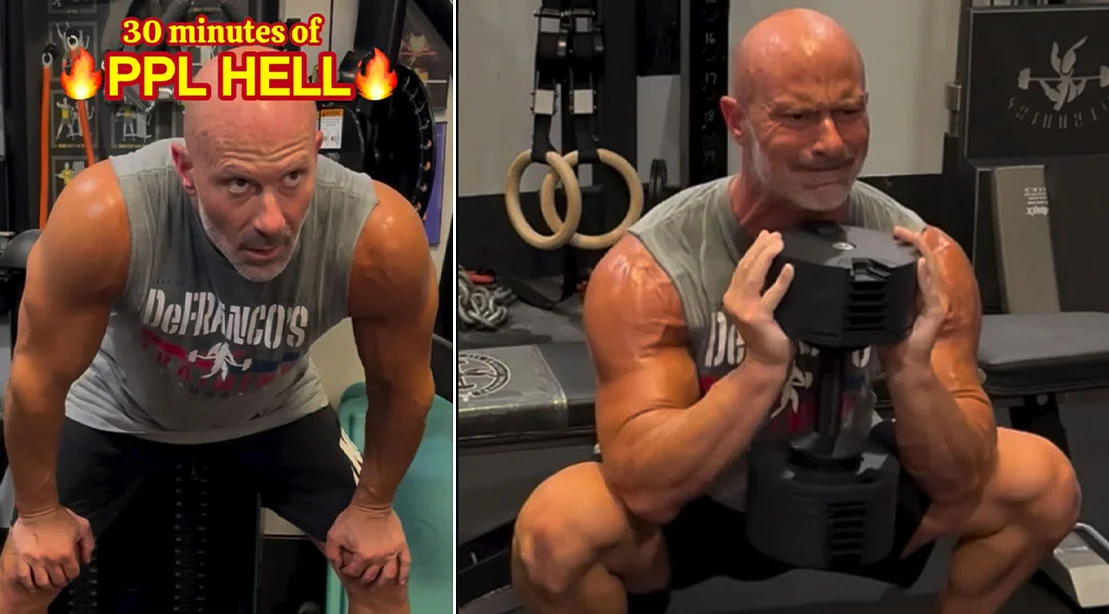
While the dog days of summer often tempt even the most dedicated fitness enthusiasts to trade their training sessions for sun loungers, world-renowned strength and conditioning coach Joe DeFranco is turning up the heat in the gym. As the mastermind behind the elite, magazine-cover physiques of NFL, UFC, and WWE stars, DeFranco has long been the gold standard for performance-based aesthetics. His latest offering—a grueling 30-minute “Push-Pull-Legs (PPL) Hell” circuit—is currently dominating social media, proving that you don’t need hours in the gym to elicit transformative results.
The Man Behind the Muscle
To understand the efficacy of DeFranco’s programming, one must look at his pedigree. Operating out of his namesake facility, DeFranco’s Gym, he has cultivated a reputation for turning athletes into powerhouse performers. His philosophy is rarely about “gym aesthetics” in the traditional, superficial sense; instead, he focuses on functional hypertrophy and explosive power. When DeFranco speaks, the industry listens, and his latest Instagram revelation has provided his 220,000+ followers with a blueprint for high-density training that bridges the gap between raw strength and cardiovascular conditioning.
The Anatomy of the “PPL Hell” Circuit
The brilliance of DeFranco’s 30-minute circuit lies in its elegant simplicity. By distilling complex training protocols into three foundational movements, he has created a workout that targets every major muscle group while maintaining a metabolic demand that torches body fat.
1. Bench-Assisted Dumbbell Rows (The Pull)
For the modern professional, sedentary desk work is the primary enemy of posture. DeFranco emphasizes the bench-assisted dumbbell row as a corrective and strength-building pillar. By supporting the torso on a bench, the athlete removes the lower back stability requirement, allowing for an isolated attack on the lats, traps, and rhomboids. This movement not only broadens the back but also corrects the "hunched" posture inherent to office life, while simultaneously challenging grip strength.
2. The Goblet Squat (The Legs)
The goblet squat is a full-body integrator. By holding a weight at chest height, the trainee is forced to maintain an upright torso, which recruits the core and lower back stabilizers in addition to the primary movers—the glutes, quads, hamstrings, adductors, and calves. It is a functional movement that builds a robust foundation, essential for both athletic performance and daily mobility.
3. The Shoulder-Tap Pushup (The Push)
This is not your standard pushup. The shoulder tap introduces an element of instability and unilateral tension. As the athlete descends into the pushup, the chest (upper and lower pecs) is worked through a full range of motion. The addition of the shoulder tap forces the core to fight rotation, while the triceps and shoulders act as the primary stabilizers. It is a high-reward movement that turns a simple bodyweight exercise into a comprehensive upper-body challenge.
Chronology of a High-Intensity Transformation
The methodology of this circuit is designed to be performed in a continuous loop for exactly 30 minutes. Unlike traditional “circuit training” that emphasizes speed and low resistance, DeFranco’s approach is rooted in strength-first conditioning.
- The Warm-up Phase: DeFranco mandates a thorough warm-up, acknowledging that the intensity of the PPL circuit requires primed joints and a nervous system ready to fire.
- The Execution Phase (0–30 Minutes): The athlete moves through the three exercises with minimal rest, maintaining a steady, aggressive tempo.
- The Progressive Overload: DeFranco suggests using a load equivalent to 30% to 35% of the athlete’s body weight for the rows and squats. This is the “sweet spot” that ensures the movement is heavy enough to stimulate muscle protein synthesis while keeping the heart rate in the anaerobic threshold.
Supporting Data: Why Load Matters
In an era where “HIIT” (High-Intensity Interval Training) is often synonymous with burpees and bodyweight jumping, DeFranco is pushing back. His core argument is that the “conditioning” aspect of a workout should be a byproduct of moving heavy weight, not a result of light weights and mindless repetition.
Scientific literature on metabolic demand supports this. When a trainee moves a significant load (30–35% of body weight) through a full range of motion, the body experiences a higher degree of Excess Post-exercise Oxygen Consumption (EPOC). This means that the metabolic fire continues to burn long after the session is finished. By focusing on heavy resistance rather than light, fast movements, the athlete is building a structural framework of lean tissue that increases the resting metabolic rate (RMR) over time.
Official Guidance and Professional Modifications
DeFranco has been clear in his instructions: this is not for the faint of heart. However, accessibility is key to his brand.
Scaling for the Novice
If the 30-minute duration proves too daunting for a beginner, DeFranco suggests scaling the time down to 15 or 20 minutes. The goal is to build volume over time, not to cause injury in a single session. Consistency, as he often preaches, is the bedrock of transformation.
Ramping up for the Elite
For the advanced trainee, DeFranco suggests modifying the shoulder-tap pushup by elevating the feet on a bench. This shifts the center of gravity, placing significantly more tension on the upper chest and anterior deltoids. Another metric for progress is to track the number of total reps completed within the 30-minute window, effectively turning the workout into a quantifiable challenge of work capacity.
The Philosophical Implications of “PPL Hell”
Beyond the physical, there is a psychological component to DeFranco’s training. He posits that “PPL Hell” is as much about mental fortitude as it is about physical output. In a world of instant gratification, a 30-minute block of sustained, high-intensity labor requires a specific mindset. “Think positive, and trust the process,” he reminds his followers.
The implications for this training style are significant for those struggling with time-management issues. Many potential gym-goers cite a lack of time as the primary barrier to entry. DeFranco’s protocol dismantles this excuse. If one can commit to 30 minutes of focused effort, the necessity for a two-hour gym session evaporates.
Conclusion: The Path to Heavenly Results
Joe DeFranco’s “PPL Hell” is a testament to the fact that intensity is not merely about how fast you move, but how effectively you apply load to the body. By prioritizing structural integrity, functional movement patterns, and a calculated intensity, he provides a roadmap for anyone—from the professional athlete to the time-strapped parent—to achieve elite-level results.
The takeaway is simple but profound: grab a pair of dumbbells that actually challenge you, maintain your form, and push through the 30-minute threshold. It may be hell in practice, but the physiological and mental rewards are, by all accounts, heavenly. As DeFranco continues to influence the global fitness landscape, his focus remains sharp: stop looking for shortcuts, start looking for challenges, and never underestimate the power of a well-executed, high-intensity circuit.
For those ready to test their mettle, the gym is waiting. Just remember to hydrate—because if you’re doing it right, the heat is only just beginning.