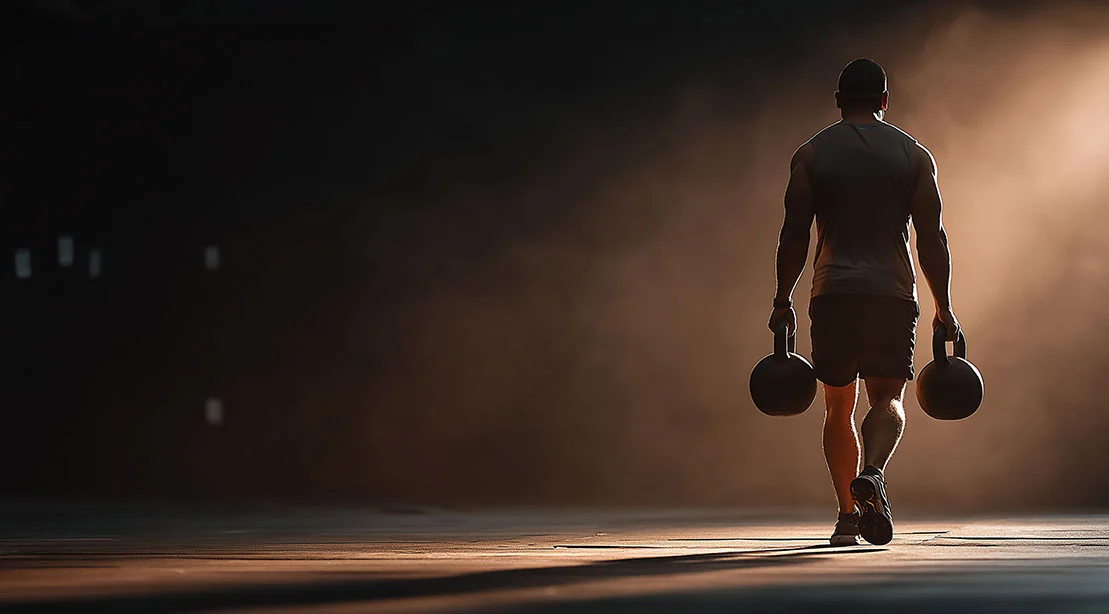
In the landscape of modern strength and conditioning, the "loaded carry" is often hailed as the king of functional training. It is simple, primal, and brutally effective. However, as athletes and fitness enthusiasts adapt to the standard suitcase carry—walking while holding a heavy dumbbell—the body inevitably learns to "game" the movement. Enter the Chaos Suitcase Carry, a sophisticated evolution of the traditional carry that introduces intentional instability to force the body into a state of constant, high-level adaptation.
By suspending a kettlebell or weight plate from a looped resistance band rather than holding a static handle, the lifter is forced to manage a load that refuses to stay still. This article explores the mechanics, physiological implications, and tactical programming of this "chaotic" approach to training.
Main Facts: The Mechanics of Chaos
At its core, the Chaos Suitcase Carry is a unilateral loaded carry that weaponizes kinetic energy. Unlike a static weight, which moves in perfect synchronization with the lifter’s gait, a band-suspended load creates an oscillating effect. As the athlete takes a step, the weight bounces, sways, and pulls in directions that are not perfectly aligned with gravity.
The Physics of Instability
When you walk with a standard kettlebell, the center of gravity is fixed. Your nervous system quickly calculates the necessary muscular output to maintain an upright torso. In the Chaos variation, the "load" is effectively dynamic. The resistance band acts as a spring, storing and releasing energy with every foot strike. This forces the central nervous system (CNS) to transition from a "pre-planned" movement pattern to a "reactive" one. Every stride requires an instantaneous, subconscious adjustment in the obliques, quadratus lumborum (QL), and hip stabilizers to counteract the erratic tug of the weight.
Chronology: The Evolution of Functional Carries
The history of the loaded carry traces back to the strongman tradition, where farmers’ walks and suitcase carries were used to build raw, resilient strength.
- The Traditional Era: For decades, the suitcase carry was performed with dumbbells or kettlebells. The primary focus was grip strength and the ability to prevent lateral spinal flexion (side-bending).
- The Stability Revolution (Early 2000s): Coaches began incorporating unstable surfaces—like BOSU balls or foam pads—to improve joint stability. However, these methods often compromised the ability to move heavy loads.
- The "Chaos" Innovation: Borrowing from the concept of "chaos training" (often attributed to coaches like Joe DeFranco or the late Charles Poliquin), the industry shifted toward using bands to suspend weights. This allowed for significant loading while creating internal instability, bridging the gap between heavy, grinding strength and reflexive stability.
Supporting Data: Why Instability Matters
Research into "instability training" consistently highlights a shift in muscle recruitment patterns. When the body is forced to balance an unstable load, electromyography (EMG) studies often show higher activation in the stabilizer muscles compared to stable, fixed-weight movements.
The Core Reflex
Your core—specifically the internal and external obliques—acts as the primary defense against the lateral pull of the weight. In a standard carry, your core works at a consistent level of tension. In a Chaos Carry, the core must engage in a "reflexive" manner. It is not just about bracing; it is about adapting. This constant, rapid-fire recruitment builds a more resilient midsection that is better prepared for the unexpected demands of sports and daily life.
Proprioception and Neuromuscular Control
Proprioception, the body’s ability to sense its position in space, is taxed significantly during this movement. As the weight swings, the brain must constantly recalculate the center of mass. This enhances the communication between the cerebellum and the peripheral musculature, leading to improved balance and coordination under duress.
Official Perspectives: The Coaching Consensus
Expert trainers and physical therapists argue that the Chaos Suitcase Carry serves as a "bridge" between the gym floor and real-world performance.
"The beauty of the Chaos Carry," notes elite strength consultant Marcus Thorne, "is that it prevents the athlete from becoming a ‘static’ lifter. You can be the strongest person in the gym, but if your stabilizers aren’t trained to handle dynamic shifts, you are susceptible to injury the moment you step outside that perfect environment."
Conversely, some traditionalists warn against using this movement for maximal strength. The consensus is clear: Do not treat this as a 1-rep max exercise. The goal is not to move the heaviest weight possible, but to move a challenging weight with perfect, unwavering technique despite the "chaos" introduced by the band.
Implications for Training and Programming
Integrating the Chaos Suitcase Carry into a regimen requires a shift in mindset. It is not a "filler" exercise, but a specialized tool for core integrity and grip endurance.
How to Perform the Movement
- Preparation: Select a moderate-weight kettlebell. Loop a heavy-duty resistance band through the handle.
- The Grip: Grasp the band itself. The further down the band you hold, the more the weight will sway.
- The Stance: Stand tall. Your head, ribs, and pelvis should be stacked in a neutral line. Avoid the common mistake of leaning away from the weight.
- The Walk: Execute slow, deliberate steps. As the weight begins to oscillate, keep your torso rigid. Your arm should remain long and relaxed at the shoulder, resisting the urge to shrug.
Programming Guidelines
- Volume: Perform 2 to 3 sets.
- Distance: Aim for 20 to 50 yards per side. Quality of movement must remain the priority; if your form breaks down, the set is over.
- Rest: Allow 60 seconds between sides to ensure the central nervous system is recovered enough to maintain technical proficiency.
Addressing Common Pitfalls
Even with the best intentions, the Chaos Carry is frequently performed incorrectly. Here are the most common errors observed in gym environments:
- Excessive Oscillation: If the weight is swinging like a wrecking ball, the intensity is likely too high, or the band is too long. Fix: Shorten your grip on the band to limit the amplitude of the sway.
- Shoulder Shrugging: As fatigue sets in, the trapezius often takes over. This can lead to neck strain. Fix: Focus on "long neck" cues—actively depress the scapula and keep the shoulder away from the ear.
- Speeding Through the Set: Moving too quickly amplifies the chaos beyond the point of effective training. Fix: Treat each step as an individual repetition. Pause for a split second between steps if the weight becomes too erratic.
Conclusion: The Final Carry
The Chaos Suitcase Carry represents the pinnacle of functional core training. By moving away from the "predictability" of traditional iron and embracing the unpredictability of band-suspended loads, athletes can unlock a new level of core engagement, grip strength, and neuromuscular stability.
While it requires patience and a ego-free approach to loading, the payoff is a body that is not just strong, but functionally resilient. Whether you are an athlete looking to improve your agility or someone simply seeking to bulletproof your lower back against the rigors of life, the Chaos Suitcase Carry provides a unique, high-yield solution. When the weight moves but your body remains a pillar of stability, you are building the kind of strength that truly carries over.