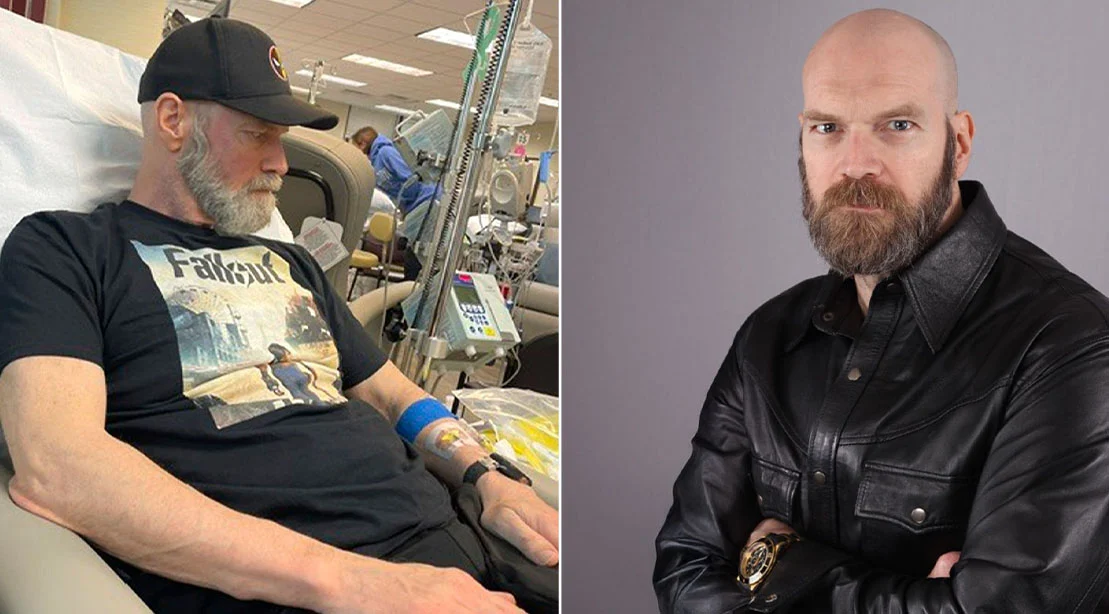
In the realm of cinematic giants, few command the screen with the sheer, imposing presence of Tyler Mane. Standing at 6’8”, the former professional wrestler turned Hollywood powerhouse has spent decades embodying the formidable "heel." Whether he was locking horns with legends like André the Giant in the squared circles of Japan, trading blows with icons like Sting and the British Bulldog in WCW, or terrorizing audiences as the relentless Michael Myers in the Halloween franchise, Mane has built a career on being the man you don’t want to meet in a dark alley.
However, in 2025, the man known for playing iconic supervillains—including the razor-clawed Sabretooth in X-Men and Deadpool & Wolverine—faced an antagonist far more lethal than any fictional adversary: male breast cancer. Today, Mane is no longer just a screen legend; he has become a vocal advocate for men’s health, using his platform to dismantle the stigma surrounding a diagnosis that many men believe only affects women.
The Unexpected Diagnosis: A Health Curveball
The narrative of Tyler Mane’s health journey is one of vigilance and the critical importance of listening to one’s body. While his professional life under his production banner, Mane Entertainment, was thriving—notably with the launch of the The Last Spartan graphic novels and his commitment to casting "vertically gifted" actors—his physical health was undergoing a silent, alarming shift.
As winter 2025 approached, Mane had dedicated himself to an intensive fitness regimen. He had eliminated alcohol and revamped his nutritional intake, successfully dropping a significant amount of body fat. It was this victory in body composition that inadvertently saved his life. As he shed layers of fat, he discovered a lump on the side of his chest.
"I was like, ‘Oh, that’s just… I probably tweaked something. It’s nothing,’" Mane recalls during an exclusive interview with Muscle & Fitness. It is a sentiment common among men—a mix of denial and the "tough it out" mentality. However, his wife, Renae, refused to let him dismiss it. Her persistence proved to be the turning point. Following his wife’s advice—and acutely aware of the fragility of life after recently losing his brother to a heart attack—Mane sought medical evaluation.
The results were life-altering. The lump was identified as invasive ductal carcinoma (IDC), a condition that accounts for approximately 80% of all breast cancer cases. For a man who had survived the physicality of professional wrestling and the rigors of stunt work, the diagnosis was a shock. "I was like, how can that be? How could this be happening to me?"
Chronology of a Fight
The timeline of Mane’s ordeal highlights the rapid progression of his specific diagnosis. Following the discovery, medical professionals determined that Mane was dealing with a fast-moving Oncotype, meaning time was of the essence.
- Discovery: During a fitness transformation, a lump was discovered on the chest.
- Medical Consultation: Despite initial suggestions that the lump might be a non-cancerous lipoma, Mane pushed for a biopsy.
- Diagnosis: Confirmed as Invasive Ductal Carcinoma (IDC).
- Treatment Phase: Mane underwent four intense rounds of chemotherapy. He notes that the physical toll was immediate; he lost his signature beard after just one session and experienced escalating side effects, including severe cramping, hives, and limited mobility in his arm.
- Current Status: Having completed his final round of chemotherapy, Mane is entering a four-week course of radiation therapy—a daily, ten-minute procedure designed to ensure no residual cancer cells remain.
Throughout this process, Mane has maintained a stoic, proactive attitude, viewing his recovery as the "next project." He admits that the treatment caused him to lose eight to ten pounds of lean muscle mass, but his focus has already shifted to his eventual return to the gym.
The Silent Crisis: Why Men Are At Risk
While breast cancer in men is rare, it is by no means nonexistent. Statistics from the American Cancer Society indicate that approximately 2,670 men will be diagnosed with the disease in the United States this year, resulting in an estimated 530 deaths. The mortality rate is disproportionately high, not necessarily because the disease is more aggressive in men, but because of late-stage diagnosis.
The disparity in health outcomes between men and women is largely rooted in behavioral tendencies. Research shows that men are up to 50% less likely to seek medical attention for persistent symptoms than women. This is driven by a complex intersection of social conditioning, the "suck it up" archetype of masculinity, and a prioritization of professional or familial duties over self-care.
Mane is acutely aware of this, noting, "Guys are like, ‘It’ll go away,’ ‘I gotta suck it up,’ ‘I’ve got to support the family.’ No, you’ve got to be your best and biggest advocate for yourself."
Advocacy and the Role of Medical Literacy
Mane’s mission is to transform the conversation around male health. He is adamant that men must stop relying on internet hearsay and start trusting the scientific process. During his own research, he encountered a deluge of misinformation that nearly led him astray. His response is to use his upcoming podcast, Main AF with Tyler & Renae (launching August 27, 2026), to provide a platform for medical experts to speak directly to the public.
"See your doctor, because that’s where the science is. That’s where the training is," he says. While he acknowledges the role of holistic wellness in recovery, he warns that it must be an adjunct to—not a replacement for—evidence-based oncology.
His advocacy has already had a real-world impact. During a recent convention, a fan approached him, sharing the tragic story of his father, who had ignored a similar lump until it reached stage 4. By sharing his own journey, Mane is dismantling the shame that prevents many men from discussing "female" cancers.
The Path Forward: Implications for the Future
The implications of Tyler Mane’s journey extend far beyond his own recovery. He is challenging the cultural narrative that equates vulnerability with weakness. By documenting his treatment—from the loss of his beard to the fatigue of radiation—he is humanizing a terrifying experience.
His message to men is simple but urgent:
- Be Vigilant: If you feel something, get it checked immediately.
- Challenge the Opinion: If a doctor dismisses a concern, do not be afraid to demand tests. "If the doctors say, ‘Oh, it’s probably nothing,’ say: ‘No, I want the tests,’" Mane advises.
- Acknowledge the Odds: With a 40% chance of anyone developing some form of cancer in their lifetime, the "it won’t happen to me" mindset is statistically dangerous.
As Mane prepares for his "comeback," he retains his signature humor. Referring to his post-treatment hair growth as "the road back to beard," he remains a figure of resilience. His story serves as a reminder that even the most formidable individuals are susceptible to the vagaries of biology. However, in the face of such adversity, Mane has found a new purpose: ensuring that other men don’t have to fight their battles alone, or, more importantly, too late.
Through his podcast, his public advocacy, and his commitment to transparency, Tyler Mane is proving that the greatest sign of strength isn’t invulnerability—it’s the courage to prioritize one’s health. As he continues his treatment and looks toward his future projects, one thing is certain: he is no longer just playing a superhero on screen. He has become a real-life advocate for a demographic that desperately needs to hear his message.