
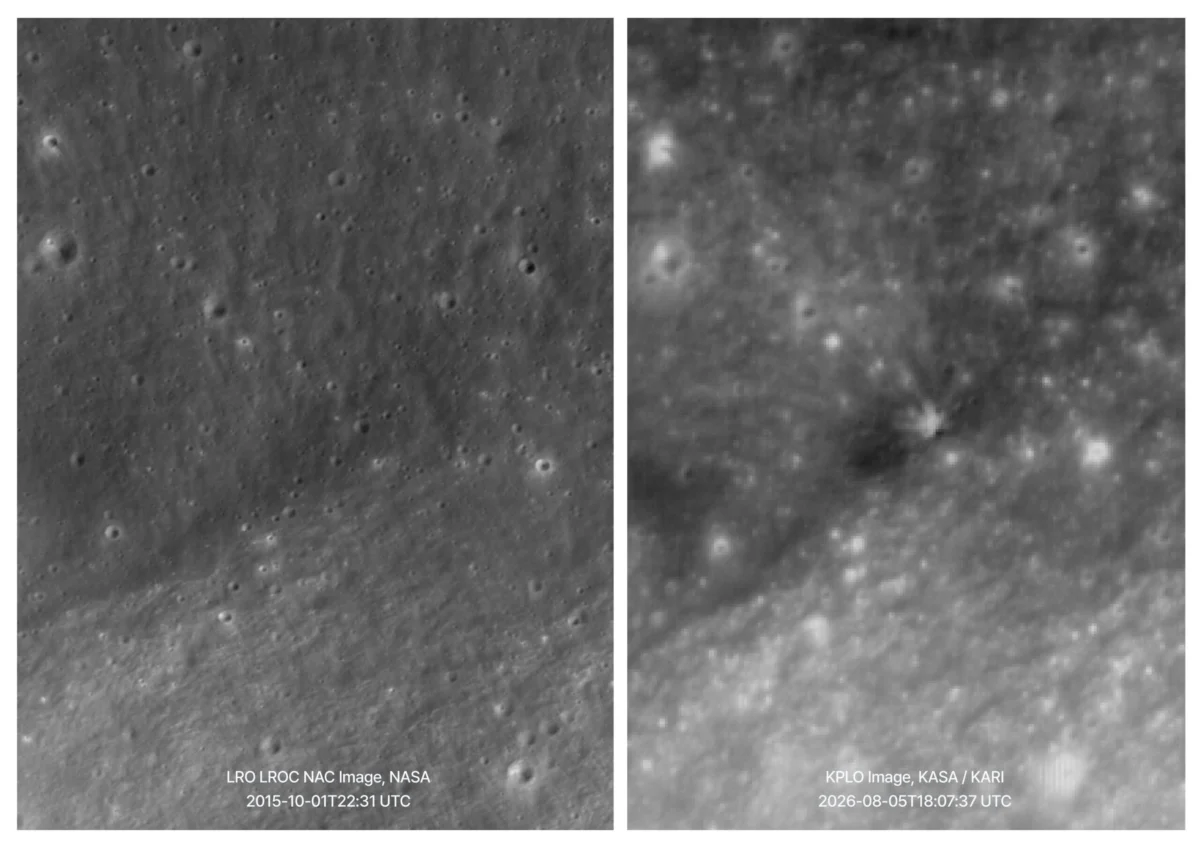
The silent, desolate surface of the moon—a landscape that has remained largely unchanged for billions of years—now bears a new, human-made scar. The Korea Aerospace Research Institute (KARI) has released the first definitive photographic evidence of a SpaceX Falcon 9 rocket stage colliding with the lunar surface. The images, captured by South Korea’s Danuri lunar orbiter, confirm the culmination of a year-long orbital drift that turned a piece of aerospace hardware into an unexpected lunar projectile.
This event marks a rare, documented instance of a man-made object impacting our celestial neighbor, providing scientists with a unique opportunity to study the kinetic effects of such collisions on the moon’s regolith.
A Visual Confirmation: The Danuri Orbiter’s Findings
Operating from an altitude of approximately 62 miles (100 kilometers) above the lunar surface, the Danuri orbiter is part of an elite class of satellites currently monitoring the moon. By capturing high-resolution imagery of the designated impact site both before and after the event, KARI has provided the most compelling evidence to date of the Falcon 9’s final resting place.
The photographs reveal a distinct, dark crater, estimated to be dozens of feet wide and nearly 12 feet (3.6 meters) deep. The scale of the impact is sobering; while the moon itself spans 2,160 miles in diameter, the crater created by the rocket stage is larger than several cars combined. These visual records are bolstered by independent findings from the Very Large Telescope (VLT), which detected the telltale chemical signatures of sodium and lithium—elements consistent with the combustion and material composition of a modern rocket stage—rising from the impact zone immediately following the collision.
Chronology of a Celestial Collision
The journey of this Falcon 9 second-stage fragment began in January 2025. Following a successful mission to deliver lunar landers into deep space, the stage was left in an unstable, highly elliptical orbit.
The Long Drift
For over a year, the fragment became a victim of the complex gravitational dance between Earth, the moon, and the sun. Unlike missions in low-Earth orbit, which are routinely deorbited into the Pacific Ocean, this stage occupied a "lunar transfer orbit." Because of the high-energy requirements of such missions, the vehicle’s fuel was entirely consumed to place its primary payload on its intended trajectory, leaving no reserve for a controlled deorbiting maneuver.

The Unpredictable Path
As the months progressed, the object’s trajectory was gradually altered by "n-body" gravitational perturbations—a chaotic interplay of forces where the sun’s radiation pressure and the uneven gravity fields of the Earth-Moon system tugged at the abandoned hardware. Astronomers tracked the object’s erratic path, eventually calculating a precise window for its impact. Despite advanced modeling, space agencies including NASA warned that visual confirmation would be difficult, citing the complexities of lunar lighting, weather conditions, and the precise timing of the intersection between the orbiter’s path and the impact site.
The Science of Space Debris and Impact Dynamics
The crater left behind is more than just a piece of space junk; it is a laboratory. By analyzing the depth, width, and debris pattern (ejecta) of the crater, planetary scientists can gain insights into the mechanical properties of the lunar regolith.
Understanding Kinetic Energy
When a multi-ton piece of metal strikes the moon at thousands of miles per hour, it creates a high-velocity impact that mimics natural meteoroid collisions. Because we know the exact mass and velocity of the Falcon 9 stage, the resulting crater provides a "ground truth" calibration for lunar cratering models. This helps researchers understand how smaller, natural objects impact the moon, which is essential for planning future lunar infrastructure.
Chemical Signatures
The VLT’s detection of sodium and lithium provides critical data on the vaporized material of the rocket. These observations help experts understand the environmental impact of human missions on the moon’s extremely thin, fragile atmosphere—the lunar exosphere. As international interest in lunar mining and habitation grows, understanding the chemical footprint of our hardware is becoming a matter of scientific necessity.
Official Responses and the Future of Space Safety
The incident has reignited global conversations regarding the "responsible disposal" of space hardware. As private and national missions to the moon increase, the "Wild West" era of leaving stages in deep-space orbits is facing mounting scrutiny.
SpaceX’s Stance
In a formal statement addressing the crash, SpaceX acknowledged the limitations of current orbital mechanics. "For most of our missions, we plan for a controlled deorbiting of the Falcon second stage so that it re-enters safely over the ocean," the company explained. "In higher-energy missions, such as those heading to a lunar transfer orbit, nearly all of the vehicle’s performance is dedicated to successfully placing the payload into the intended orbit, and a controlled deorbiting maneuver is not always possible."

The company emphasized its commitment to long-term space safety, noting, "We are actively working to be as responsible as possible with the hardware left in space. We are collaborating with NASA to find the optimal disposal solution for future missions."
NASA and International Oversight
NASA, which maintains several orbiters around the moon, continues to analyze data to determine if higher-resolution imaging is possible. The agency has been in close communication with KARI, as the global community moves toward more robust tracking of deep-space debris. The consensus among space agencies is clear: while the current impact was an unavoidable byproduct of a high-energy mission, future architectures must incorporate "disposal orbits" or collision-avoidance maneuvers as a standard requirement, rather than an optional luxury.
Implications for Future Lunar Exploration
The scar on the moon serves as a reminder of the fragility of the lunar environment. As plans for the Artemis program and various private lunar bases gain momentum, the issue of "lunar pollution" is moving from the realm of theory into practical policy.
The Need for Clean Space
If human presence on the moon is to be sustainable, we must move away from the practice of abandoning hardware in unstable orbits. The KARI/Danuri mission, while primarily a scientific endeavor, has inadvertently provided a wake-up call. We now have concrete evidence that what goes up—even into the deepest reaches of the Earth-Moon system—must eventually come down.
Looking Ahead
The scientific community is currently awaiting more data, including potential thermal scans of the crater site to determine if subsurface ice or other materials were exposed during the impact. As we enter a new era of lunar exploration, this specific event will likely be cited in textbooks and policy manuals alike as the moment when the international community recognized that the moon is not just a destination, but a delicate ecosystem that requires careful stewardship.
While the Falcon 9 fragment is now a permanent part of the lunar landscape, the lessons learned from its final, violent descent are invaluable. We are no longer just looking at the moon; we are actively shaping its topography, and with that power comes a renewed responsibility to ensure that the footprints we leave—both human and mechanical—are managed with the utmost scientific and ethical rigor.