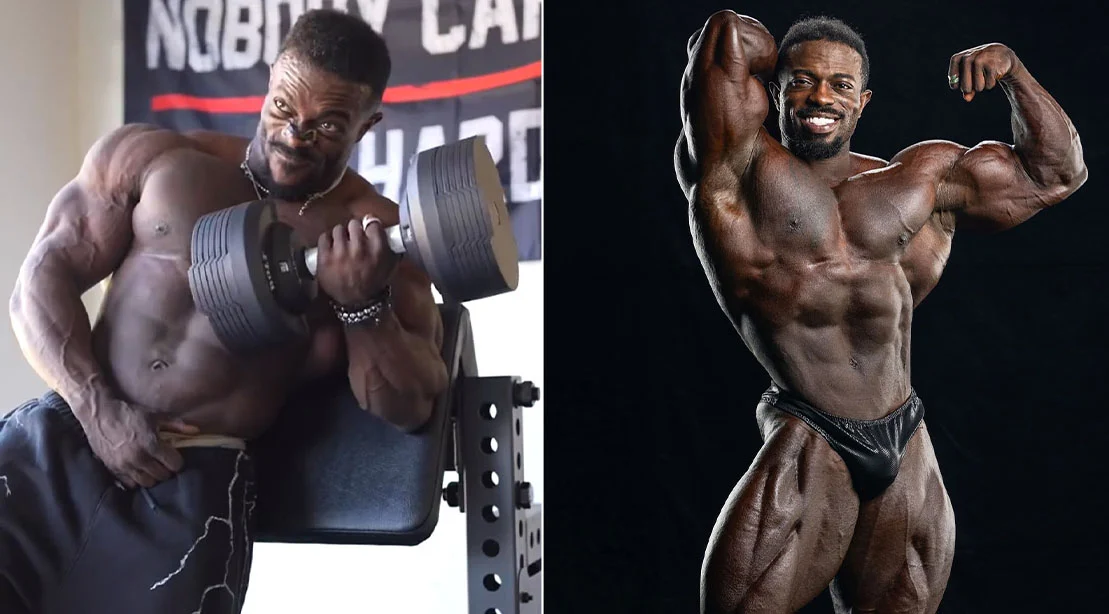
In the hyper-competitive world of IFBB Classic Physique, the difference between a podium finish and the middle of the pack often comes down to millimeters of muscle tissue. Terrence "Ruff Diesel" Ruffin, a two-time Arnold Classic champion and a perennial force in the bodybuilding world, recently solidified his status by winning the 2025 EVLS Prague Pro. This victory served a dual purpose: it asserted his dominance on the international stage and secured his coveted qualification for the 2026 Olympia final.
Yet, for a man whose silhouette is defined by artistic flow and aesthetic perfection, Ruffin remains startlingly candid about his struggles. Despite his success, he admits that his arms—specifically his biceps—were once a glaring weak point in his physique. For years, the former Air Force Senior Airman struggled to elicit the growth required to compete at the highest level of the sport. Recently, however, Ruffin unveiled the strategic, science-backed methodology that has transformed his arms into assets that make his competition nervous.
The Evolution of a Champion: A Chronology of Growth
To understand the magnitude of Ruffin’s recent success, one must look at the arc of his career. Ruffin burst onto the scene in 2014, earning his IFBB Pro Card at the remarkably young age of 21. Even then, his proportions were undeniable, but the world of professional bodybuilding is an unforgiving arena where "good enough" is rarely sufficient.
The Early Years: Military Discipline Meets Bodybuilding
Before his rise to international stardom, Ruffin served as a Senior Airman in the United States Air Force. This period of his life was formative; the military instilled in him a level of discipline and systematic thinking that would eventually become his trademark in the weight room. While most athletes rely on "bro-science," Ruffin treats his training like a military operation: calculated, disciplined, and optimized for results.
The Turning Point: Addressing the Weak Link
For much of his early pro career, Ruffin’s arms lagged behind the rest of his physique. "Arms have taken the longest time to grow for me," Ruffin admitted in a recent social media breakdown. While his back and shoulders were often cited as the gold standard for the Classic Physique division, his biceps failed to match that density and peak. Recognizing this, Ruffin shifted his focus. Instead of adding more volume, he began refining his execution, moving toward a bi-weekly frequency that emphasized high-intensity, low-volume stimulation.
The Science of the Sleeve: Ruffin’s Training Philosophy
Ruffin’s approach is defined by a commitment to unilateral movement—training one limb at a time. This is not merely a preference; it is a tactical necessity for achieving symmetry. By isolating each arm, Ruffin ensures that he can identify and rectify imbalances in strength and mobility, ensuring that neither the left nor the right side can compensate for the other.
The Role of Time Under Tension (TUT)
A central pillar of Ruffin’s training is the concept of Time Under Tension. In an era where many bodybuilders prioritize heavy, ego-driven lifts, Ruffin opts for slow, controlled eccentric movements. By extending the duration of each repetition, he maximizes the mechanical tension placed on the muscle fibers, triggering a greater hypertrophic response. He avoids the "bounce" or momentum that often characterizes amateur arm training, choosing instead to force the muscle to do all the work throughout the entire range of motion.
Decoding the Top 3 Exercises for Mass
Ruffin’s arm-building routine is deceptively simple. He focuses on just two to three movements per session, twice a week, targeting the biceps brachii and the brachialis. Here is the breakdown of the movements he credits for his current gains.
1. Single-Arm Preacher Curls
The preacher curl is a staple of bodybuilding, but Ruffin utilizes it with a specific focus on stability. By leaning against the preacher bench, he eliminates the possibility of using the hips or shoulders to generate momentum. This isolation is critical for hitting the biceps brachii—the long and short heads of the muscle responsible for the "peak." Because the movement is performed unilaterally, he can ensure a full stretch at the bottom and a peak contraction at the top, forcing the muscle to fire without assistance.
2. Single-Arm Heavy Curls
For Ruffin, the heavy, single-arm curl is where he builds raw density. By moving significant weight in a controlled fashion, he recruits the biceps brachii while simultaneously engaging the brachialis—the muscle that lies beneath the bicep. As the brachialis grows, it effectively "pushes" the bicep up, contributing to the overall size and depth of the arm.
3. Single-Arm Cable Hammer Curls
The hammer curl is the secret weapon for anyone looking to add thickness to their arms. By keeping the palms facing the torso (a neutral grip), Ruffin shifts the emphasis away from the bicep and toward the brachialis and the brachioradialis in the forearm. This creates a wider, more mature-looking arm profile. The use of cables, as opposed to dumbbells, provides constant tension throughout the entire range of motion, ensuring that the muscle never gets a chance to "rest" at the top or bottom of the movement.
The "Double Progression" Method: An Official Breakdown
Perhaps the most technical aspect of Ruffin’s training is his reliance on the "Double Progression" method, a concept popularized by renowned coach Paul Carter. This methodology removes the guesswork from hypertrophy training.
Step 1: Establishing the Baseline
In the first phase, Ruffin focuses on identifying the weight where he can perform roughly 8 repetitions with perfect form. This serves as the benchmark for that specific exercise.
Step 2: Ramping the Intensity
Once he masters the movement at the initial repetition range, he begins to tighten the rep window. He aims to bring the reps down to 4 to 8, significantly increasing the weight. This is the essence of progressive overload: forcing the body to adapt to increasing levels of stress. By cycling between the volume phase (8 reps) and the intensity phase (4–8 reps), he keeps his muscles in a constant state of adaptation, preventing the dreaded "plateau."
Implications for the Industry
Terrence Ruffin’s journey serves as a blueprint for athletes at every level. His success at the 2025 EVLS Prague Pro proves that even at the highest levels of professional bodybuilding, one must be willing to strip away ego and revisit the fundamentals of movement.
Symmetry and the Future of Classic Physique
As the Classic Physique division continues to grow in popularity, the standard for excellence is shifting. Judges are increasingly rewarding athletes who display not just size, but artistic balance and structural perfection. Ruffin’s emphasis on unilateral work is a direct response to this trend. In a sport where the "perfect" body is the goal, Ruffin is teaching the next generation that asymmetry is the enemy of the title.
The "Ruff Diesel" Legacy
For those following Ruffin’s nearly 100,000-strong Instagram community, his transparency is refreshing. In an industry often shrouded in secrecy, Ruffin shares his failures as openly as his successes. He has demonstrated that growth—whether in the gym or in one’s professional life—requires a willingness to accept that you are not perfect, and the humility to go back to the basics to fix what is broken.
Conclusion: The Road to the 2026 Olympia
As Terrence Ruffin prepares for the 2026 Olympia, the bodybuilding world watches with anticipation. He has proven that he can refine his weaknesses, optimize his training through science-based methodologies, and execute with the precision of a veteran soldier.
His advice remains simple: focus on the muscle, not the weight. Master the movement, prioritize your recovery, and never stop looking for the weak link in your own chain. If the man they call "Ruff Diesel" can turn his most significant insecurity into his most formidable weapon, there is no limit to what the rest of us can achieve with the same level of discipline and focus.
For those looking to follow the progress of this elite athlete as he marches toward the Olympia stage, Ruffin continues to document his journey on Instagram, providing a masterclass in the intersection of hard work, science, and the relentless pursuit of perfection.