In the lexicon of modern fitness, there is one universal litmus test for physical prowess. Walk into any gym, from a boutique fitness studio in Manhattan to a gritty basement powerlifting den in rural Ohio, and the conversation eventually gravitates toward the same inquiry: "How much can you bench?"
For decades, the bench press has been the undisputed king of upper-body exercises—the primary metric by which "strength" is quantified. It is a compound movement of unparalleled efficiency, targeting the pectorals, deltoids, and triceps in a single, kinetic chain. However, beneath the veneer of its popularity lies a cautionary tale. The bench press is also arguably the most common cause of shoulder pathology among recreational lifters. The disparity between its effectiveness and its potential for injury isn’t inherent to the lift itself, but rather to the way it is performed.
To master the bench press is to understand a delicate balance: the pursuit of maximal force production versus the necessity of long-term joint integrity.
The Foundation: Ego, Anatomy, and the "Three-Decade Rule"
The first rule of the bench press is a commandment often ignored: Leave your ego at the door. For the beginner, the bench press is not a theater for public performance; it is a technical skill. Unfortunately, the desire to impress peers frequently leads to a total collapse of biomechanical integrity.
When a lifter prioritizes weight over form, the shoulder joint—a highly mobile but notoriously unstable ball-and-socket joint—is subjected to forces it cannot stabilize. Over time, this leads to chronic inflammation, impingement, and labral tears. The goal of any training program should be "the three-decade rule": the ability to train pain-free for twenty or thirty years. The strongest lifter in the gym is not the individual who manages a shaky, ego-driven personal record today; it is the athlete who can still bench press with fluid mechanics two decades from now.
Chronology of a Rep: The Mechanics of Safety
If you are a novice, the learning curve can be steep. Many strength coaches now advocate for a "phased approach" to the movement.
Phase 1: The Stability Training Wheels
There is a prevailing stigma against the Smith machine among purists, yet for the uninitiated, it serves as an invaluable pedagogical tool. Before introducing the instability of a free-floating Olympic bar, a beginner must learn the proper bar path and the engagement of the scapula. The Smith machine allows for a controlled environment where the lifter can focus on mind-muscle connection without the anxiety of losing balance or being trapped under a heavy load.
Phase 2: The Setup
Once the movement pattern is ingrained, the transition to the free-weight bench must be handled with surgical precision.
- The Foundation: Your feet should be planted firmly on the floor, providing a stable base. This is not a "feet-up" exercise; the legs drive force upward through the kinetic chain.
- Scapular Retraction: Your shoulder blades must be pinched together and pulled down into the bench. Think of tucking your shoulder blades into your back pockets. This creates a stable shelf for the bar and protects the rotator cuff.
- The Grip: Your grip should be slightly wider than shoulder-width. A common error is the "suicide grip" (thumb-less), which is an unnecessary risk. Always wrap your thumbs around the bar.
Phase 3: The Execution
Lower the bar with intent. Control is the currency of hypertrophy; momentum is its thief. Lower the bar to the mid-sternum, maintaining tension throughout the descent. When the bar touches the chest, it should be a controlled tap, not a violent rebound off the rib cage. Muscle fiber recruitment is a product of tension, not the speed at which you bounce weight off your sternum.
Supporting Data: Why "Control" Trumps "Chasing"
The scientific consensus on muscle hypertrophy is clear: mechanical tension is the primary driver of growth. When you allow the bar to plummet and rely on a bounce to return it to the starting position, you are bypassing the eccentric phase—the portion of the lift where the most significant muscle fiber damage (and subsequent repair) occurs.
Furthermore, the "chasing" of weight—constantly adding plates before the connective tissue is ready—is a fast track to injury. Tendons and ligaments adapt to stress at a significantly slower rate than muscle tissue. If you increase the load too rapidly, you create a structural mismatch where your muscles are strong enough to move the weight, but your joints are not robust enough to support it.
The Vital Role of the Spotter
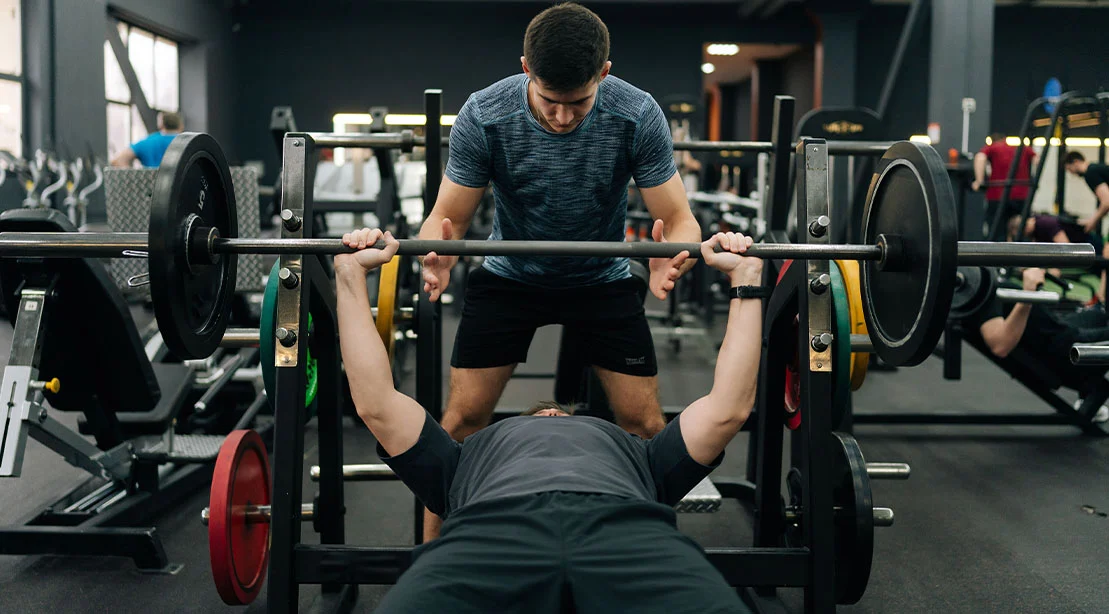
A proper spotter is not a passive observer, nor are they there to perform an upright row while you struggle. Effective spotting is a communication-based partnership. Before a single plate is loaded, the lifter and spotter should establish a protocol:
- The Lift-Off: Does the lifter need help un-racking the bar?
- The Failure Threshold: If the bar speed slows to a crawl, does the lifter want a forced rep or an immediate rack?
- The Communication: Both parties must agree on the target rep range to ensure the spotter knows when to be hyper-vigilant.
If you are training solo, the rules change. You must not attempt personal records without a power rack equipped with safety pins. If a rack is unavailable, keep the weight at a "conservative maximum"—a weight you are 100% certain you can complete with perfect form for the desired repetition count.
Implications: The Long-Term Training Perspective
The most significant mistake in modern training culture is the "program-hopping" induced by social media. Beginners often abandon the bench press after a few weeks because they haven’t seen a dramatic transformation, or because a viral video suggested a "better" exercise.
The body responds to progressive overload, not constant entertainment. The bench press requires patience. It requires the repetition of a specific movement pattern thousands of times to reach true proficiency. Consistent, incremental progress—adding 2.5 pounds, or performing one additional repetition with perfect form—will always yield greater results than a year of chaotic, flashy workouts.
The Role of Accessory Work
Finally, one cannot build a massive, healthy chest in a vacuum. The bench press is only as strong as the muscles that support it:
- Upper Back: A thick, powerful upper back provides a stable base for the bench.
- Rotator Cuff: Dedicated work for the external rotators of the shoulder is non-negotiable for anyone who presses regularly.
- Flexibility: A rigid thoracic spine and tight pectoral muscles will force the shoulder joint into compromised positions.
Conclusion: Mastering the Movement
The bench press is a rite of passage. It has earned its place in the pantheon of fitness because it is an incredibly effective tool for building power and aesthetic appeal. However, it is a tool that demands respect.
If you view the bench press as a way to prove your worth, you will eventually find yourself sidelined by injury. If, however, you view it as a discipline—a lifelong practice of refinement, control, and incremental progress—it will serve as the cornerstone of your physique for decades.
Do not be the lifter who sacrifices their future for a heavy Monday afternoon set. Master the movement, respect the anatomy, and prioritize the longevity of your joints. When you finally stop chasing the weight and start chasing the technique, the weight will eventually follow.