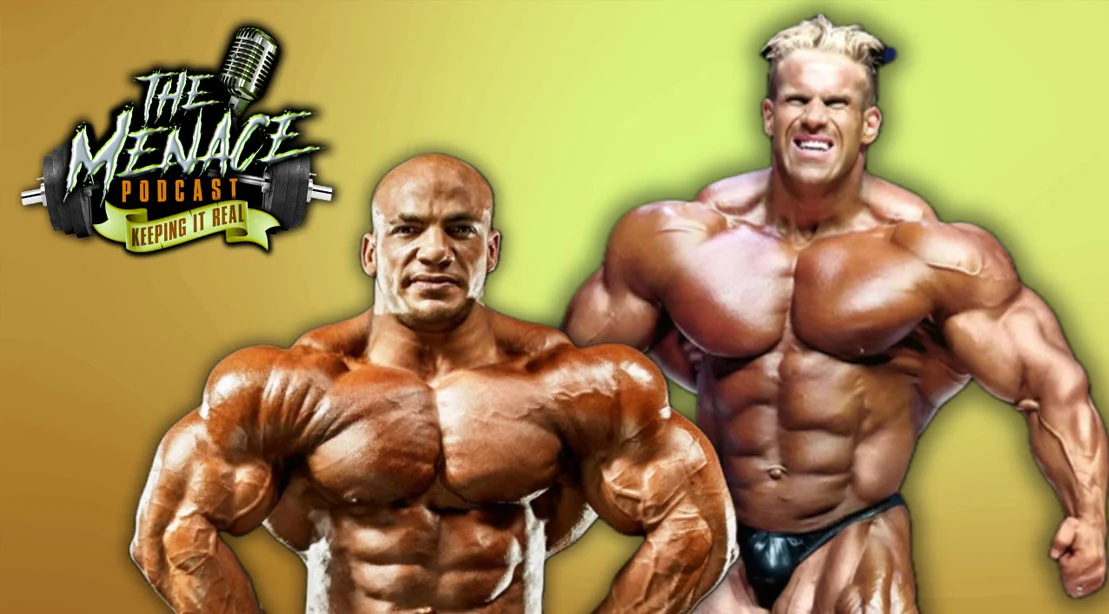
In the hyper-competitive world of professional bodybuilding, the debate over who constitutes the "greatest of all time" often shifts from objective metrics to subjective aesthetics. However, rarely does a discussion spark as much intensity as the comparison between two of the sport’s most gargantuan figures: the four-time Mr. Olympia Jay Cutler and the two-time champion Mamdouh "Big Ramy" Elssbiay.
On the recent 295th episode of The Menace Podcast, host and bodybuilding legend Dennis James, joined by industry staples Milos Sarcev and Jose Raymond, revisited this classic clash of generations. By pitting the "Quad Stomper" against the Egyptian phenomenon, the panel peeled back the layers of what makes a champion, questioning whether mass, symmetry, or stage presence ultimately defines the pinnacle of the sport.
The Evolution of a Behemoth: Big Ramy’s Rise
To understand the gravity of the debate, one must look at the meteoric rise of Mamdouh "Big Ramy" Elssbiay. Hailing from Egypt, Elssbiay did not merely enter the sport; he redefined the boundaries of human hypertrophy. His professional trajectory was nothing short of cinematic. After dominating the 2012 IFBB Amateur Mr. Olympia, he transitioned to the professional ranks with a velocity that caught the industry off guard.
By 2013, Ramy was already standing on the Olympia stage, signaling a new era of "super-heavyweight" bodybuilding. His journey was one of constant refinement, culminating in back-to-back Mr. Olympia titles in 2020 and 2021. For many, Ramy represented the ultimate evolution of the sport—a bodybuilder who could carry extreme mass while maintaining a degree of structural width that bordered on the superhuman.
The Standard of Excellence: The Jay Cutler Era
Jay Cutler’s career, by contrast, serves as the modern blueprint for the disciplined professional. A four-time Mr. Olympia (2006, 2007, 2008, 2010), Cutler is remembered not just for his massive quads and his signature "vacuum-less" wide waist, but for his tactical approach to the sport.
Cutler was a master of the "total package," often prioritizing conditioning and stage presence over pure, raw volume—though he was never lacking in the latter. His ability to dethrone the legendary Ronnie Coleman remains one of the most significant moments in bodybuilding history. By the time he faced a young, hungry Big Ramy in 2013, Cutler was in the twilight of his career. Despite being past his prime, Cutler managed to secure sixth place, while a rising Ramy finished eighth. Yet, as the Menace Podcast panel argued, final rankings on a scorecard do not always tell the full story of what occurred under the stage lights.
The 2013 Flashpoint: Re-evaluating the Scorecards
The core of the recent podcast discussion centered on the 2013 Olympia, a contest that serves as the primary point of contention between the two athletes. Jose Raymond was particularly vocal, suggesting that Cutler’s sixth-place finish over Ramy was a matter of reputation rather than performance.
"He was gifted that spot," Raymond remarked, asserting that at that specific point in time, the Egyptian powerhouse was objectively superior in terms of both conditioning and sheer physical development. Dennis James, providing his own expert analysis, concurred. The consensus among the panel was that in the specific poses where width and density were the deciding factors, Ramy had effectively made the veteran Cutler look "bad."
This segment of the discussion highlights a recurring theme in bodybuilding: the "political" nature of judging. Is a reigning legend protected by his status, or does the sport truly reward the best physique on that specific day? For the Menace crew, the 2013 Olympia was a clear example of the "old guard" holding onto its throne against an encroaching, more imposing future.
Analyzing Physicality: Symmetry, Conditioning, and Mass
When comparing the two, the debate often fractures into two distinct schools of thought: the "aesthetic" camp and the "mass monster" camp.
The Case for Big Ramy
Dennis James did not mince words when describing the physical presence of Big Ramy. "Those two were the widest bodybuilders I’ve ever seen," James noted. "But the most impressive one, was Ramy, in my eyes. Just because the width, then the waist, and then the f***ing flare in the quads."
James went as far as to describe Ramy as looking like a "cartoon character"—a testament to the fact that his proportions were so extreme they challenged the viewer’s perception of reality. Ramy’s physique relies on a combination of extreme skeletal width and an unprecedented ability to pack muscle onto a large frame. When he was "on"—hitting his conditioning targets—he was arguably the most imposing figure to ever stand on the Olympia stage.
The Case for Jay Cutler
Conversely, Jay Cutler’s legacy is built on structural consistency. While he may not have possessed the sheer, freakish width of Ramy, his muscle maturity and "grainy" conditioning in his prime were unmatched. Cutler understood the science of the sport; he knew how to manipulate his diet and training to ensure his physique was at its absolute peak on the day of the show. His success was not just about the size of his legs—the infamous "Quad Stomper" look—but his ability to present a complete, balanced, and daunting physique that was difficult to find flaws in.
Official Perspectives and the Industry Pulse
The dialogue on The Menace Podcast serves as a mirror for the broader bodybuilding community. Industry experts like Milos Sarcev and Dennis James offer a level of technical insight that casual observers often miss. They analyze the "insertion points," the "depth of muscle," and the "flow" of the physique.
The implication of this debate is significant: it forces fans and judges alike to define what they want to see in a Mr. Olympia. If the criteria favor mass above all else, Ramy stands as the victor. If the criteria favor the "total package" and the ability to maintain a world-class physique over a decade, Cutler’s record remains untouchable.
The Legacy of the "Monster" Era
The discussion also touches upon the evolution of the "Monster" era in bodybuilding. Since the early 1990s, the sport has seen a consistent push toward greater and greater size. This trend, while polarizing, has produced some of the most memorable physiques in history. Both Cutler and Ramy are primary examples of this trajectory.
However, the debate between them is also a debate about the sustainability of such mass. Can a bodybuilder maintain that level of intensity and conditioning indefinitely? Cutler retired on his own terms, leaving a legacy of sustained excellence. Ramy, meanwhile, experienced the volatility of the sport, riding the highest highs and navigating the challenges of maintaining his gargantuan frame as his career progressed.
Final Reflections: Is There a Definitive Winner?
Ultimately, the question of "Who is best?" may remain unanswered, as the two men competed in different contexts and represented different phases of bodybuilding’s evolution.
Jay Cutler remains a symbol of the "Golden Era" transition into the "Mass Monster" era—a bridge between the aesthetic focus of the 90s and the sheer volume of the 2010s. Big Ramy represents the absolute extreme of that volume-focused era, pushing the human frame to its theoretical limits.
As the industry moves forward, the insights provided by legends like Dennis James and Jose Raymond serve as a reminder that bodybuilding is as much an art form as it is a sport. Whether one prefers the balanced, calculated greatness of a four-time champion or the mind-bending, cartoonish proportions of a modern giant, the debate itself keeps the sport alive.
For those who wish to delve deeper into the analysis, the full episode of The Menace Podcast on the Muscle & Fitness YouTube channel provides a comprehensive breakdown of these points, alongside the latest developments in the professional circuit. The conversation continues, and as long as these titans are remembered, the debate over who truly stood the tallest on the Olympia stage will endure.