By Mika Rantanen
The year 2026 has been marked by a meteorological anomaly that has not gone unnoticed by climate observers and the public alike: an extraordinary lack of storm activity. While the Finnish landscape is often associated with the howling winds of autumn and the intense low-pressure systems of mid-winter, the period between January and September 2026 has been characterized by a profound, almost eerie stillness.
Data compiled from maritime weather stations reveals that there have been only five days of storm-force winds (defined as sustained wind speeds of at least 21 m/s) in Finnish sea areas during the first nine months of the year. This figure stands in stark contrast to the long-term trends and serves as a reminder of how much the "prevailing" weather can deviate from the historical norm.
The Statistical Anomaly: A Historical Context
To understand the rarity of this year’s calm, one must look at the historical data set, which has been rigorously maintained since 2006. Over the past two decades, the median number of storm days recorded between January and September has been 18. By that metric, 2026 is significantly below the baseline.
In fact, only one year in the last two decades has been quieter: 2006, which saw a mere four storm days during the same nine-month window. The current count of five stands as the second-lowest in the 21-year tracking period. This data point is not merely a curiosity; it highlights a significant departure from the expected seasonal volatility that Finns have grown accustomed to.
The primary culprit for this relative serenity was the early part of the year. January and February 2026 were defined by high-pressure systems that dominated Northern Europe, resulting in unseasonably cold, dry, and stagnant air. During these two months, when the region typically expects a series of vigorous Atlantic depressions, only one day of storm-force winds was recorded. The long-term average for those two months combined is eight days—eight times the activity seen this year.
The Mechanics of Stillness: Why the Storms Stayed Away
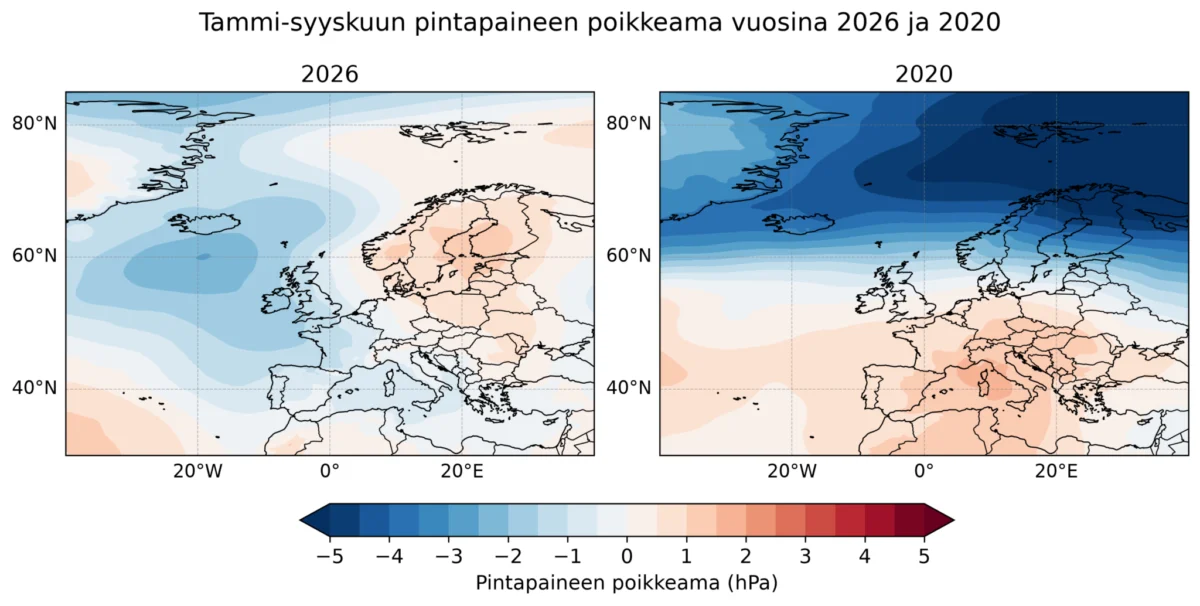
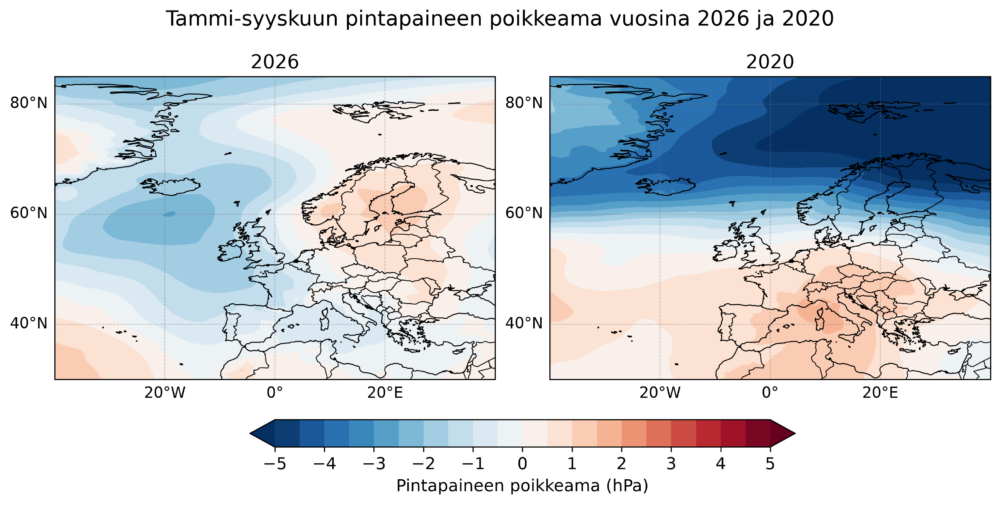
The question naturally arises: what forces dictated this atmospheric tranquility? By comparing the atmospheric pressure anomalies of 2026 with those of 2020—the latter being the stormiest year on record with 35 storm days—we can begin to map the underlying mechanics of the shift.
In 2026, air pressure over the Nordic countries remained higher than average. This creates a "blocking" effect, preventing the deep, moisture-laden low-pressure systems that usually track across the Atlantic from penetrating into Finnish territory. Conversely, in 2020, the pressure was significantly lower than average over Finland and the regions to its north. This created a strong north-to-south air pressure gradient, which acted as a superhighway for wind, intensifying westerly to easterly airflows and creating the perfect conditions for frequent, violent storms.
However, meteorologists urge caution in attributing these differences solely to broad "large-scale" weather states. There is a classic "chicken-or-the-egg" paradox at play here. While a specific pressure configuration may facilitate the development of a storm, the storms themselves possess the kinetic energy to alter local air pressure. Therefore, one cannot definitively state that the lack of storms in 2026 was solely a result of the pressure system; rather, it is a complex, feedback-driven relationship where the atmosphere acts as a holistic, self-regulating system.
The Myth of Predictive Continuity
A common assumption among the public is that a quiet start to the year suggests a quiet finish. However, historical data suggests that the number of storm days in the first nine months of the year holds virtually no predictive power for the final quarter. The correlation between the two periods is essentially non-existent (R = -0.07).
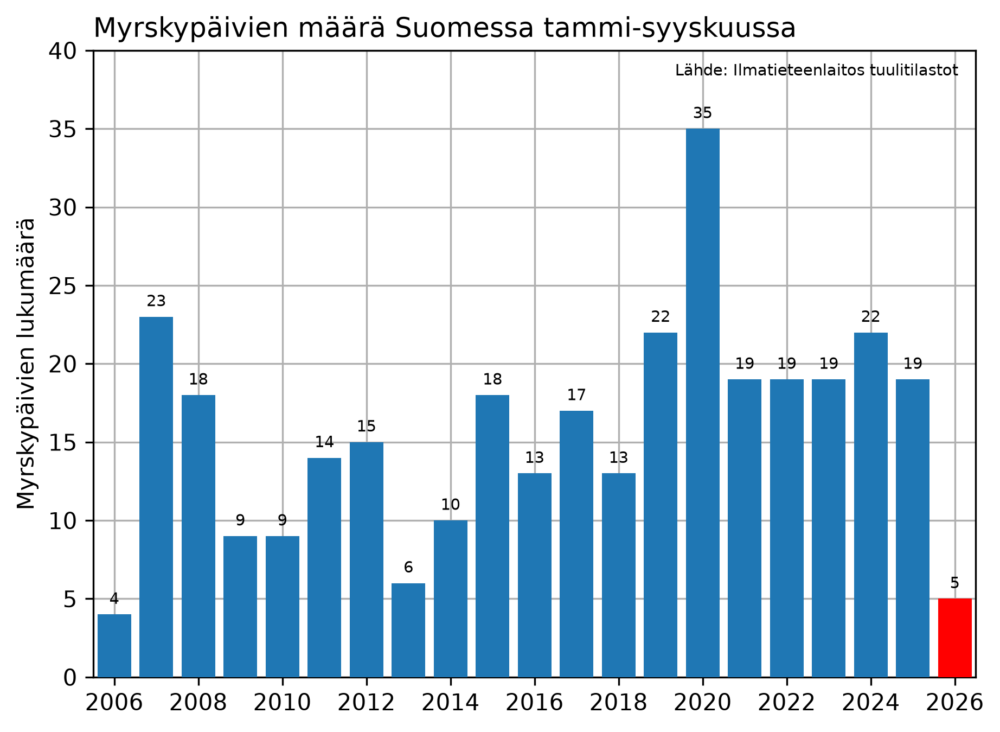
We have seen this lack of correlation manifest in several previous years. For instance, in 2006 and 2013, the early parts of the year were remarkably calm, yet the final three months (October–December) were volatile, recording 13 and 18 storm days respectively. Conversely, 2020 began with a flurry of activity only to end with a relatively peaceful final quarter, recording only nine storm days.
This is critical because the storm season is heavily front-loaded toward the end of the year. Historically, approximately half of all annual storms occur between September and December, despite that window comprising only 25% of the calendar year. Therefore, it is entirely possible for the total number of storm days in 2026 to spike significantly before the year ends, provided the prevailing wind patterns shift.
Long-Term Trends: Is the Climate Changing Our Storms?
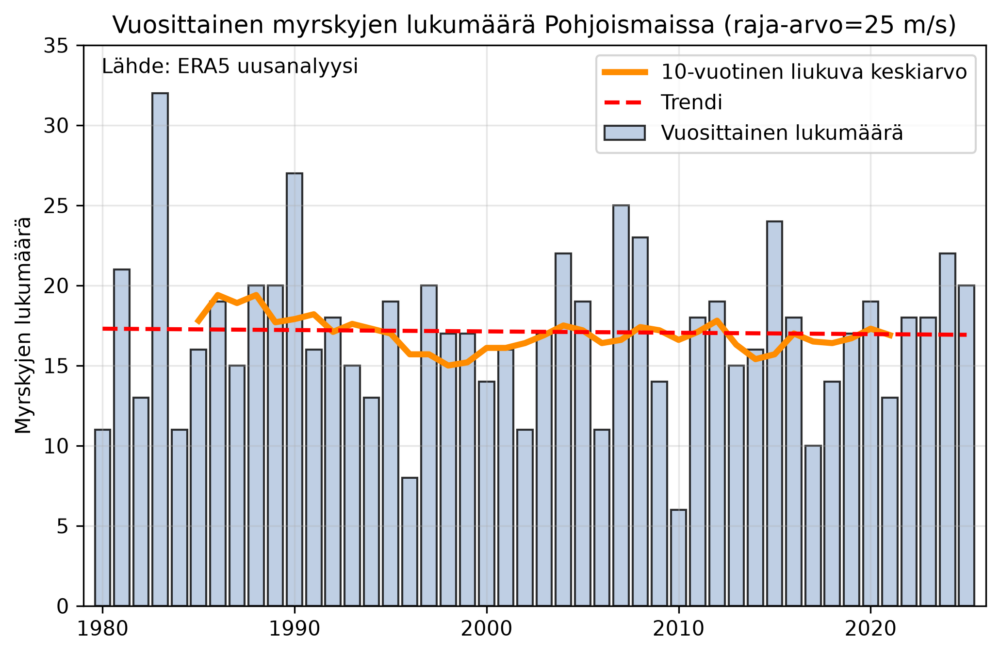
While 2026 is a standout year, it is vital to contextualize this against the backdrop of long-term climate analysis. Using the ERA5 reanalysis data, which provides a high-resolution snapshot of global climate back to 1979, we can evaluate the broader trajectory of Northern European storms.
When analyzing the paths of low-pressure systems that result in gusts exceeding 25 m/s on land, there is no clear, long-term linear trend pointing toward an increase or decrease in storm frequency. There are, of course, peaks and valleys—1983 remains the most active year in the dataset, while 2010 was the quietest—but the noise of annual variability tends to drown out any clear, long-term climate signal.
It is worth noting that the definition of a "storm" in these datasets can vary based on the geographic constraints and the wind-speed thresholds used. In our analysis, we used a 25 m/s gust threshold in the ERA5 data to represent a 21 m/s sustained wind speed on the ground, accounting for the known "negative bias" inherent in reanalysis models, as recently noted in studies by Laurila et al. (2025). Despite these technical nuances, the conclusion remains the same: the frequency of storms in Northern Europe has remained remarkably stable over the last four decades.
Implications for Society and Infrastructure
The variability of storm activity has profound implications for how Finland manages its infrastructure. Energy companies, forestry managers, and transport authorities rely on these statistical models to plan for the "worst-case scenarios."
For the forestry sector, a calm year is a blessing, as it prevents the widespread windthrow that can decimate timber yields and force premature harvesting. For energy providers, it means fewer power outages and less expenditure on emergency repairs to the electrical grid. However, meteorologists emphasize that a quiet year should not lead to complacency. Because storminess is stochastic—or essentially random—in its timing, the risk of a "century storm" remains present regardless of whether the preceding months were calm.
Future Research and Moving Forward
As we continue to monitor the remainder of 2026, the scientific community is actively working on more comprehensive analyses. We are currently in the process of drafting a more extensive research article that will integrate these updated 2026 figures with a deeper look at the atmospheric dynamics of the North Atlantic Oscillation (NAO).
The goal of this upcoming work is to provide a more robust framework for understanding how shifts in the jet stream might influence local weather in the coming decades. As climate change continues to alter global temperature gradients, the way these storms form and track will undoubtedly become a focal point of future study.
For now, the people of Finland can enjoy the relative peace of a quiet autumn. However, the data reminds us that the atmosphere is rarely static for long. Whether the final months of 2026 will bring the gale-force winds that have been missing so far remains to be seen. In the world of meteorology, the only certainty is change, and the historical records suggest that even the calmest years can be interrupted by the raw, unpredictable power of the Nordic elements.
Mika Rantanen is a meteorologist specializing in high-impact weather events and climate data analysis. This report utilizes ERA5 reanalysis data and historical records from the Finnish Meteorological Institute.