By Samuli Haapasalo
Published: June 16, 2026 | Suomen Luonto
The silence of the Northern Karelian night is rarely absolute. To the practiced ear of a naturalist, the forest is a symphony of subtle shifts—the rustle of a pine needle, the distant call of an owl, or the heavy, rhythmic breathing of a nocturnal predator. However, on this particular June night, the silence was shattered by a sound that instantly snapped me into a state of high alert.
Lying on the narrow wooden bunk of a remote hide in Lieksa, I was jolted from a deep sleep by a series of low, guttural growls. They were primal, resonating with a rhythmic intensity that vibrated through the floorboards of the blind. In the darkness of the boreal summer night, which at this latitude in late May and June never truly descends into pitch blackness, I moved with the practiced silence of a shadow. I reached for my camera, my heart hammering against my ribs. Outside, the drama was already unfolding.
The Midnight Confrontation: A Chronology of Conflict
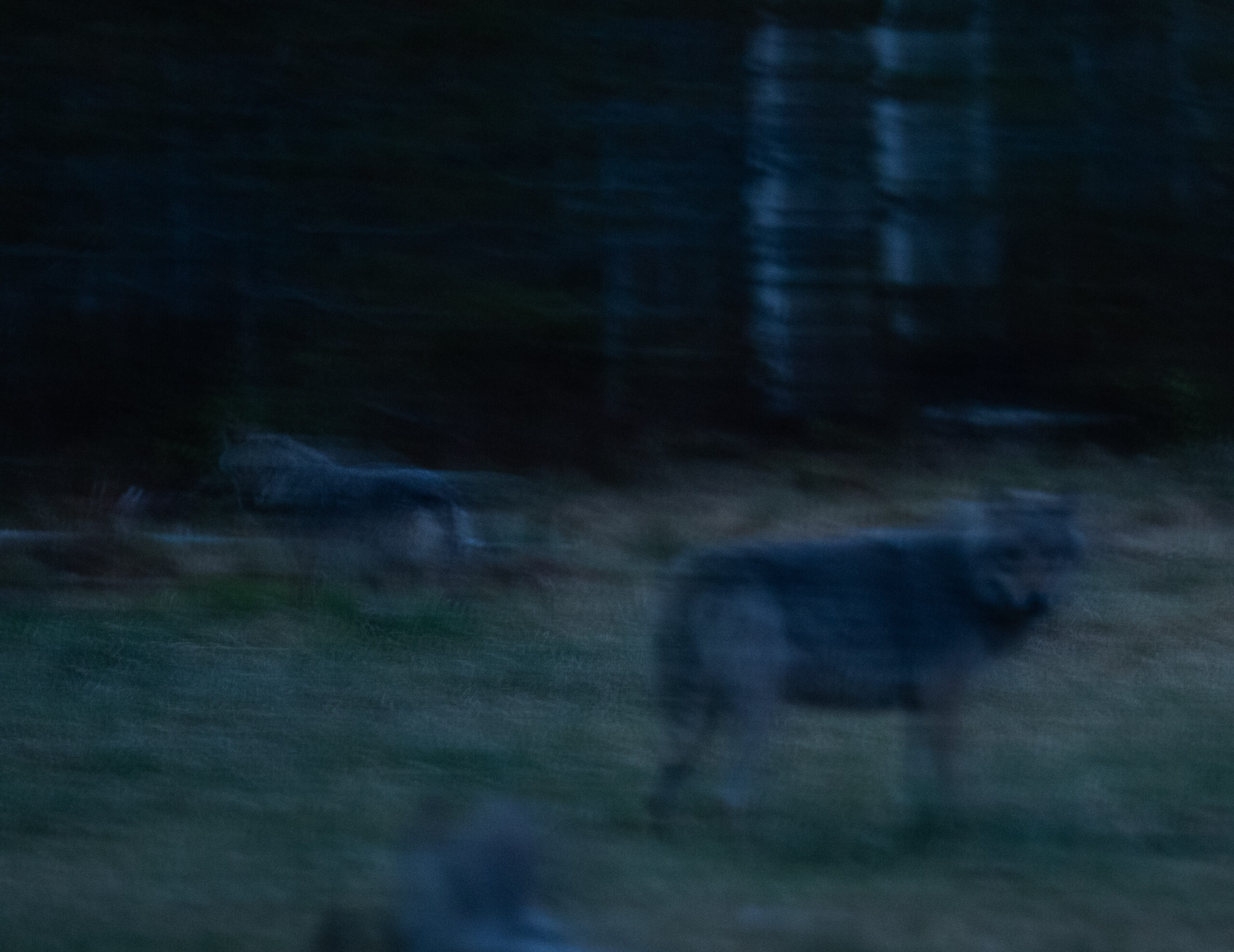
The scene before me was as rare as it was intense. Two wolves and a wolverine were locked in a high-stakes standoff. For over thirty minutes, the forest floor in front of the hide transformed into an arena of tactical maneuvering and raw, predatory instinct.
00:00 – The Initial Engagement
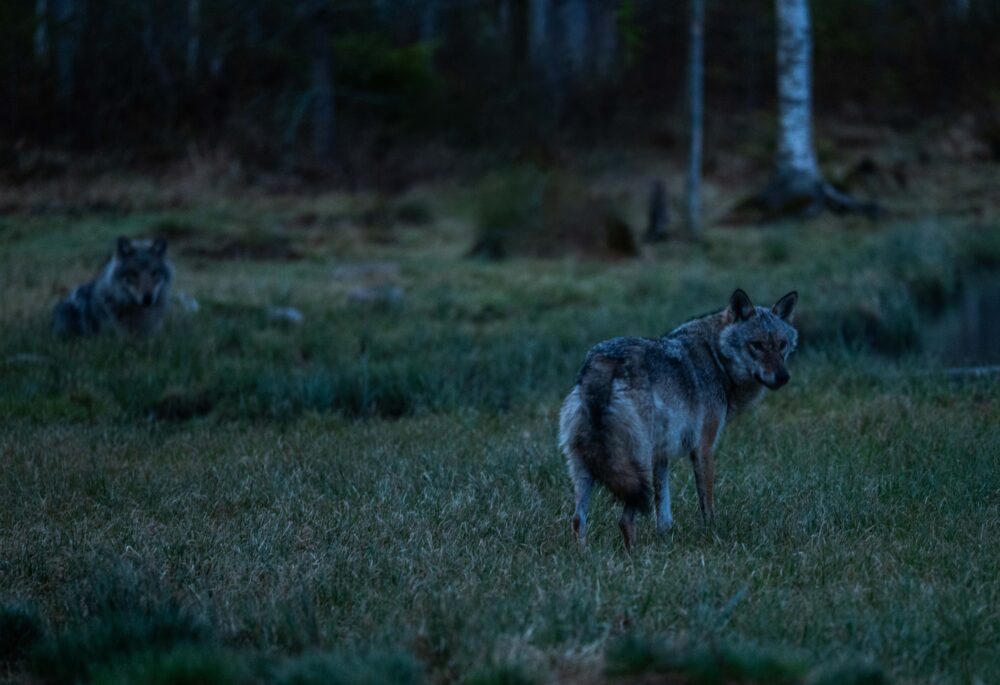
As my eyes adjusted to the dim, ethereal light of the northern midnight, I discerned the shapes. Two wolves—lean, efficient, and hauntingly pale in the gloaming—were circling a single wolverine. The wolverine, a beast known for its tenacity and disproportionate strength, was not backing down. It stood its ground, emitting those deep, rumbling growls that had woken me.
00:15 – Tactical Shifts
The interaction was not a blind, chaotic brawl, but a measured game of patience. The wolves utilized their superior speed, launching silent, explosive sprints toward the wolverine, only to pull back at the last millisecond. They seemed to be testing the wolverine’s defenses, looking for a vulnerability. The wolverine, meanwhile, remained stationary, its posture defensive yet defiant. When the wolves pressed too close, the wolverine would snap, its jaws wide, showing teeth capable of crushing bone.
00:25 – Seeking High Ground
Recognizing the tactical disadvantage of the open ground, the wolverine performed a remarkable feat: it climbed a short, dead pine snag (a kelo). From this elevated position, it kept a watchful eye on its pursuers. The wolves, seemingly undeterred but clearly frustrated, laid down in the meadow, their bodies tense, eyes never leaving the tree. They were, in effect, waiting out the opponent, a display of predatory patience that underscored their status as apex pack hunters.
00:35 – The Resolution
The tension eventually dissipated. Realizing that a direct assault would likely result in catastrophic injury for both parties, the wolves and the wolverine reached a tacit agreement of mutual survival. One by one, the participants drifted away into the gloom of the surrounding forest, leaving the meadow as silent as it had been before the storm of movement.
Photographic Challenges in the Boreal Night
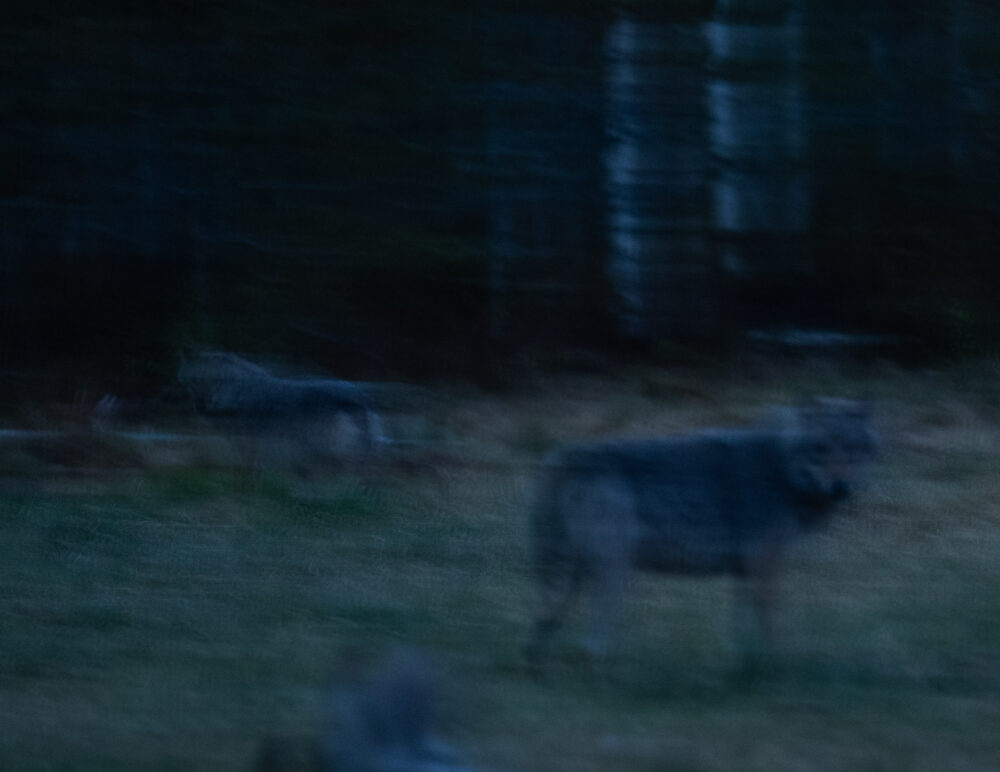
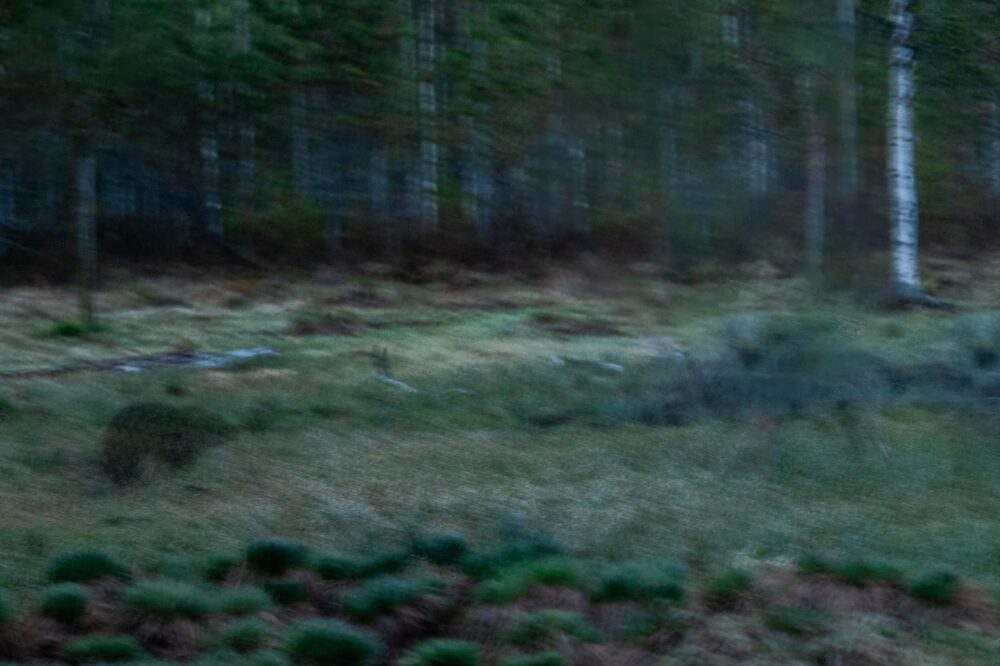
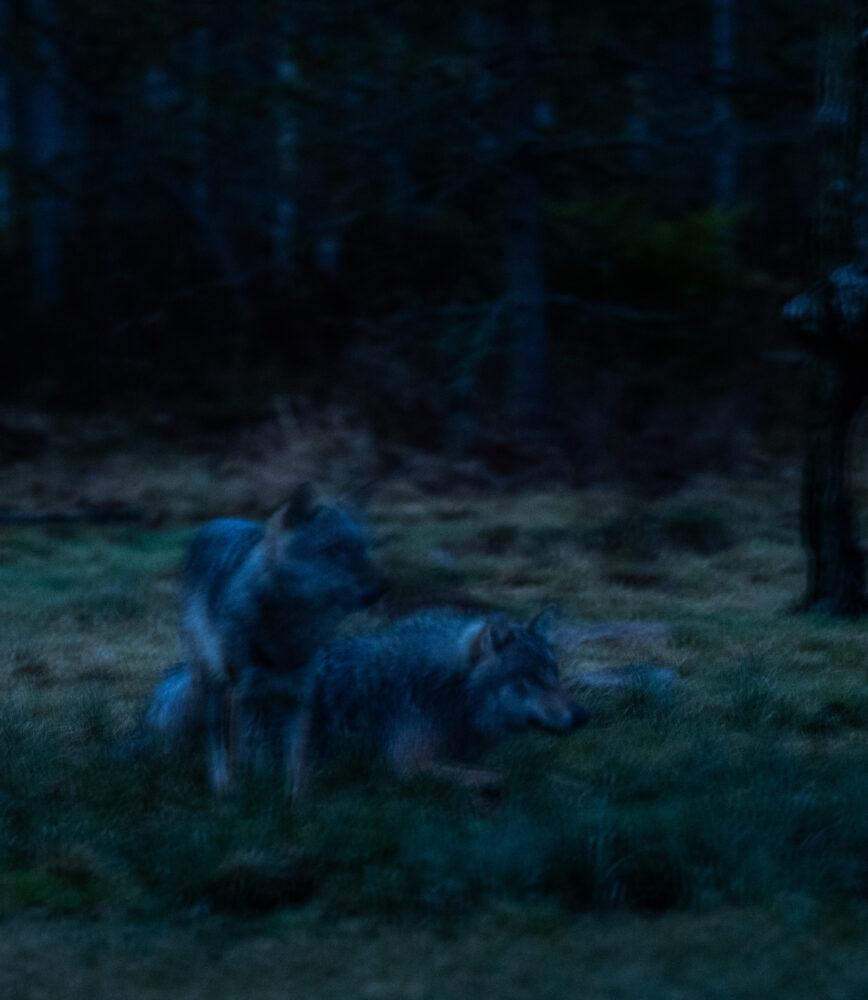
Capturing such a scene requires not just equipment, but a fundamental understanding of the limitations of light. Shooting with a 70–200mm telephoto lens at full aperture, I was pushing my camera to its absolute limits. With shutter speeds hovering between 1.5 and 2 seconds, any movement by the animals resulted in what photographers call "motion blur."
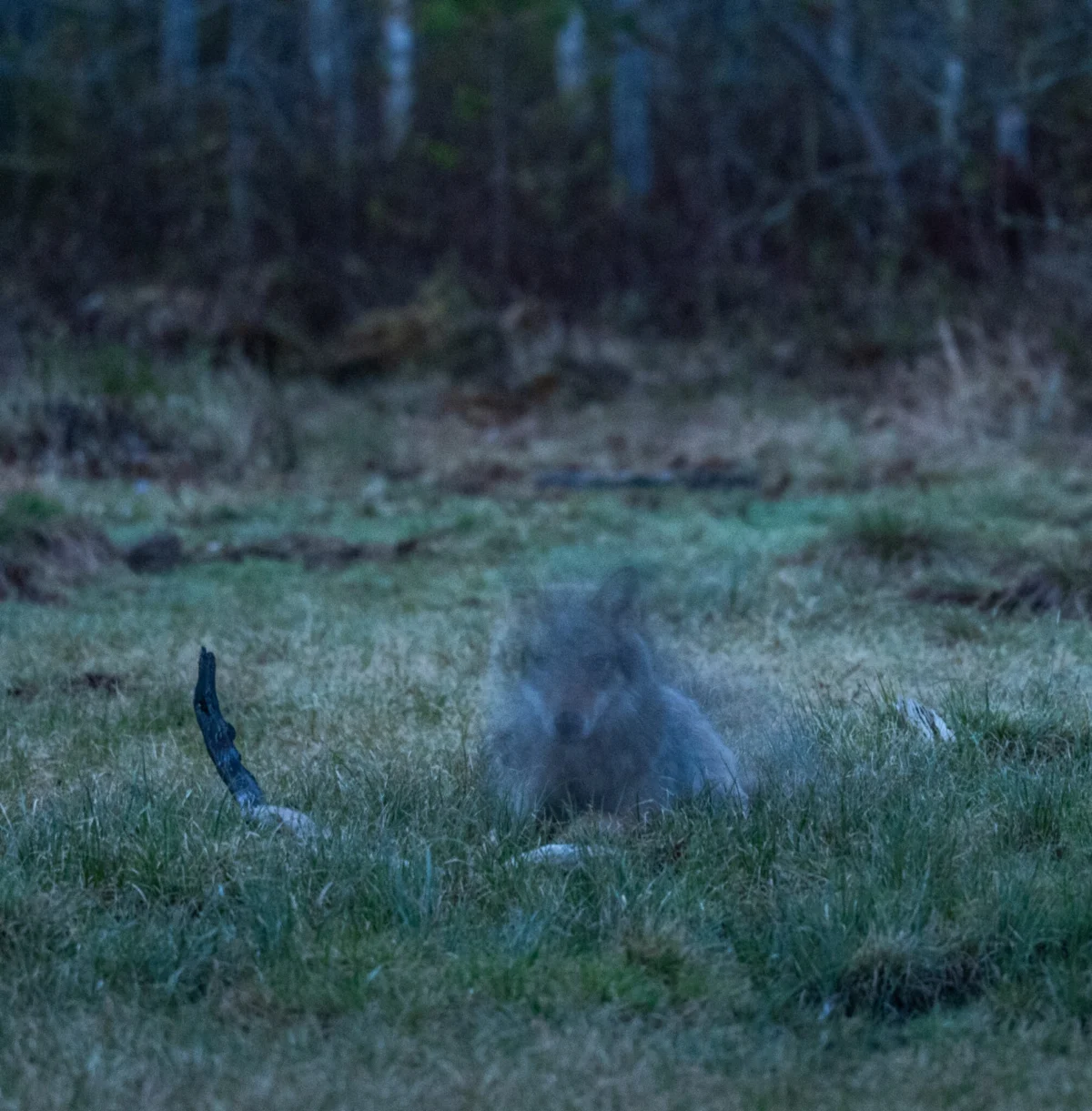
The resulting images are, in a sense, more evocative than sharp. The animals appear as spectral, ghostly silhouettes—hauntings of the Karelian woods. In some frames, the background landscape is visible through the body of a wolf, a testament to the long exposure required to gather even the faintest glimmer of midnight light. While I could have increased the ISO sensitivity further to gain a faster shutter speed, I chose to lean into the atmospheric nature of the scene. The lack of clinical sharpness does not detract from the event; rather, it highlights the transient, otherworldly nature of a meeting between such formidable creatures.
Biological Implications: The Cost of Aggression
Why do these animals, both highly capable of lethal violence, choose to avoid a full-scale battle? The answer lies in the harsh realities of wilderness survival.
For a wolf, a broken leg is a death sentence. While a pack can support an injured member to a degree, a solitary hunter—or one separated from the pack—cannot hunt effectively if its mobility is compromised. The wolverine, despite being significantly smaller, possesses a bite force and a ferocity that is legendary. A single well-placed snap from a wolverine could shatter a wolf’s metatarsal bones, ending its ability to pursue prey for the rest of the season.
This behavior, known as "ritualized aggression," is a way for predators to resolve disputes over territory or carcass access without risking life-altering injury. By posturing, snarling, and feinting, they communicate their resolve without escalating to the point of a physical struggle that neither can afford to win.
Comparative Ecology: Past and Present
This incident reminded me of a similar encounter I documented in Kuhmo several years ago. In that instance, a large pack of six wolves faced off against a wolverine. The result was identical: a long night of tension, a retreat to a tree, and a peaceful, if cautious, withdrawal.
The behavior patterns suggest that these encounters are not random. They represent a complex social negotiation between species that occupy similar ecological niches. Both the wolf and the wolverine are apex predators that rely on scavenging and active hunting. When their paths cross at a food source, the resulting "dance" is a manifestation of the intense competition that defines life in the northern wilderness.
Reflections from the Hide
As I sat in the darkness, I couldn’t help but reflect on the privilege of witnessing such an event. Modern society often views the wilderness through the lens of statistics, conservation policy, and aerial surveys. However, to truly understand these animals, one must experience the raw, visceral reality of their existence—the smell of the damp earth, the sound of their breath, and the palpable electricity of a confrontation in the dead of night.
The following morning, as the sun began to lift the veil of mist from the forest floor, the scene returned to its more mundane state. A common greenshank, a green sandpiper, and a common sandpiper moved through the shallows, oblivious to the high-stakes drama that had unfolded just hours before.
For the naturalist, these moments of "high drama" are the peaks of a life spent in the field. They are reminders that the forest is not merely a collection of trees and rocks, but a dynamic, living entity where every movement has meaning, and where the line between predator and prey is drawn in the shifting light of the midnight sun.
Technical Data: Observations in Lieksa
- Location: Lieksa, Kontiovaara (Erä-Eero Hide)
- Date: June 16, 2026
- Conditions: Mid-June, Northern Karelia (twilight, low-light conditions)
- Equipment: 70–200mm telephoto lens, full aperture.
- Key Observations: Ritualized aggression; use of vertical escape routes by the wolverine; persistence of wolves as observers; lack of physical contact during a 30-minute encounter.
Official Perspective on Predator Interaction
While the Finnish Wildlife Agency and various conservation groups continue to monitor the populations of wolves (Canis lupus) and wolverines (Gulo gulo) in Eastern Finland, the interaction between these two species is considered a natural occurrence. Experts note that as predator densities increase, the frequency of "resource-based competition" is expected to rise.
The primary concern for conservationists remains the protection of large, contiguous wilderness areas where these species can interact and coexist without human interference. As noted in current management strategies, the ability of these animals to avoid direct conflict is a sign of a healthy, functioning ecosystem where both species have developed the social intelligence required to navigate complex predatory landscapes.
Implications for Future Research
This documentation provides valuable insight into the nocturnal behavior of these elusive predators. Future studies utilizing motion-activated high-speed thermal cameras could provide even more clarity on the specific communication cues—scent marking, vocalization pitches, and body language—that dictate these standoffs. By understanding these interactions, we gain a deeper appreciation for the complex social structures that govern the lives of Finland’s most iconic wild animals.
For those interested in supporting the ongoing documentation and conservation of Finnish wildlife, consider subscribing to Suomen Luonto. Your support ensures that we can continue to provide expert, independent journalism from the heart of the forest.