As the bodybuilding world turns its eyes toward the 2026 Olympia, one competitor has managed to consistently capture the attention of fans and experts alike: Wesley Vissers. Known for his classic aesthetics and unwavering commitment to the traditional foundations of the sport, the Dutch bodybuilder has been on an absolute tear. Following dominant performances at the Arnold Classic and the Detroit Pro, Vissers is currently building significant momentum as he prepares for the biggest stage in the industry.
However, behind the polished posing routines and the accolades lies a relentless pursuit of physical perfection. Recently, Vissers pulled back the curtain on his training methodology, revealing that a cornerstone of his current success is an exercise often dismissed by modern gym-goers as a "relic" or a "gimmick": the sissy squat. By integrating this movement into a high-intensity superset on the hack squat machine, Vissers claims he has unlocked a new level of quad development.
The Main Facts: Why the Sissy Squat?
For the uninitiated, the sissy squat is a compound movement that focuses almost exclusively on the quadriceps, specifically targeting the teardrop-shaped vastus medialis. Unlike a standard back squat, where the goal is to maintain a relatively upright torso to engage the posterior chain, the sissy squat requires the lifter to lean backward while rising onto their toes.
Vissers, affectionately known as the "Dutch Oak," argues that the exercise’s efficacy stems from its unique mechanical advantage. "Not only does it stretch the quads all the way to the top, it also stretches the hips and ankles at the same time," Vissers explained. In the high-stakes environment of professional bodybuilding, where every millimeter of muscle separation counts, this deep, loaded stretch is essential for hypertrophy.
By placing the muscles under tension while in a state of maximum elongation, Vissers is applying the principle of stretch-mediated hypertrophy. This is not merely about moving weight; it is about manipulating the muscle fibers to encourage growth in areas that standard leg presses or heavy barbell squats might miss.
A Chronology of the Dutch Oak’s Rise
The journey to the 2026 Olympia podium has been a long and calculated one for Vissers. His path to the top tier of the Classic Physique division can be broken down into several distinct phases:
- 2023 – The Foundation: Vissers focused heavily on refining his symmetry and conditioning, moving away from purely mass-based training to a more aesthetic, old-school approach.
- 2024 – The Breakthrough: With several top-five finishes, the world began to take notice of his improved proportions. He began experimenting with unconventional movements, including varied angles of hack squats.
- 2025 – The Arnold Classic Dominance: The win at the Arnold Classic served as a turning point. It proved that his training philosophy—which emphasizes full range of motion and mind-muscle connection over ego-lifting—was superior to the current trend of "power-bodybuilding."
- 2026 – The Road to Olympia: Currently, Vissers is in the refinement stage. His focus has shifted to "filling out" the lower body to match his impressive upper-body width. His public endorsement of the sissy squat reflects this final push for detail and density.
Supporting Data: The Mechanics of Hypertrophy
To understand why Vissers is so adamant about this exercise, one must look at the biomechanics of the quadriceps. The quads are composed of four heads: the vastus lateralis, vastus medialis, vastus intermedius, and rectus femoris. The rectus femoris is the only head of the quad that crosses both the hip and the knee joint.
When a bodybuilder performs a traditional squat, the rectus femoris is often limited by the movement of the hip. However, by leaning the torso backward in a sissy squat, the lifter places the rectus femoris in a position of extreme stretch. When combined with the knee flexion provided by the hack squat machine, the result is a targeted, high-intensity stimulus that is difficult to replicate with any other movement.
Vissers’ approach is also supported by recent trends in sports science, which suggest that "lengthened partials" or training at long muscle lengths can lead to superior muscle growth. By forcing his quads into these deep ranges of motion before moving into a standard hack squat, Vissers is essentially pre-exhausting the muscle, ensuring that the primary mover is the target area rather than the lower back or glutes.
Official Perspectives and Expert Analysis
The fitness community has been quick to react to Vissers’ training tips. While some critics argue that the sissy squat places undue stress on the knee joint, experts in kinesiology point out that when performed with controlled tempo—as Vissers does—it can actually strengthen the connective tissues surrounding the patella.
"Wesley is utilizing what we call a ‘mechanical dropset,’" says one prominent strength coach. "By moving from a biomechanically disadvantageous position (the sissy squat) to a position where you can load more weight (the regular hack squat), he is creating a metabolic environment that is highly conducive to muscle fiber recruitment."
This sentiment is echoed by the results seen in the IFBB professional circuit. Judges have noted that the "sweep" of Vissers’ legs has become significantly more pronounced over the last twelve months, a direct result of his focus on these high-stretch movements.
The Vissers Protocol: The Superset Explained
Vissers does not just perform sissy squats in isolation; he uses them as the first half of a brutal, two-part superset. Here is how he structures it:
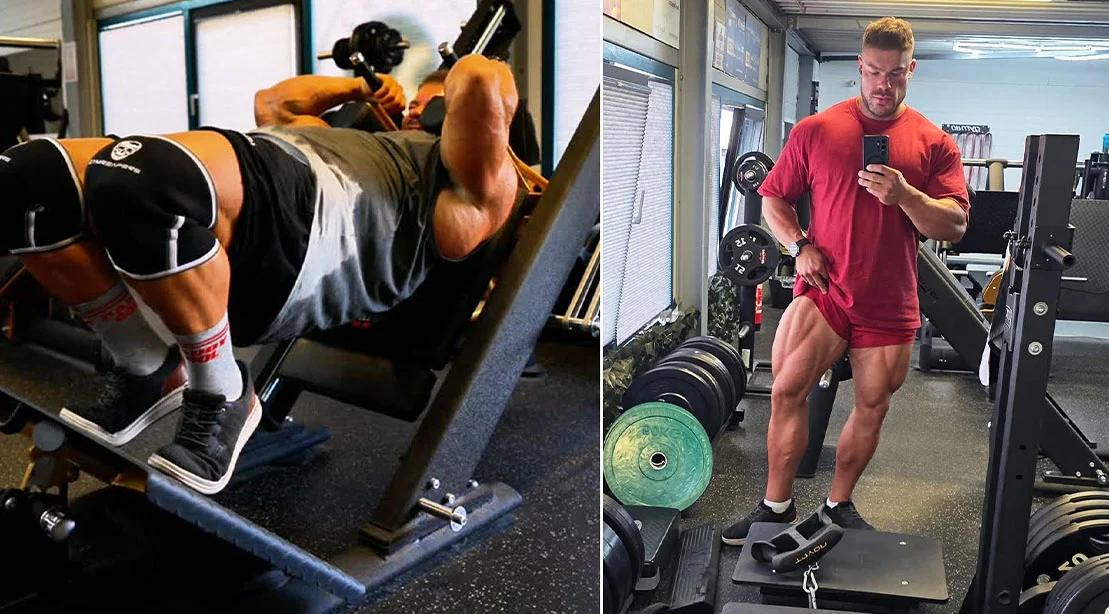
- The Sissy Hack Squat: Vissers sets up on the machine, focusing on keeping his knees forward and his hips locked in a way that forces the quads to bear the entire load. He takes this set to complete technical failure.
- The Immediate Transition: Without resting, he adjusts his foot placement on the hack squat machine to a standard stance.
- The Regular Hack Squat: Because the quads are already fatigued from the sissy portion, he can no longer use his glutes or lower back to compensate. He then grinds out additional repetitions until the quads are "toast."
"Try this if you dare," Vissers noted on social media. "It’s an incredible, safe, and effective way to ensure your legs have nowhere to hide."
Implications for the Industry
The endorsement of such a movement by a top-tier Olympia contender has massive implications for the bodybuilding world. It signifies a shift away from the "heavier is always better" mentality that has dominated the last decade. Instead, we are seeing a return to the fundamentals of bodybuilding: isolation, tension, and the pursuit of the "pump" through intelligent exercise selection.
For amateur bodybuilders and fitness enthusiasts, Vissers’ success serves as a reminder that the most effective exercises are often those that have been around for decades. The sissy squat, which was a staple for golden-era bodybuilders like Vince Gironda, is proving its worth once again in the modern era.
As the 2026 Olympia approaches, all eyes will be on the Dutch Oak. If his legs continue to grow at their current rate, we may be looking at a new standard for lower-body development in the Classic Physique division. By prioritizing depth, range of motion, and mechanical intensity, Wesley Vissers is not just preparing for a competition; he is actively contributing to the evolution of physique training.
Whether or not this specific superset is the key to the Sandow trophy remains to be seen, but one thing is certain: the industry is paying attention. The "Dutch Oak" is showing the world that sometimes, the road to the biggest stage in the world is paved by going back to the basics—and being willing to suffer through the most difficult, yet rewarding, movements in the gym.