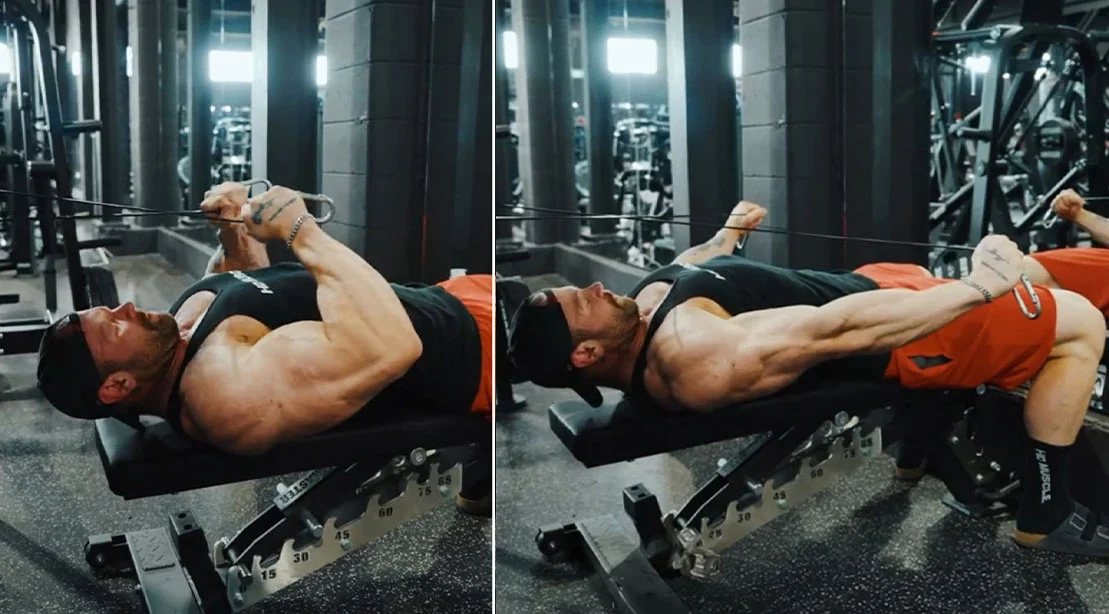
For decades, the overhead triceps extension has stood as a monolith in the bodybuilding world. Whether performed with a heavy dumbbell, a barbell, or a cable attachment, the overhead position is widely recognized for its unique ability to stretch the triceps—specifically the long head—under load. However, as many athletes discover the hard way, this movement comes with a hidden cost: significant spinal stress and, for many, persistent elbow discomfort.
In a recent shift in training methodology, transformation coach Travis Smith has proposed a more sustainable, high-performance alternative: the Lying Triceps Cable Crossover. By shifting the plane of movement from vertical to horizontal, Smith argues that lifters can achieve superior hypertrophy while safeguarding the spine and joints.
The Main Facts: Rethinking Triceps Hypertrophy
The triceps brachii is composed of three distinct heads: the lateral, the medial, and the long head. The long head is the largest of the three and is the only portion that crosses the shoulder joint, meaning it is best activated when the arm is positioned overhead. This is why the overhead extension has been a staple for decades.
However, the physics of the overhead movement often works against the trainee. As the weight increases, the vertical load can cause the lower back to arch excessively, shifting the focus from the triceps to the stabilizing muscles of the spine. For those with pre-existing back issues or those who struggle with core bracing, this poses a risk of injury.
Travis Smith’s solution is deceptively simple: horizontal stability. By performing the movement while lying supine on a bench, the lifter effectively "locks" the torso and shoulders in place. This removes the need for the body to expend energy on stabilization, redirecting that physiological output directly into the triceps muscles.
Chronology: The Evolution of the Extension
To understand why this shift is significant, one must look at the timeline of triceps training.
- The Era of the Skull Crusher (1970s–1990s): The decline-bench "skull crusher" dominated gym culture. While effective, it became notorious for causing "triceps tendonitis" due to the shearing forces placed on the elbow joint when using heavy barbells.
- The Overhead Boom (2000s–2010s): Coaches began emphasizing the "stretch-mediated hypertrophy" of the long head, pushing the overhead extension to the forefront. While it solved some elbow issues, it introduced a new problem: spinal loading.
- The Modern Era of Stability (Present): Trainers like Travis Smith are now moving toward a synthesis of these methods. By using cables—which provide constant tension—and a supine bench position, athletes are finding a "middle ground" that provides the deep stretch of an overhead movement without the stability compromises of standing exercises.
Supporting Data: Why Stability Equals Growth
The efficiency of a movement is dictated by the "energy leak" principle. If a muscle (the triceps) is trying to generate force, but the body is unstable, a significant percentage of the nervous system’s drive is diverted to stabilizing the core, shoulders, and hips.
The Mechanics of the Cable Crossover
When performing the Lying Triceps Cable Crossover, the setup is critical. By positioning a bench in front of a cable station and lying with the head toward the pulleys, the lifter creates a mechanical advantage. Crossing the cables over allows for a natural path of motion that mimics the anatomy of the triceps.
- The Stretch: As the arms straighten and the cables are lowered, the long head of the triceps is placed under maximum tension.
- The Tension: Unlike free weights, which have "dead zones" at the top of the movement where tension is lost, cables keep the muscle under load throughout the entire arc.
- The Lock: By lying flat, the spine is supported by the bench, eliminating the "vertical load" that plagues standing exercises.
According to Smith, "Stability is one of the most underrated variables for muscle growth. The less energy spent stabilizing movement, the more you can put into the target muscle."
Official Perspective: Insights from Travis Smith
In his recent demonstration, Travis Smith emphasized that this movement is not meant to "throw shade" at traditional exercises, but rather to refine them. "We aren’t here to say overhead work is bad," Smith notes. "We are here to say that for many people, it is uncomfortable. If you cannot perform a movement without pain, you aren’t training effectively."
Smith’s approach centers on the concept of "force production efficiency." When the torso is locked against a bench, the triceps can be taken to true mechanical failure without the risk of the lifter "cheating" the weight by swinging their back. This isolation is the key to breaking through plateaus in arm size.
Furthermore, Smith highlights the impact on joint health. "If regular skull crushers bother your elbows, this variation is the one for you," he explains. The cable’s resistance profile is smoother than the abrupt force curve of a barbell, making it a "joint-friendly" alternative that allows for higher volume training without the typical wear and tear associated with heavy pressing.
Implications: A New Standard for Arm Day
What does this mean for the average gym-goer? It suggests a fundamental shift in how we prioritize exercise selection. If the goal is hypertrophy (muscle growth), the priority should be the stimulus-to-fatigue ratio.
Implications for Spinal Health
For the aging athlete or those with lumbar sensitivity, the Lying Triceps Cable Crossover is a game-changer. It allows for heavy, intense training without the risk of aggravating lower back discs or soft tissues. By removing the vertical gravity vector, the spine remains in a neutral position throughout the set.
Implications for Programming
For those looking to integrate this into their routine, Smith recommends a specific rep range:
- Volume: 2 to 3 sets per session.
- Repetition: 8 to 12 reps, which is widely considered the "hypertrophy sweet spot."
- Execution: Do not move the fists past the shoulders. Focus on the stretch, not the range of motion for the sake of range.
This program structure encourages progressive overload—slowly increasing the weight over weeks—without the high risk of burnout associated with standard skull crushers.
The Science of the "Deep Stretch"
The secret to the success of this movement lies in the biomechanics of the triceps. Muscles grow best when they are challenged in their lengthened position. When the arms are held in the setup position for this crossover, the long head is already under significant tension. As the cable is pulled, the muscle undergoes a dynamic contraction while maintaining that stretch.
This combination of loaded stretching and constant tension triggers a cascade of signaling pathways related to muscle growth, including the activation of mechanoreceptors that sense mechanical load and translate it into protein synthesis.
Conclusion: Getting Things Done While Lying Down
The fitness industry is often obsessed with "harder" movements, but smart training is about "smarter" movements. The Lying Triceps Cable Crossover is a prime example of high-level exercise engineering. It respects the anatomical requirements of the triceps while acknowledging the biological limitations of the spine and elbows.
As Travis Smith demonstrates, the ability to produce maximum force is often limited by how stable the body feels. By lying back, anchoring the torso, and utilizing the consistent, smooth resistance of a cable system, lifters can finally focus on what really matters: the contraction of the muscle.
For those who have struggled to grow their arms, or for those who have had to stop training triceps due to recurring pain, this variation offers a path forward. It is a reminder that in the quest for physical transformation, the most effective solution is often the one that keeps you in the game longer.
As Smith concludes, "Who said you can’t get anything done while laying on your back?" In the world of bodybuilding, it turns out that lying down might be the best way to stand out.
To follow Travis Smith and see his full library of training demonstrations, visit his Instagram page.