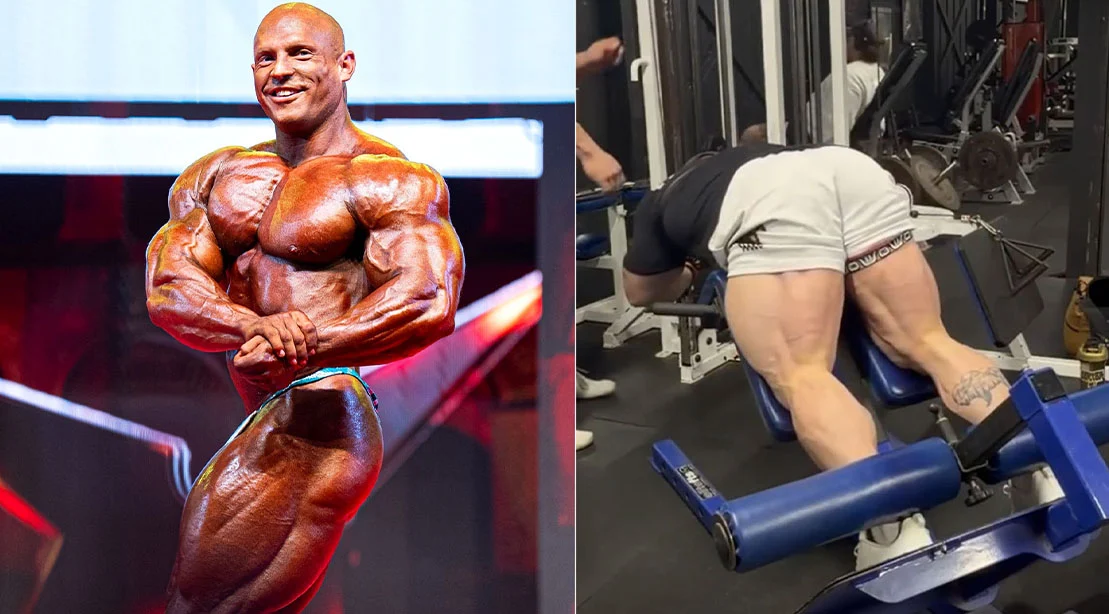
After a hard-fought, fifth-place finish at the 2025 Mr. Olympia, Martin “The Martian” Fitzwater has returned to the drawing board with a singular focus: closing the gap between himself and the sport’s elite. Following an early qualification for the 2026 Olympia in Las Vegas—secured by a dominant performance at the EVLS Prague Pro last October—Fitzwater is no longer just chasing size; he is chasing mechanical perfection.
In a bid to refine his physique for a lineup that includes reigning champion Derek Lunsford, Samson Dauda, and Hadi Choopan, Fitzwater has begun experimenting with unconventional training modalities. Among these, his recent adoption of the “Cable Nordic Curl” has sent ripples through the bodybuilding community. By blending the grueling eccentric load of a traditional Nordic curl with the constant, adjustable tension of a cable stack, Fitzwater is looking to etch even deeper detail into his hamstrings—a prerequisite for standing atop the podium in Las Vegas.
The Pursuit of Excellence: Chronology of a Contender
Martin Fitzwater’s trajectory in the IFBB Pro League has been nothing short of meteoric. However, the upper echelons of professional bodybuilding are notoriously unforgiving. The 2025 Mr. Olympia proved that while Fitzwater possesses the density and structural foundation to stand among the top five, the margin for improvement is razor-thin.
Following the 2025 finals, where Derek Lunsford secured back-to-back victories, Fitzwater recognized that his physique required a new stimulus to combat the hyper-competitive nature of the modern Men’s Open class. Instead of resting on his laurels, he shifted his focus toward “intelligent hypertrophy.”
By late 2025, Fitzwater began documenting his off-season training protocols on social media. His collaboration with fellow pro Brett Wilkin became a focal point of his training content. It was during these sessions that the “Cable Nordic Curl” emerged as a centerpiece of their leg-day routine. By leveraging this movement, Fitzwater isn’t just training; he is strategically dismantling the weaknesses that held him back in 2025, ensuring that when he steps onto the 2026 Olympia stage, his posterior chain is nothing short of structural armor.
Anatomy and Mechanics: The Science of the Cable Nordic Curl
To understand why a top-tier athlete like Fitzwater is obsessing over this movement, one must look at the anatomy of the posterior chain. The hamstrings are a complex trio of muscles: the biceps femoris, the semimembranosus, and the semitendinosus. Traditional movements like stiff-legged deadlifts and lying leg curls are staples, but they often lack the specific biomechanical focus required for peak development at the elite level.
Why the Nordic Curl Reigns Supreme
The standard Nordic hamstring curl is arguably the most effective bodyweight exercise for the posterior chain. It forces the hamstrings to act as both knee flexors and hip stabilizers. By anchoring the ankles and lowering the torso, the athlete places an immense eccentric load on the hamstrings.
The “Martian” Innovation: Adding Cable Resistance
Fitzwater’s variation takes the standard Nordic curl and introduces a cable stack via a belt attachment. This provides several distinct advantages:
- Constant Tension: Unlike bodyweight exercises, which can have “dead zones” in the strength curve, the cable stack ensures that the hamstrings are under tension throughout the entire range of motion.
- Safety and Stability: By using a hyperextension (Roman) chair as the anchor point, the user can isolate the hamstrings without the instability of free-weight variations.
- Controlled Progression: For a bodybuilder of Fitzwater’s caliber, bodyweight is no longer a sufficient stimulus. The cable stack allows for precise, micro-loadable increases in resistance, facilitating progressive overload.
How to Perform the Cable Nordic Curl: A Step-by-Step Guide
Fitzwater has been transparent about the learning curve associated with this movement. It is not merely an exercise; it is a technical challenge. Below is the methodology favored by “The Martian” for maximum growth.
1. The Setup
Position yourself on a standard hyperextension or Roman chair. The key is to securely anchor your ankles. Ensure your knees are pushed firmly into the pads. This fixation is critical; if the knees shift or the hips sag, the tension shifts from the hamstrings to the lower back, increasing the risk of injury.
2. The Harness
Wear a cable belt attachment securely fastened just under the armpits. The cable should be routed from a low-to-mid position on the cable tower, ensuring the line of pull is perpendicular to your torso at the start of the movement.
3. The Execution
Keep your upper body in a rigid, straight line. Initiate the movement by curling at the knee. As Fitzwater notes, “Don’t hyperextend, but rather pull hips straight back, curling at the knee.” It is vital to keep the movement out of your lower back. The glutes and hamstrings should be the only engines driving the torso back to the starting position.
4. The “Humbling” Factor
As Fitzwater advises his 320,000 followers, “Start light. It’s very heavy and humbling.” The isolation provided by this movement is significant; those accustomed to heavy deadlifts may find themselves shocked at how quickly the hamstrings reach failure when the lower back is taken out of the equation.
Implications for the 2026 Olympia
The implications of this training shift extend far beyond a single exercise. In professional bodybuilding, the “Olympia look” is defined by extreme conditioning and the seamless integration of muscle groups. By focusing on the hamstrings through the Cable Nordic Curl, Fitzwater is targeting a specific area that often separates the Top 5 from the Top 3.
Competitive Landscape
The 2026 Mr. Olympia is shaping up to be one of the most competitive in history. With Derek Lunsford holding the Sandow and veterans like Hadi Choopan and Samson Dauda showing no signs of slowing down, the requirements for the podium are evolving. Judges are increasingly looking for “flow” and “detail” over raw, unrefined mass.
Fitzwater’s commitment to biomechanically superior movements suggests he is moving away from the “more is better” mentality that plagues many amateurs. He is opting for targeted hypertrophy, which allows him to add mass to his legs without compromising his waist-to-shoulder ratio.
Official Responses and Community Impact
The reaction from the bodybuilding community has been one of intrigue. While some purists argue that the setup is overly complex, the results speak for themselves. The move has been shared widely, with professional trainers noting that it is an excellent way to bridge the gap between rehab-style leg curls and high-intensity deadlifts.
Fitzwater’s willingness to share these “hacks” highlights a shift in how modern Olympians interact with their fans. No longer are training secrets hidden behind closed doors; instead, they are shared as part of the “Martian” brand—a transparent, analytical, and highly disciplined approach to the sport.
Expert Analysis: Why This Matters for Hypertrophy
Sports scientists often point out that the hamstring is a dual-function muscle, crossing both the knee and hip joints. Most gym-goers only train the hamstrings through knee flexion (leg curls). By incorporating a movement that requires hip stabilization and knee flexion simultaneously—under the resistance of a cable—Fitzwater is essentially “shocking” the muscle fibers into new growth.
Because the path of the exercise is fixed by the cable machine, the athlete can focus entirely on the mind-muscle connection. There is no balancing a barbell or stabilizing a machine; the user simply pushes the resistance. This leads to higher muscle activation, less systemic fatigue, and a reduced risk of injury compared to heavy barbell Romanian deadlifts, which can be taxing on the central nervous system.
Conclusion: The Road to Vegas
As the calendar turns toward the 2026 Olympia, Martin Fitzwater stands at a crossroads. He has the size, the structure, and now, the refined training methodology to potentially disrupt the status quo. His adoption of the Cable Nordic Curl is a symptom of a larger, more calculated mindset.
Whether this specific movement is the “secret weapon” that elevates him to the top of the podium remains to be seen. However, one thing is certain: “The Martian” is not satisfied with being in the conversation—he is training to command it. By focusing on the minutiae of his anatomy and embracing novel, high-intensity techniques, Fitzwater is ensuring that he will be the most improved, most detailed, and most dangerous version of himself when he walks out onto the Las Vegas stage.
For those looking to follow in his footsteps, the advice remains simple: keep your form tight, keep the ego in check, and prepare to be humbled by the intensity of the cable. The road to the Sandow is long, but for Martin Fitzwater, every rep counts.
To keep up with Martin Fitzwater’s training journey and his preparations for the 2026 Mr. Olympia, you can follow him on Instagram.