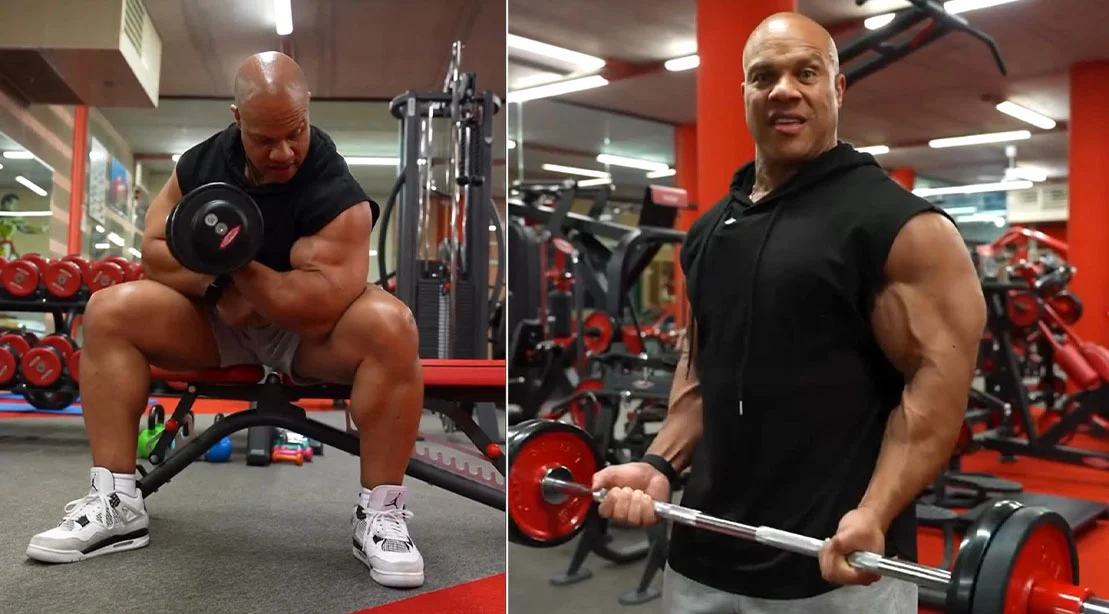
At 46 years old, seven-time Mr. Olympia champion Phil “The Gift” Heath continues to command the weight room with an authority that makes gym-goers half his age pause mid-set. While many athletes see their physical dominance wane in their mid-forties, Heath remains a physical anomaly, sporting arms that once measured a staggering 22 inches at the height of his competitive career.
His secret is not found in complex machinery or the latest bio-hacking gadgets, but in the brutal, time-tested fundamentals of bodybuilding. Recently, the legend shared his signature three-move arm routine designed to induce extreme hypertrophy. While the workout is deceptively brief, Heath warns that there are “no shortcuts” to building a pair of arms that can compete on the Olympia stage.
The Foundation of Excellence: Understanding the Philosophy
To understand why Phil Heath’s arm routine is effective, one must first understand the methodology that propelled him to seven consecutive Mr. Olympia titles (2011–2017). Heath’s training philosophy has always been rooted in intensity, mechanical tension, and meticulous form. Unlike those who sacrifice range of motion for ego-lifting, Heath’s approach prioritizes the "mind-muscle connection."
By focusing on the biceps brachii, the brachialis, and the brachioradialis, Heath ensures that the arm is developed as a complete, three-dimensional unit. The following routine is not merely a list of exercises; it is a strategic protocol designed to force muscle growth through progressive overload and extended time under tension.
The Core Routine: A Chronology of the Session
Heath’s workout is structured to fatigue the muscles systematically, moving from heavy compound movements to isolation, and finally to a high-volume finisher that leaves no fiber untapped.
1. Alternating Dumbbell Curls
The session begins with the seated alternating dumbbell curl. By remaining seated, Heath eliminates the possibility of using the lower back or hips to create momentum, effectively "locking" the biceps into a position where they must do 100% of the lifting.
- The Goal: Target the biceps brachii and the brachialis.
- Execution: Control the weight on both the concentric (lifting) and eccentric (lowering) phases.
- Rest: 90 seconds between sets.
2. Concentration Curls
Once the biceps are pre-exhausted, Heath transitions to the concentration curl. This movement is the gold standard for peak development. By pinning the elbow against the inner thigh, the lifter achieves maximum isolation.
- The Goal: Peak development and definition.
- Execution: Heath advises dropping the weight here. The objective is not to move heavy iron, but to maximize the squeeze at the top of the movement.
- Rest: 90 seconds between sets.
3. The Finisher: Barbell Curl 21s
The crown jewel of the workout is the “21s” technique. This is where Heath’s background as a professional champion shines through. The “21s” method is a grueling exercise in endurance, forcing the muscle to work through three distinct ranges of motion in a single set.
- The Setup: Using an EZ-bar, perform 7 reps from the bottom to the midway point, 7 reps from the midway point to the top, and 7 full-range reps.
- The Intensity: Heath insists on seven total sets of this torture. The extended time under tension ensures that the forearm and the upper arm are taxed well beyond their typical capacity.
- Rest: Two minutes between sets.
Supporting Data: Why This Routine Works
The efficacy of Phil Heath’s routine is supported by established principles of exercise science, specifically the concept of Time Under Tension (TUT). Research suggests that for hypertrophy to occur, muscles must be placed under stress for an adequate duration—typically 30 to 60 seconds per set.
By utilizing the 21s method, Heath forces his biceps to stay under tension for significantly longer than a standard set of 8–12 reps. Furthermore, the combination of compound movements (dumbbell curls) and isolation movements (concentration curls) allows for "mechanical drop-setting," where the athlete moves from a movement that allows for higher load to one that prioritizes strict isolation. This ensures that the muscle is fully exhausted by the time the workout concludes.
Official Guidance and Professional Advice
Phil Heath is quick to emphasize that while he is a seven-time champion, the average gym-goer should focus on longevity and safety. "Make sure you’re doing the following," Heath noted in a recent breakdown of his regimen: "Training hard, training smart, and having fun, because arms day should put a smile on your face."
For those not yet at an elite level, Heath offers specific modifications:
- Volume Adjustment: If seven sets of 21s is too taxing, start with three or four sets and gradually increase as your work capacity improves.
- Weight Selection: Never allow the weight to dictate your form. If you cannot maintain a slow, controlled cadence, the weight is too heavy.
- The "Momentum" Rule: The moment you use your back to swing the bar, the effectiveness of the exercise plummets. Maintain a rigid posture to force the arms to handle the load.
The Implications of Sustained Training
The fact that Heath continues to train with this intensity at 46 serves as a powerful reminder to the fitness community that muscle maturity and consistency are the keys to long-term physique maintenance.
The implications for the average trainee are clear: you do not need a four-hour "arm day" to see results. By focusing on three movements performed with absolute perfection—and pushing them to the point of muscular failure—you can elicit a growth response that surpasses hours of mediocre, distracted training.
Conclusion: Embracing the Process
Phil Heath’s approach to arm training is a testament to the idea that bodybuilding is as much a mental game as it is a physical one. His insistence on the "mind-muscle connection" and his refusal to rely on shortcuts provide a blueprint for anyone looking to build significant mass. Whether you are aiming for a competition-ready physique or simply looking to improve your upper-body aesthetics, the principles remain the same: intensity, smart programming, and the dedication to show up and do the work, day after day.
As Heath remains a fixture in the gym, his influence continues to set the standard for what is possible in the world of bodybuilding. For those who want to follow his journey or catch glimpses of his training sessions, he remains active on social media, continuing to share the wisdom that made him one of the greatest to ever step on the Mr. Olympia stage.
Quick Reference Guide for Your Next Arm Day:
- Alternating Dumbbell Curls: 3–4 sets of 8–12 reps (90s rest).
- Concentration Curls: 3 sets of 10–12 reps (90s rest).
- Barbell Curl 21s: 7 sets total (2 minutes rest between sets).
Note: Always consult with a healthcare professional or a certified personal trainer before attempting high-intensity training programs, especially if you are returning to the gym after a period of inactivity.