For nearly half a century, the Rocky franchise has stood as the quintessential American success story. From the grit of the 1976 original to the polished evolution of the Creed spin-offs, Sylvester Stallone’s creation has remained a cultural touchstone. However, behind the iconic training montages and the immortalized steps of the Philadelphia Museum of Art lies a story far more compelling than any scripted bout: the true history of how a struggling, broke actor convinced Hollywood to let him become its next big star.
Enter I Play Rocky, the highly anticipated biographical drama that promises to pull back the curtain on the desperate, high-stakes gamble that birthed a cinematic titan. With a buzz currently echoing across social media and a trailer that has already amassed 20 million views, the project is shaping up to be one of the most significant film events of the decade.
The Man, the Myth, and the Manuscript: What Is ‘I Play Rocky’?
The premise of I Play Rocky is inherently meta—a film about the making of a film. Yet, the stakes portrayed are grounded in a cold, hard reality. Before he was the "Italian Stallion," Sylvester Stallone was a desperate actor living in a tiny apartment, struggling to pay for heating, and facing the grim prospect of selling his beloved dog, Butkus, because he couldn’t afford to feed him.
The narrative arc of the film focuses on the friction between Stallone’s creative vision and the corporate machinery of 1970s Hollywood. Producers were captivated by the script—a visceral, poignant underdog tale about a bottom-tier pugilist getting a million-to-one shot at the heavyweight title—but they were adamant that the lead role should be occupied by a bankable star. Names like Burt Reynolds, Ryan O’Neal, and Robert Redford were floated as the faces of the project. Producers offered the then-unknown Stallone increasingly staggering sums of money to relinquish the rights and walk away, effectively trying to buy the soul of the project.
I Play Rocky chronicles Stallone’s steadfast refusal to yield. He understood that the story was autobiographical in spirit; he was the underdog, fighting for a chance to be taken seriously. By insisting on playing the lead, he engaged in a high-stakes standoff that risked the production entirely. It is a story of artistic integrity, financial ruin, and the sheer audacity required to force the industry’s hand.
Chronology of a Revolution: From Script to Screen
To understand the weight of I Play Rocky, one must look at the timeline of the original production, which the film meticulously reconstructs.
- The Winter of 1975: Stallone, inspired by the real-life fight between Muhammad Ali and Chuck Wepner, writes the screenplay for Rocky in a feverish three-day period.
- The Rejection Phase: Despite the script’s obvious quality, major studios balked at the idea of a no-name actor in the lead. The project was essentially shelved until Stallone found producers Irwin Winkler and Robert Chartoff, who were willing to take the risk, albeit on a shoestring budget.
- The Gamble: The film was greenlit with a minuscule budget of just under $1 million. The production was fraught with technical challenges and a condensed 28-day shooting schedule.
- The 1977 Breakthrough: The release of Rocky was a seismic event. It went on to win the Academy Award for Best Picture and established Stallone as a global icon.
I Play Rocky aims to capture this specific, volatile period, providing a fly-on-the-wall perspective of a man betting his entire future on a single, singular vision.
The Casting Choice: Anthony Ippolito as the Stallion
The heavy lifting of portraying a legend falls to Anthony Ippolito, an actor who has already demonstrated his ability to inhabit the skin of Hollywood icons. Ippolito, known for his nuanced portrayal of Al Pacino in the 2022 miniseries The Offer, has reportedly undergone an exhaustive physical and vocal transformation for the role.
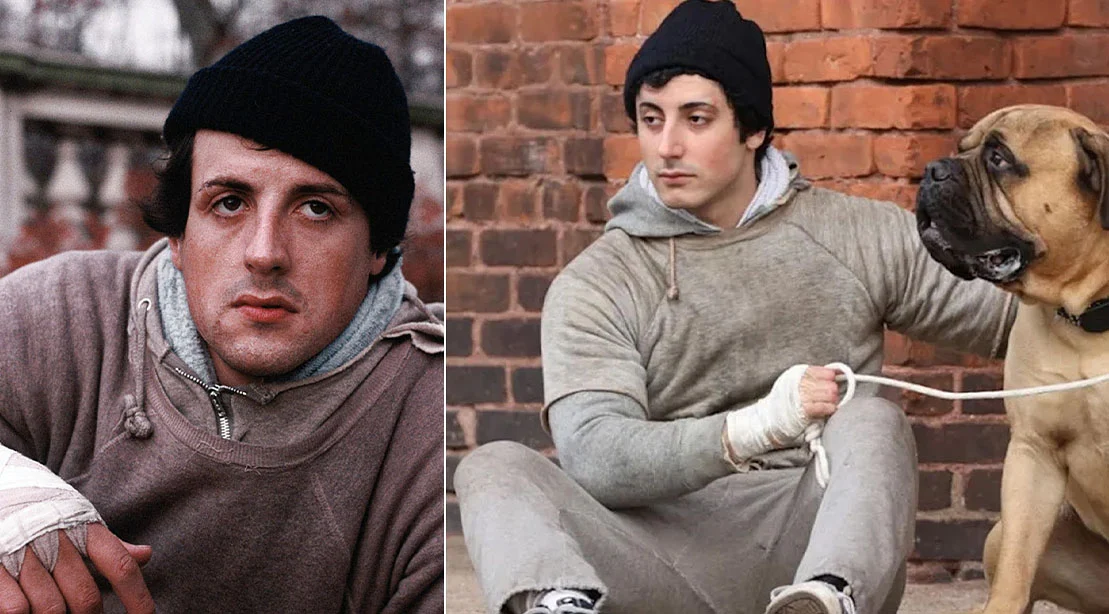
Publicity materials released for the film show Ippolito sporting the iconic grey sweats, with a jawline and intensity that eerily mirror the 1970s-era Stallone. The choice to cast Ippolito reflects a broader trend in biographical filmmaking: moving away from mere impersonation toward a psychological deep dive. By focusing on the vulnerability and the unyielding ambition of a young Stallone, Ippolito is tasked with bridging the gap between the mythic star we know and the desperate, hungry artist he once was.
Official Responses and the Blessing of the Stallion
One of the most pressing questions surrounding any biopic is the involvement—or lack thereof—of the subject. Sylvester Stallone has been famously protective of his legacy, particularly regarding the Rocky intellectual property.
Initially, reports suggested that the film was being developed without direct input from the man himself. However, in a move that has silenced critics and galvanized the fanbase, Stallone recently took to Instagram to offer his official blessing. In a post that has since gone viral, the legend wrote: "Every story has a beginning, and I’m excited to see this one brought to life. Congratulations to the cast and crew of ‘I Play Rocky.’ Keep punching."
This public endorsement acts as a seal of approval that lends the film an air of authenticity. For the production team, headed by director Peter Farrelly—who is pivoting from his usual comedic roots (Dumb and Dumber) into a more dramatic space—this support is invaluable. The script, penned by Peter Gamble, is reported to be as much a love letter to the process of filmmaking as it is a biography, focusing on the collaborative grit that turned a low-budget project into a cultural phenomenon.
Supporting Data: Why Now?
The cultural appetite for Rocky has never truly waned. Despite the franchise being decades old, the core themes of the narrative—resilience, the struggle for self-worth, and the rejection of defeat—remain universally applicable.
The 20 million views on the trailer are not merely a result of nostalgia; they reflect a contemporary obsession with "behind-the-scenes" content. Modern audiences are increasingly interested in the "making-of" narratives that reveal the fragility behind Hollywood’s polished exterior.
Furthermore, the economic viability of such a film is high. Recent successes of biographical dramas like Oppenheimer or Elvis have proven that when a biopic is executed with high artistic standards, it can command both critical acclaim and massive box-office returns. I Play Rocky is positioned to occupy this intersection of prestige drama and commercial blockbuster.
Implications for the Industry
The release of I Play Rocky—slated for November 6, 2026—carries significant implications for the film industry. Firstly, it signals a shift in how studios view legacy franchises. Rather than simply producing sequels or reboots, there is a clear appetite for exploring the "origin myths" of the franchises themselves.
Secondly, the involvement of a director like Peter Farrelly highlights a trend of genre-fluidity among established filmmakers. By stripping away the slapstick elements he is known for, Farrelly is clearly aiming for the prestige of the awards circuit. With a planned premiere at the Toronto International Film Festival this September, the industry is already anticipating a strong Oscar campaign.
Finally, the film serves as a reminder of the power of the "independent spirit." In an era where superhero blockbusters and franchises dominate the screen, the story of Rocky—a film that nearly didn’t get made—is a potent reminder that the best stories often come from the individuals who have the most to lose.
A Legacy Refined
As we look toward the 2026 release, I Play Rocky represents more than just a trip down memory lane. It is an exploration of the American Dream in its rawest form. Through the eyes of a young, hungry actor who refused to let his story be told by someone else, we are reminded of the power of conviction.
Whether you are a die-hard fan of the Rocky saga, a student of film history, or simply someone who appreciates a story of triumph against the odds, this project is one to watch. As the trailer continues to break records and the anticipation builds, one thing is clear: the Italian Stallion is back, and this time, he’s not just fighting for the title—he’s fighting for his legacy.
Keep your eyes on the release date, because if history is any indication, this is going to be the main event.