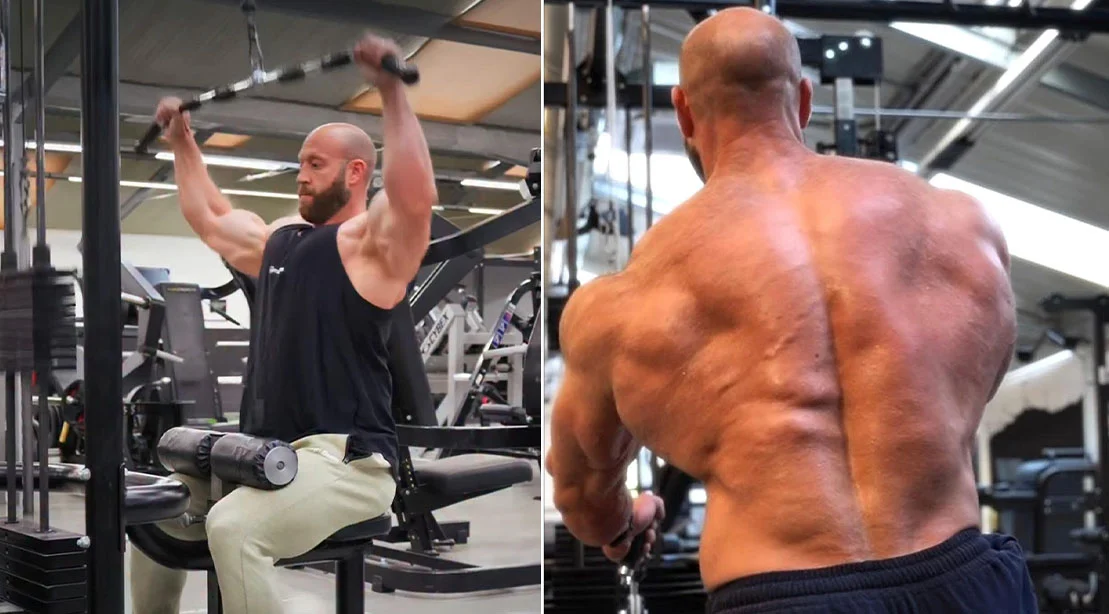
In the high-stakes world of professional bodybuilding, the prevailing image is often one of raw, unbridled ferocity—massive athletes grunting under the weight of gargantuan stacks, pushing their bodies to the absolute brink of mechanical failure. However, for IFBB Pro and elite bodybuilding coach Petar Klancir, this "more is more" philosophy is not just misguided; it is a direct obstacle to achieving true physiological hypertrophy.
The Croatian colossus, renowned for a physique that combines structural mass with surgical precision, has recently turned his attention to one of the most fundamental movements in the weight room: the lat pulldown. In a candid and highly technical breakdown shared with his followers, Klancir argues that many gym-goers are squandering their potential by prioritizing weight over the nuances of biomechanics. For Klancir, mastering the lat pulldown is not about how much iron you can move, but how effectively you can isolate the largest muscle group in the upper back.
The Anatomy of the Lat Pulldown: Why Technique Reigns Supreme
The latissimus dorsi, or "lats," are the largest muscles in the upper body. Spanning from the lower back up toward the humerus, these fan-shaped muscles are responsible for the coveted V-taper that serves as the hallmark of a professional physique. When developed through hypertrophy-specific resistance training, the lats provide a visual width that commands attention.
The lat pulldown is a staple in almost every strength program, yet it is arguably the most poorly executed exercise in the commercial gym. The premise is simple: pull a weighted bar from an overhead position down toward the upper chest. Because the movement is intuitive, most trainees assume they are performing it correctly. However, as Klancir points out, the ease of the movement is deceptive. Without a rigorous adherence to proper form, the load is frequently distributed across the shoulders, biceps, and lower back, leaving the lats under-stimulated and under-developed.
A Chronology of the "Form-First" Movement
The shift toward biomechanical precision in bodybuilding has been a slow evolution. In the early days of the sport, the focus was primarily on volume and intensity. Athletes trained to the point of exhaustion, often using "cheat reps" to force muscle growth.
However, the current era of bodybuilding, led by coaches like Klancir, has seen a pivot toward "mind-muscle connection" and "time under tension." This pedagogical shift was evidenced in Klancir’s recent social media demonstration. Rather than showcasing a heavy, ego-driven set, Klancir performed the movement with a deliberate, slow tempo. He showed that by removing the momentum and focusing on the path of the elbow, he could elicit a more profound contraction than he ever could by simply throwing weight around.
Supporting Data: The Mechanics of Hypertrophy
To understand why Klancir’s advice carries such weight, we must look at the kinesiology behind the lat pulldown. Hypertrophy—the increase in muscle size—relies on three primary factors: mechanical tension, metabolic stress, and muscle damage.
When a trainee allows their torso to swing or their elbows to flare, they are essentially introducing "compensatory movement." This forces smaller, secondary muscle groups to take over the work that the lats are supposed to perform. Data from sports science suggests that when the lats are not isolated through scapular control and fixed elbow positioning, the neural drive to the back muscles decreases significantly. Klancir’s methodology effectively minimizes this "neural leakage," ensuring that the mechanical tension is placed precisely where it belongs: on the fibers of the latissimus dorsi.
Petar Klancir’s Three Pillars of Lat Pulldown Perfection
In his recent instructional breakdown, Klancir identified three specific errors that represent the primary culprits behind stagnation in back development.
1. The Stability Principle: Eliminating Body Swing
The most common mistake observed in gyms is the use of the torso as a pendulum. Many trainees lean back excessively, using their body weight to "row" the bar down. Klancir is adamant: "Stop swinging your body to move the weight. Keep your torso stable and pull the bar to your upper chest."
The Scientific Rationale: By keeping the spine in a neutral, stable position, the trainee creates a fixed pivot point. This forces the lats to function as the primary movers of the humerus. When the body swings, the momentum of the torso masks the true load, essentially "stealing" the tension from the back muscles and turning a vertical pull into an inefficient, jerky motion that risks injury to the lumbar spine.
2. The Scapular Stretch: Protracting for Growth
Most gym-goers are taught to "retract the shoulder blades" before every movement. While this is sound advice for bench pressing, Klancir warns against starting a lat pulldown this way. "Don’t start with your shoulder blades squeezed back," he explains. "Reach up, protract your scapulae, and keep that stretch as you initiate the pull."
The Scientific Rationale: Muscle growth is heavily dependent on the range of motion through which a muscle is lengthened under load. By protracting the scapulae at the top of the movement, the lats are placed in a fully elongated, stretched state. Starting in a retracted position effectively "shortens" the muscle before the pull even begins, severely limiting the range of motion and reducing the hypertrophic stimulus.
3. The Elbow Path: Avoiding the Flare
The final error is the positioning of the elbows. Many lifters allow their elbows to drift outward, turning the exercise into a wide-grip row rather than a vertical pull. "Don’t flare your elbows out," says Klancir. "Lock them in and drive them down towards your hips."
The Scientific Rationale: The path of the elbow dictates which muscle fibers are engaged. If the elbows flare, the load shifts to the rear deltoids and the traps. By tucking the elbows slightly and driving them downward, the trainee aligns the pull with the natural fiber orientation of the lats. This ensures that the force vector is directed squarely at the lower and mid-back, maximizing the "winged" aesthetic that defines a championship physique.
Official Responses and Industry Implications
Klancir’s instructional videos have garnered significant attention within the bodybuilding community. Professional peers and strength coaches alike have lauded his emphasis on "execution over ego."
"What Petar is doing," says one prominent strength coach, "is stripping away the vanity of the weight room. It is easy to put 200 pounds on a machine and swing it around. It is much harder to put 100 pounds on and control every millimeter of the movement. The latter is what builds a pro-level back."
The implications of this approach extend beyond just aesthetics. By teaching trainees to prioritize form, Klancir is also promoting longevity. The lower back and shoulders are two of the most common sites for injury in bodybuilding. By eliminating swinging and correcting elbow positioning, athletes can train harder and more frequently without the systemic fatigue and joint inflammation associated with poor form.
Conclusion: The Path Forward
The "big man" has spoken, and his message is clear: if you want to build a back that looks like it was carved from granite, you must be willing to leave your ego at the door. Petar Klancir’s demonstration is a masterclass in the philosophy of "less is more."
By stabilizing the torso, maximizing the scapular stretch, and controlling the path of the elbows, the lat pulldown transforms from a generic exercise into a potent tool for muscle development. As Klancir puts it, "Fix these three mistakes and your lat pulldowns will feel completely different." For those who take his advice to heart, that "different" feeling is likely the first step toward significant, long-overdue growth.
In an industry often clouded by misinformation and superficial trends, Klancir stands out as a technician. He represents a new generation of bodybuilders who understand that while size is the goal, precision is the vehicle that gets you there. Whether you are a professional athlete or a weekend warrior, the path to a wider, more powerful back is not found in the weight of the stack, but in the discipline of the movement.