For the majority of elite athletes, the measure of a career is distilled into a linear progression of championships, world rankings, and podium finishes. However, for seven-time AVP champion Betsi Flint, those accolades—while still significant—no longer occupy the summit of her priorities. Today, Flint stands at the intersection of professional excellence and the demanding, beautiful chaos of motherhood, proving that the highest level of sport is not defined by the absence of struggle, but by the capacity to integrate it.
“I love when they introduce me as a mom of two,” Flint tells Muscle & Fitness. “That holds a lot more weight to me than any other accolade.”
Following the birth of her son, Odin, Flint took a strategic hiatus from the 2025 AVP season. Her return to the sand this year with the Dallas Dream has been a masterclass in adaptation, requiring her to navigate one of the most complex balancing acts in modern professional athletics: maintaining the physical requirements of a top-tier volleyball player while managing the emotional and logistical realities of raising two young children.
A Chronology of the Comeback: The Reality Behind the Facade
From an external perspective, the "postpartum comeback" is often romanticized in sports media as an effortless transition—a quick return to peak form that ignores the physiological and psychological hurdles inherent in the process. Flint is determined to dismantle that narrative.
The Physical Toll
The journey back was far from linear. Unlike her first pregnancy, her second was complicated by a severe, undiagnosed iron deficiency that left her physically depleted. “I would sit down and fall asleep,” she recalls. “Some doctors told me it was just a normal pregnancy, but it didn’t feel normal.” The resulting need for iron infusions and the subsequent recovery period meant that her physical foundation had to be rebuilt from the ground up.
The Logistics of Elite Performance
Early in the 2026 season, the logistical requirements were staggering. Flint was pumping breast milk before matches, storing it between sets, and coordinating the travel logistics necessary to sustain breastfeeding while competing at the highest level. These hurdles were not just physical; they required a mental fortitude that surpassed any tactical challenge she had faced in her decade-long career.
She admits that even after returning to the sand, the immediate results were humbling. “I want to do things that I used to do, but I’m not doing them,” she admits. “I’m not jumping as high, running as fast, or hitting as hard yet.” By choosing to celebrate incremental, weekly progress rather than chasing the ghost of her pre-motherhood self, Flint has successfully navigated the "rebuilding" phase of her professional trajectory.
Building a Better Support Team: The Evolution of Training
The most significant shift in Flint’s career has been the realization that athletic longevity is not solely about the volume of training. It is about the quality of the ecosystem surrounding the athlete.
The Pelvic Floor Revolution
While Flint has long had access to world-class strength coaches, she credits the addition of a pelvic floor physical therapist as the turning point in her recovery. “Finding a pelvic floor physical therapist that understands women coming back after having babies made such a difference,” she notes.
This specialist provided guidance on hormonal shifts and joint instability—factors that are often overlooked in traditional strength and conditioning programs. This insight allowed Flint to manage postpartum aches—which were often misidentified as "injuries"—with a nuanced, informed approach. Instead of pushing through pain that could lead to long-term issues, she learned to trust the process, guided by experts who recognized the physiological reality of the postpartum body.
A Mindset of Sustainable Progress
Flint, by her own admission, is not a patient person. Her instinct is to push through discomfort and accelerate her timeline. However, her support team—comprised of strength coaches, sports psychologists, and therapists—has been instrumental in tempering that intensity. They have taught her that rushing the recovery process is, in reality, a form of regression. By focusing on consistent, small-scale gains, she has built a foundation that is arguably more robust than the one she relied upon in her twenties.
Adaptability as a Competitive Advantage
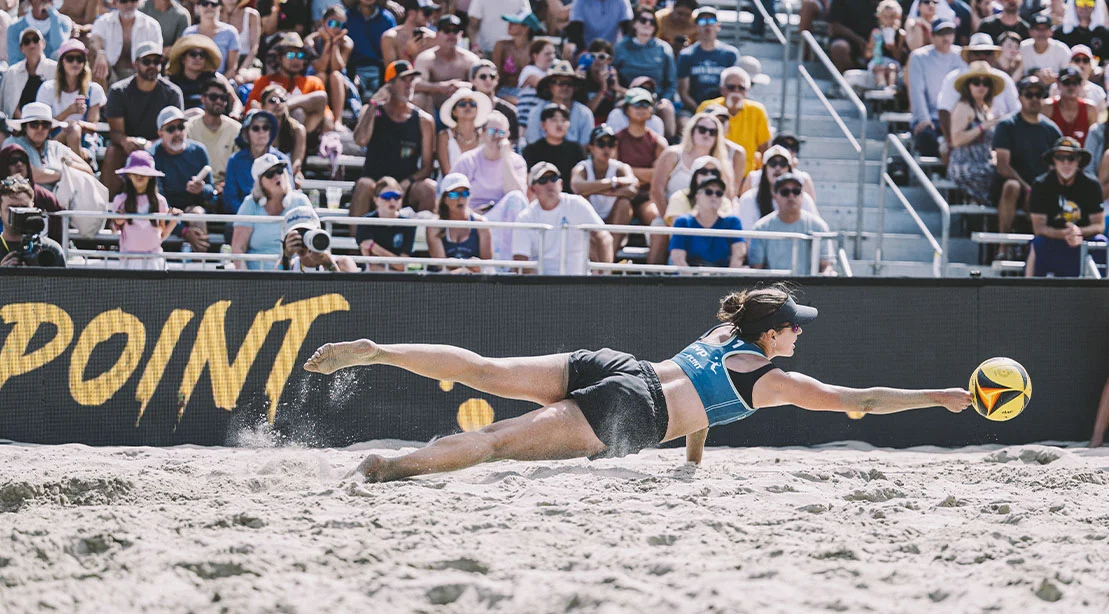
Beach volleyball is an inherently volatile sport. Unlike indoor disciplines, which occur in climate-controlled environments, beach volleyball is at the mercy of shifting sand, unpredictable wind, and extreme temperatures. For Flint, the ability to adapt to these variables has become her greatest tactical weapon.
Navigating the AVP League Format
The 2026 AVP League season has presented a new set of variables. The league’s innovative format—races to 15 points and one scheduled match per day—has been a game-changer for veteran athletes.
“It’s nice to know what time we’re playing, and we know we’re playing one match a day,” Flint explains. “I think you get to see the best performance then, versus when we play tournaments where you’re physically exhausted by the end.” By eliminating the "survival of the fittest" grind of traditional, multi-match tournament days, the league allows athletes like Flint to showcase their tactical acumen and technical precision rather than merely their endurance.
Embracing the Elements
Whether it is the stifling humidity of Miami or the intense heat of a blacktop-based court in Las Vegas, Flint has learned to treat obstacles as inherent components of the job. In Las Vegas, she and her teammates intentionally modified their 50-minute warm-up routine to conserve energy for the match itself. This is the definition of high-level performance: the ability to strip away ego and tradition in favor of what the specific moment requires.
The Pillars of Longevity: Nutrition and Daily Discipline
Longevity in professional sports is rarely the result of a single breakthrough; it is the culmination of thousands of small, disciplined choices.
The Morning Routine
Flint’s day begins between 5:00 and 6:00 a.m. Her training schedule is tightly woven around her responsibilities as a mother. By early afternoon, the "athlete" persona is set aside for the "mom" persona. This transition is not a distraction, but a grounding force. She jokes that chasing her five-year-old daughter on a bicycle has become an impromptu conditioning session, highlighting how her life and her sport have become inextricably linked.
The Power of Systems
Nutrition, specifically meal preparation, has become a cornerstone of her recovery. Flint emphasizes that by automating her nutrition through a professional partnership, she eliminates the "decision fatigue" that plagues many high-level performers. This allows her to direct her mental energy toward her family and her game rather than worrying about logistics.
Implications for the Next Generation
Flint’s career trajectory offers a roadmap for the next generation of athletes. She is a vocal critic of early specialization, which she identifies as a primary cause of burnout and overuse injuries in young players. Her own background—having played basketball, softball, and indoor volleyball—provided her with a varied motor skill set that has protected her joints and prevented the repetitive-use injuries that plague many single-sport athletes.
A Shift in Success Metrics
Ultimately, Flint is redefining what it means to be a "successful" athlete. When she eventually retires, she does not want to be remembered only for her seven AVP titles. She wants to be recognized as a teammate who elevated those around her and as a woman who navigated the profound challenges of early motherhood while remaining at the top of her game.
"Some days I’m feeling 60 percent," she says. "Success is bringing all of that 60 percent."
This philosophy—that resilience is not about being "ready," but about showing up—is the hallmark of a true champion. For the five-year-old girl at home, already wearing a miniature Dallas Dream jersey and staging matches in the living room, Betsi Flint is not just a volleyball player. She is a living example of how to build a life that is, by every measure, a success.