With the 2026 Joe Weider’s Olympia Fitness & Performance Weekend looming on the horizon in Las Vegas, the anticipation surrounding the Men’s Open division has reached a fever pitch. At the center of this storm is Chinedu Andrew “Jacked” Obiekea, a man whose physique has been described by fans and pundits alike as the “Mona Lisa” of modern bodybuilding—a blend of structural perfection, aesthetic flow, and intimidating mass.
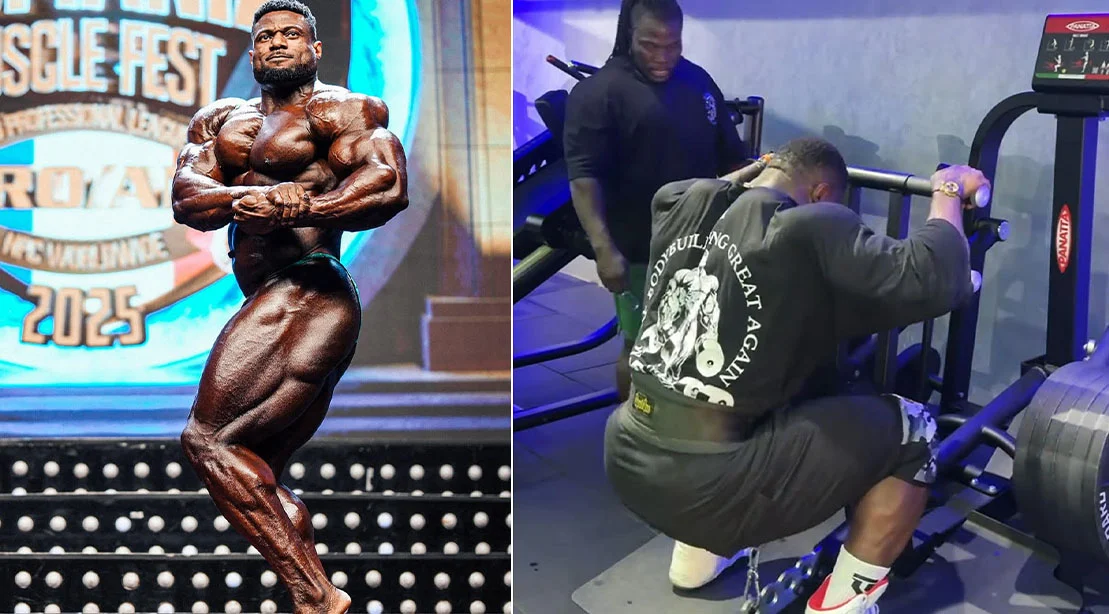
As the clock ticks toward the September 24–27 showdown, Obiekea has turned his focus toward the most grueling aspect of his preparation: his lower body. Recently taking to social media to share a high-intensity, volume-heavy leg routine, the Nigerian powerhouse has signaled to his rivals that he is not merely content with being a contender; he is building the infrastructure necessary to claim the sport’s ultimate crown.
The Path to the Sandow: A Chronology of Excellence
To understand the intensity Obiekea brings to the gym, one must look at his trajectory over the past two years. Andrew Jacked has not relied on luck to ascend the ranks; he has utilized a calculated, systematic approach to his development.
In 2025, the bodybuilding world was put on notice when Obiekea secured a hard-fought third-place finish at the Mr. Olympia. That performance was not an end goal, but a pivot point. Following the Olympia, he shifted his focus to the Arnold Classic circuit. His dominance in 2026 was total, as he swept the Arnold Classic titles in both the United States and the United Kingdom. These victories cemented his status as a legitimate threat to the long-standing hierarchy of the Men’s Open division.
Now, with less than a month before he steps onto the stage in Las Vegas, his training has shifted from the pursuit of mass to the refinement of detail. His mantra, “Brick by brick,” serves as both a training philosophy and a blueprint for his career. By focusing on the incremental progress of each muscle fiber, Obiekea is attempting to bring a package to the 2026 Olympia that addresses the minor deficiencies judges noted in his previous outings.
The Science of Hypertrophy: Decoding the “Jacked” Routine
Obiekea’s lower body session is a masterclass in biomechanical efficiency. Rather than relying on ego lifting or excessive weight that compromises range of motion, he prioritizes "time under tension" and "depth of contraction." Below is the breakdown of his current hypertrophy session, designed to sculpt the quads, hamstrings, and glutes into championship-ready form.
1. Leverage Squat Machine
The session begins on the leverage squat machine. Unlike traditional barbell squats, the fixed path of the leverage machine allows Obiekea to manipulate his stance to optimize knee flexion. By positioning his feet lower on the platform, he forces his quadriceps to take the brunt of the load. The primary benefit here is the ability to achieve a deeper depth than standard free-weight squatting, ensuring that the muscle fibers in the lower quads and the teardrop (vastus medialis) are fully stimulated.
2. Belted Squats
The second movement, the belted squat, is a staple for athletes concerned with spinal longevity. By securing a belt around his hips, Obiekea offloads the stress from his lumbar spine, allowing him to focus entirely on the leg drive. Research published in the Journal of Strength and Conditioning Research confirms that while the spinal load is significantly reduced, the activation of the quadriceps and glutes remains comparable to, or in some cases superior to, traditional back squats. For Obiekea, this is about volume without the systemic fatigue that heavy spinal loading often induces.
3. Leg Press (Low Stance)
For his third movement, Obiekea transitions to the leg press. His technique here is deliberate: he places his feet lower on the platform to maximize knee flexion. This placement shifts the mechanical demand away from the glutes and onto the quadriceps. By slowing the eccentric (lowering) phase of the movement, he maximizes the stretch on the muscle, ensuring that he reaches the point of muscular failure through precise control rather than sheer momentum.
4. Leg Extensions
The penultimate exercise is the leg extension machine, a classic isolation movement. However, Obiekea approaches this with a focus on the “peak contraction.” He holds the weight at the top of the movement for a second, feeling the muscle fibers shorten under tension. This is essential for the aesthetic "sweep" that judges look for in the front-double-bicep pose, where the quadriceps must display distinct separation and striations.
5. Plate-Loaded Hip Thrusts
The final movement is a nod to the evolution of modern bodybuilding. Obiekea utilizes a plate-loaded hip thrust machine to target the glutes. His form is impeccable—he avoids the common mistake of hyperextending the lower back, instead focusing on a horizontal plane of movement driven entirely by hip extension. This ensures maximal glute recruitment while minimizing the risk of lumbar injury.
Supporting Data: Why Form Trumps Weight
The efficacy of Obiekea’s training can be distilled into three key variables: Range of Motion (ROM), Time Under Tension (TUT), and Intent.
Sports science experts have long argued that for elite-level hypertrophy, the weight on the bar is secondary to the quality of the contraction. By sticking to a rep range of 8–12, Obiekea stays within the "hypertrophy zone," which provides enough metabolic stress to induce muscle growth without the injury risk associated with maximal 1-rep-max attempts.
Furthermore, his insistence on "brick by brick" progress reflects a long-term approach to hypertrophy. In bodybuilding, the most successful athletes are those who stay consistent over a decade rather than those who burn out in a season. By keeping his sessions focused on controlled movements, Obiekea is protecting his joints—a vital strategy for an athlete who plans to be at the top of the sport for years to come.
Official Perspectives and Industry Implications
The bodybuilding industry has taken notice of Obiekea’s shift in training intensity. IFBB Pro observers have noted that while Obiekea has always possessed the “frame” (his long limbs and small waist are genetic gifts), his recent focus on leg thickness has been the missing link to overcoming the reigning champions.
“Andrew is the most dangerous man in the lineup,” says one prominent bodybuilding analyst. “He has the aesthetic of a classic bodybuilder but the sheer mass of a modern monster. If he brings the conditioning he showed at the Arnold Classic to the Olympia stage, the title is very much within his reach.”
The implications of his victory would be seismic. Should he win, he would solidify his place as the definitive face of the sport, bridging the gap between the "mass monster" era of the early 2000s and the modern demand for "aesthetic perfection."
The Road to Las Vegas
As the September 24–27, 2026, Olympia weekend approaches, the pressure on the top-tier athletes is immense. The Olympia is not just a contest; it is a coronation. Obiekea’s social media updates serve as a reminder to his competitors that he is doing the work while they are still speculating.
For those looking to emulate his success, the advice remains simple but challenging:
- Prioritize Form: Never let the weight dictate your movement.
- Focus on the Stretch: The deeper the stretch, the greater the potential for growth.
- Consistency: A workout is only as good as the one that follows it.
As Andrew Jacked continues to grind in the gym, the world waits to see if the "Mona Lisa" of bodybuilding can finally secure the prize that would make him an immortal in the sport. The bricks are laid, the foundation is set, and in just a few weeks, the final picture will be revealed in Las Vegas.
For those interested in following the final stages of his preparation, updates are available via his official Instagram, and full event details for the upcoming Olympia can be found on the official Mr. Olympia website. The stage is set; now, it is up to the man with the drive to take what is his.