Espoo, Finland – [Date of Publication – e.g., August 15, 2023] – The tranquil waters of Oittaa Outdoor Centre in Espoo recently bore witness to a thrilling display of athleticism and strategic prowess as the Finnish Stand-Up Paddling (SUP) Sprint and Technical Race Championships unfolded as a key highlight of SM-viikko, Finland’s multi-sport national championship week. Organized by the Finnish SUP Federation in close collaboration with other SM-viikko disciplines, the event aimed not only for seamless execution but also to provide visually captivating venues for national television broadcasts by YLE. While the Technical Race earned widespread acclaim as "the best in a long time," the Sprint discipline grappled with significant logistical challenges, sparking a crucial debate about the future standards and format of SUP sprint racing in Finland.
The championships culminated in a dominant performance by Tómas Lelovits and Hanna Väisälä, who each secured double gold medals, reaffirming their status as Finland’s premier paddlers. Their victories, however, were set against a backdrop of adaptability and resilience, particularly in the sprint event, where an improvised course tested the mettle of every competitor. The broader implications of this year’s SM-viikko for SUP, including its continued visibility and the potential shift in sprint race methodologies, are now at the forefront of discussions within the Finnish paddling community.
Main Facts: A Glimpse into the Championships
The 2023 Finnish SUP Championships, encompassing both sprint and technical race disciplines, were a central feature of the annual SM-viikko, a prestigious event bringing together various national sports under one televised banner. Held at the scenic Oittaa Outdoor Centre in Espoo, the championships were meticulously organized by the Finnish SUP Federation, leveraging extensive collaboration with other sports federations to ensure a cohesive and high-quality sporting spectacle. A primary objective was to create visually engaging competition areas suitable for YLE’s extensive television coverage, aimed at showcasing the dynamic nature of stand-up paddling to a national audience.
However, the path to sporting glory was not without its obstacles. The construction of the mandated 200-meter sprint track presented a considerable hurdle. Ultimately, a dedicated SUP sprint track could not be realized, necessitating a last-minute adaptation of the coastal rowing beach sprint course. This compromise resulted in a track that was slightly overlong, notably narrower than standard, and critically, lacked the crucial central buoys typically used to delineate individual racing lanes. These improvisations directly impacted race dynamics and sparked significant post-event discussion among athletes and organizers regarding fairness and future planning.
Despite these challenges, both disciplines delivered high-octane competition. Hanna Väisälä demonstrated formidable form, securing gold in both the women’s sprint and technical race. In the men’s category, former world champion Tómas Lelovits replicated this feat, clinching double gold. Isa Merikallio consistently challenged Väisälä, earning silver in both events, while the men’s podiums saw fierce competition, particularly with the impressive performances of Thomas Fagerström and the emerging talent of Sami Lelovits and Lauri Palmroth. The Technical Race, in particular, was lauded by competitors for its dynamic nature, constant overtakes, and strategic depth, overcoming an initial delay caused by a thunderstorm to deliver a truly memorable contest.
The event not only crowned national champions but also served as a vital platform for SUP, offering significant media exposure and a high-profile stage for both established stars and promising newcomers. As SM-viikko in its current format faces an uncertain future beyond this year, the success and challenges of the SUP championships offer valuable lessons for the sport’s continued development and integration into Finland’s sporting landscape.
Chronology of Events: From Preparation to Podium
The journey to the Finnish SUP Championships at Oittaa was marked by intensive preparation and, for the sprint discipline, a significant test of adaptability.
Preparations and Early Challenges
Months of planning by the Finnish SUP Federation, in concert with the broader SM-viikko organizing committee, aimed to craft an exemplary event. The picturesque Oittaa Outdoor Centre was chosen for its natural beauty and existing infrastructure, offering a superb backdrop for televised competition. A key focus was on creating visually stunning race venues that would translate well to YLE’s live broadcasts, highlighting the vibrant action of stand-up paddling.
The most formidable pre-event challenge centered on the 200-meter sprint course. Adhering to competition rules for such a short, intense race demands a precisely marked, straight course with clearly defined lanes. However, the logistical complexities and resource constraints at Oittaa prevented the construction of a dedicated SUP sprint track. In a swift, albeit challenging, pivot, the decision was made to utilize and adapt the existing beach sprint course designed for coastal rowing. While providing a functional race environment, this adaptation came with inherent compromises: the course was slightly longer than the official 200m, notably narrower than ideal for multi-competitor sprint heats, and crucially, lacked the central buoy markers that would typically separate racers and prevent drafting or accidental contact. This laid the groundwork for a sprint competition where athletes would have to contend not only with their rivals but also with the unique characteristics of the improvised track.
Sprint Race: A Test of Adaptability
The sprint races commenced with palpable anticipation, especially given the modified course. The men’s division featured two preliminary heats, designed to narrow the field for the grand final. From the first heat, Tómas Lelovits, a seasoned former world champion, and Lauri Palmroth secured their direct qualification. The second heat saw Thomas Fagerström and Sami Lelovits, Tómas’s son, earn their spots. Hormoz Zarei and Janne Laine completed the six-person final lineup, qualifying based on their times.
The women’s category, due to a smaller field, proceeded directly to a single, high-stakes final.
Women’s Sprint Final: A Photo Finish Thriller
The women’s final immediately showcased the raw power of Hanna Väisälä, the pre-race favourite, who burst off the start line with an explosive acceleration, quickly establishing a lead. Kukka Kirjavainen, demonstrating impressive speed, managed to stay tightly on Väisälä’s tail in the initial surge. However, as the race progressed, Kirjavainen found herself inadvertently drifting into Väisälä’s line, forcing her to expend valuable energy and make extra adjustments to maintain a clear path to the finish. Väisälä, unfazed, continued her powerful stroke, paddling convincingly to claim the Finnish Championship title.
Behind her, Isa Merikallio delivered a masterclass in consistent, error-free paddling, steadily climbing through the ranks to secure a well-deserved silver medal. The battle for bronze, however, was a nail-biting affair, unfolding right down to the final meters between Kukka Kirjavainen and Nina Into. The intensity of their struggle necessitated multiple reviews of the photo-finish camera images before Nina Into was ultimately declared the narrow bronze medalist. Kirjavainen, despite her valiant effort, finished fourth, followed by Vellamo Viitanen in fifth and Tytti Kuusi in sixth.
Men’s Sprint Final: Lelovits Senior Dominates
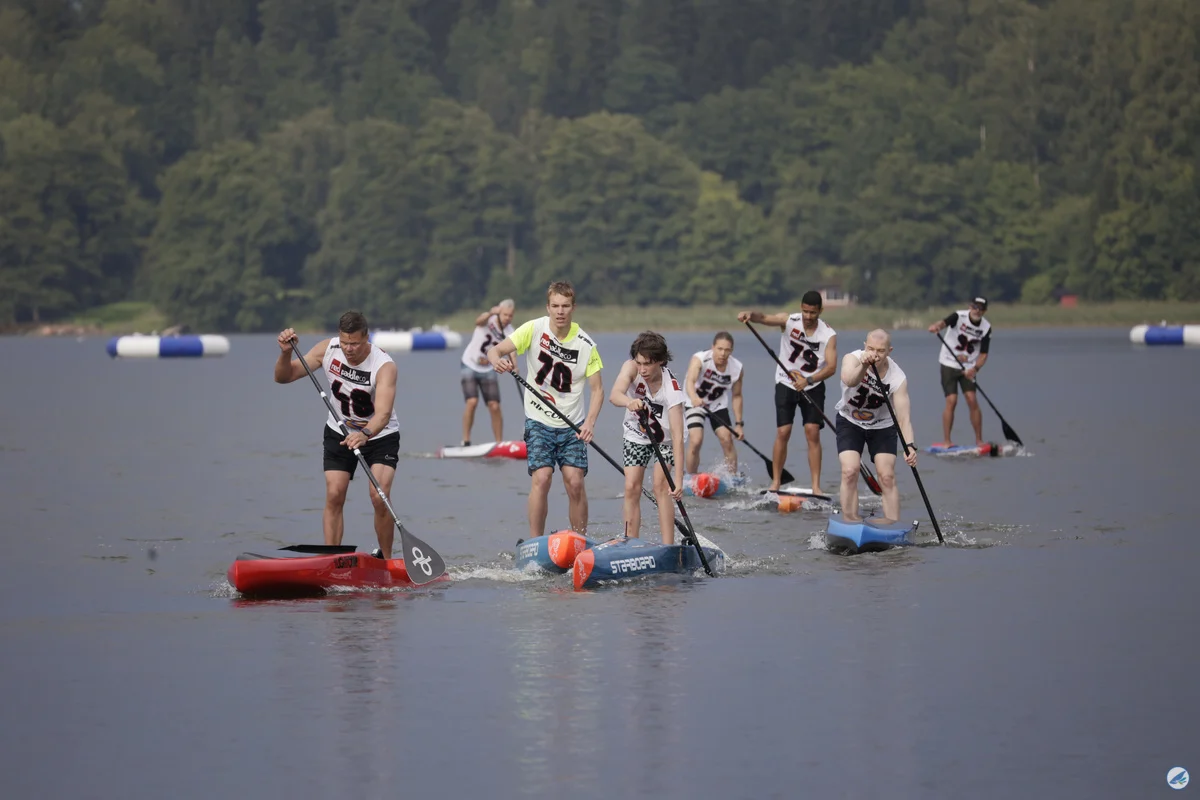
The men’s final was equally charged from the outset. Tómas Lelovits, Thomas Fagerström, and Lauri Palmroth swiftly asserted their dominance, seizing the leading positions right from the start. A moment of misfortune struck Sami Lelovits, who, in the chaotic initial acceleration, found himself caught in the powerful wake of his father, Tómas, hindering his early momentum. This allowed the leading trio to establish a significant break from the rest of the field in the early stages of the race.
Fagerström mounted a formidable challenge to Tómas, pushing him hard for approximately 150 meters. However, Tómas Lelovits, drawing on his vast experience and legendary power, ultimately demonstrated his superior strength in the closing meters, paddling to a decisive victory. Lauri Palmroth maintained a clear distance to secure the bronze medal, while Sami Lelovits, recovering from his initial setback, finished fourth. Janne Laine and Hormoz Zarei rounded out the final standings in fifth and sixth place, respectively.
Technical Race: "The Best in a Long Time"
Following the sprints, attention turned to the Technical Race, a discipline known for its blend of speed, strategy, and agility around buoys.
Thunderstorm Delays and Course Description
The start of the Technical Race was dramatically delayed by an unexpected thunderstorm, which brought with it heavy rain and strong gusts of wind. Safety protocols were enacted, and racing could not commence until the weather conditions sufficiently abated and, importantly for the broadcast, YLE’s camera drones could safely return to the sky. Once the all-clear was given, the women’s race was the first to take to the water.
The Technical Race course, identical to the previous year, was laid out in an "M" shape, requiring two laps of a challenging circuit. The race featured a dynamic beach start and finish, adding to the spectacle. Utilizing the robust competition buoys from the coastal rowing event, the course integrated sharp turns and required competitors to round a flag positioned on the beach between their two laps, adding an extra dimension of skill and transition.
Women’s Technical Race: Väisälä’s Double Gold
Hanna Väisälä, fresh off her sprint victory, was again the clear favourite in the Technical Race. She wasted no time in asserting her dominance, seizing control of the race from the very first stroke. Isa Merikallio, however, had made a strategic equipment change from the sprint race, opting for a technically more agile inflatable board over her rigid board. This choice, while potentially beneficial for the turns, might have contributed to a slower initial acceleration, as the sprint silver medalist found herself towards the back of the pack in the early stages. Meanwhile, Tytti Kuusi and Nina Into were locked in a tight battle for positions right from the first turn buoy.
Merikallio, demonstrating remarkable composure and skill, steadily worked her way through the field. Her consistent pace and flawless execution of the demanding buoy turns saw her climb to second place during the first lap, a position she expertly maintained until crossing the finish line, securing her second silver of the championships. Väisälä, meanwhile, paddled to an overwhelming victory, completing a magnificent double gold performance. The fight for bronze between Tytti Kuusi and Nina Into was once again a thrilling affair, ultimately decided on the final straight. Kuusi managed to summon a decisive burst of power, narrowly edging out Into at the finish line to claim the bronze medal.
Men’s Technical Race: Lelovits Senior Reigns, Lelovits Junior Shines
The men’s Technical Race began with a tightly packed start, but Tómas Lelovits, in a display of his characteristic power and tactical acumen, quickly broke away, establishing a lead on the very first leg of the course. He arrived at the first turn buoy as the undisputed leader. Behind him, Lauri Palmroth, who had a strong start, unfortunately overshot his turn slightly. This momentary miscalculation created an opening for the agile young challengers, Elias Rantala and Sami Lelovits, who executed nimble inside turns to surge ahead of him.
Palmroth, however, quickly regrouped and, with a better turn at the second buoy, reclaimed his second position. He was closely pursued by Sami Lelovits, Elias Rantala, and Thomas Fagerström, forming a dynamic chase group. Further back, Hormoz Zarei and Janne Laine engaged in their own intense battle for fifth place, slightly trailing the leading pack.
As the second lap commenced, Tómas Lelovits had extended his lead significantly, appearing unstoppable. The real drama unfolded in the battle for the remaining podium spots, where positions shifted almost constantly with every turn. Elias Rantala, who had been mounting a strong medal challenge, suffered an unfortunate setback with a fall at the second-to-last buoy, ending his podium hopes.
Palmroth arrived at the final buoy in second place, but Sami Lelovits, demonstrating exceptional turn speed and tactical awareness, executed a brilliant inside turn to draw level. On the final straight, Sami Lelovits unleashed a powerful sprint, surging ahead to claim the silver medal, leaving Palmroth to settle for a well-fought bronze. Thomas Fagerström finished fourth, with Elias Rantala recovering to fifth. Hormoz Zarei and Janne Laine completed the top seven.
Following the races, an unusual consensus emerged among competitors and spectators alike: both the men’s and women’s Technical Races were hailed as "the best in a long time." The M-shaped course, combined with the athletes’ skill, led to a continuous spectacle of overtakes, strategic maneuvers, lightning-fast turns, and frequent position changes, maintaining an electrifying level of excitement from the starting gun to the final sprint across the finish line.
Supporting Data: Context and Depth
To fully appreciate the scope and impact of the Finnish SUP Championships, it’s essential to understand the broader context of SM-viikko and the technical nuances of SUP racing.
SM-viikko: A National Sporting Showcase
SM-viikko, or the Finnish Championship Week, is a unique multi-sport event that brings together national championships from various sports into a single, high-profile festival. Its primary aim is to elevate the visibility of diverse sports, from traditional disciplines to emerging ones like SUP, by centralizing media coverage and offering a shared platform. YLE, Finland’s national broadcasting company, plays a crucial role in this, providing extensive live television coverage that reaches a broad audience across the country. For sports like SUP, inclusion in SM-viikko offers invaluable exposure, helping to grow participation and public interest.
The Disciplines: Sprint vs. Technical Race
Sprint Racing in SUP is a pure test of explosive power, acceleration, and maximum speed over a short distance. Traditionally, this is a head-to-head format, demanding a perfectly straight course to ensure fairness. The 200-meter distance, while challenging, is still a relatively short, all-out effort. The reliance on a dedicated, buoy-marked track is paramount to prevent drafting (riding in a competitor’s wake) and ensure clear, unhindered racing lines. The current international trend, as seen in ICF (International Canoe Federation) World and European Championships, has shifted to an even shorter, more explosive 100-meter sprint, emphasizing raw speed and quick reactions.
Technical Race, on the other hand, is a more dynamic and strategic discipline. It combines elements of speed, endurance, agility, and tactical thinking. Competitors navigate a multi-lap course featuring numerous buoy turns, often including beach sections or transitions. The ability to execute fast, clean turns, manage wave wash, and strategize overtakes is crucial. The "M-shaped" course at Oittaa, with its beach start/finish and flag turn, perfectly exemplifies the exciting and challenging nature of this format, demanding both physical prowess and mental acuity.
The Impact of Track Conditions on Sprint Fairness
The adapted sprint track at Oittaa, being narrower and lacking central buoys, had a tangible impact on the fairness of the competition. In a sport where even minor advantages can dictate the outcome, the absence of clear lane separation meant that competitors could inadvertently or strategically benefit from the wake of faster paddlers. This "drafting" effect, while a legitimate tactic in some long-distance races, is typically mitigated or prohibited in sprint events to ensure each athlete competes on an equal footing. The discussions among athletes post-race highlighted this concern, underscoring the importance of standardized course conditions for competitive integrity.
Athlete Profiles: Champions and Contenders
Hanna Väisälä and Tómas Lelovits stand as pillars of Finnish SUP. Väisälä’s consistent dominance across both sprint and technical disciplines underscores her exceptional versatility and top-tier athleticism. Lelovits, a "former world champion," brings a wealth of international experience and a proven winning mentality to the domestic scene. Their ability to perform under pressure and adapt to varying conditions solidifies their status as national leaders. The emergence of talents like Sami Lelovits, challenging his father, and the consistent performances of Isa Merikallio, Thomas Fagerström, and Lauri Palmroth, signify a healthy and competitive landscape for Finnish SUP, promising an exciting future for the sport.
Official Responses & Debates: Charting the Future
The 2023 Finnish SUP Championships, while celebratory in many respects, also ignited important conversations regarding the future direction of the sport’s competitive framework in Finland.
The Sprint Dilemma: A Call for Standardization
The most significant point of discussion centered on the sprint race. The Finnish SUP Federation, as the organizing body, acknowledged the substantial effort required to construct a compliant 200-meter sprint track. The compromises made at Oittaa – the narrow course, the slightly extended distance, and the critical absence of central buoys – were not lost on the competitors. Many athletes expressed valid concerns that these conditions led to unfair situations, particularly when faster paddlers created wakes that affected adjacent competitors, blurring the lines of individual performance.
A strong sentiment emerged among the athletes that for future SM-level sprint competitions, it would be preferable to host the event at locations already equipped with standard, purpose-built race tracks. A prominent suggestion was to integrate the SUP sprint championships with existing canoe sprint national championships. Such venues typically feature multi-lane, buoy-marked courses that adhere to international standards, ensuring a level playing field, producing comparable times, and providing each competitor with a clear, defined racing line. This would not only guarantee fairer competition but also streamline the logistical burden on organizers.
Further complicating the sprint discussion was the evolving international standard. The International Canoe Federation (ICF), the global governing body for paddle sports, has recently shifted its World and European Championship sprint distance to 100 meters. This change prompts a crucial question for the Finnish SUP Federation: should national championships align with this international trend to better prepare athletes for global competition, or maintain the 200-meter format for other reasons? This debate highlights the tension between domestic logistical realities and the aspiration for international competitive relevance.
Unanimous Acclaim for the Technical Race
In stark contrast to the sprint discussions, the feedback for the Technical Race was overwhelmingly positive. Competitors, officials, and spectators alike shared a rare consensus: "This was the best technical race in a long time." The M-shaped course, combined with the challenging weather conditions that added an unpredictable element, created a truly dynamic and engaging spectacle.
The reasons for this high praise were clear: the course design facilitated constant overtakes, showcasing strategic decision-making around buoys and on the beach section. Fast, precise turns were rewarded, and the fluid nature of the race led to numerous position changes throughout, keeping the outcome uncertain until the very final moments. This made for compelling viewing and demonstrated the full potential of the technical race format to engage both athletes and audiences. This positive reception provides a strong blueprint for future technical race planning.
The Finnish SUP Federation’s Role
The Finnish SUP Federation, despite the sprint track challenges, demonstrated significant commitment to promoting and organizing high-level SUP competition. Their proactive engagement in SM-viikko, their collaboration with other sports, and their efforts to secure YLE broadcast coverage underscore their dedication to growing the sport. Moving forward, the feedback and discussions generated by this year’s championships will be crucial for the Federation in refining future event formats and ensuring the continued development and fairness of SUP racing in Finland.
Implications & Future Outlook: A Crossroads for Finnish SUP
The 2023 Finnish SUP Championships at Oittaa represent a pivotal moment for the sport in Finland. While delivering quality competition and celebrating outstanding athletes, the event also brought to light critical considerations for the future, particularly concerning its integration into national sporting structures and its competitive standards.
The Future of Sprint Racing in Finland
The detailed discussions among competitors regarding the sprint track conditions and the call for standardized venues have significant implications. The Finnish SUP Federation now faces a clear mandate to re-evaluate how and where sprint championships are organized. Aligning with existing standard venues, perhaps co-locating with canoe sprint events, would address many of the concerns about fairness, safety, and comparability of results. Furthermore, the international shift to a 100-meter sprint distance by the ICF requires careful consideration. Adopting this shorter format domestically could better prepare Finnish athletes for international success, but would also necessitate a complete overhaul of current national standards and expectations for the discipline. The decision on sprint format and venue will undoubtedly shape the competitive landscape for years to come.
SM-viikko’s Uncertain Future for SUP
A significant piece of news emerging from the event is that SM-viikko, in its current YLE-televised multi-sport format, is set to conclude this year, at least temporarily. For SUP, this poses a substantial challenge. SM-viikko has served as an unparalleled platform for visibility, attracting national media attention and showcasing the sport to a wide audience. The loss of this high-profile stage could impact SUP’s growth trajectory and its ability to attract new participants and sponsors. The Finnish SUP Federation will need to explore alternative avenues for maintaining the sport’s profile and securing media coverage for its national championships in the years to come. This may involve seeking standalone broadcast agreements or integrating into other existing sports festivals.
Continued Growth and Visibility for Stand-Up Paddling
Despite the logistical hurdles and the uncertainty surrounding SM-viikko, the 2023 championships unequivocally affirmed the vibrant health and growing popularity of stand-up paddling in Finland. The event successfully delivered high-quality competition, providing an excellent stage for both seasoned champions and emerging talents to test their skills. The significant visibility generated through YLE’s coverage, even for this final iteration of SM-viikko, has undoubtedly contributed to raising the sport’s profile and inspiring new enthusiasts. The unanimous praise for the Technical Race, in particular, highlights the exciting potential of this dynamic discipline to captivate audiences and offer thrilling competition.
The spirit of collaboration, evident in the close cooperation between the Finnish SUP Federation and other SM-viikko organizers, is a testament to the community’s dedication. This collaborative ethos, coupled with the passion of the athletes and the support of partners like Foodin and Laguuni, will be crucial in navigating the forthcoming changes and ensuring the continued thriving of stand-up paddling in Finland.
In conclusion, the Finnish SUP Championships at Oittaa were a microcosm of the sport itself: dynamic, challenging, and ultimately, rewarding. While the sprint race highlighted areas for improvement and adaptation, the technical race showcased the discipline at its thrilling best. As Finnish SUP stands at a crossroads, the lessons learned and the momentum gained from this year’s championships will be invaluable in charting a course for an even stronger, more standardized, and widely recognized future.
Results SUP SM Sprint
Women
- Hanna Väisälä
- Isa Merikallio
- Nina Into
- Kukka Kirjavainen
- Vellamo Viitanen
- Tytti Kuusi
Men
- Tómas Lelovits
- Thomas Fagerström
- Lauri Palmroth
- Sami Lelovits
- Janne Laine
- Hormoz Zarei
Results SUP SM Technical Race
Women
- Hanna Väisälä
- Isa Merikallio
- Tytti Kuusi
- Nina Into
- Kukka Kirjavainen
- Vellamo Viitanen
Men
- Tómas Lelovits
- Sami Lelovits
- Lauri Palmroth
- Thomas Fagerström
- Elias Rantala
- Hormoz Zarei
- Janne Laine
Image Credit: Kai Lindqvist