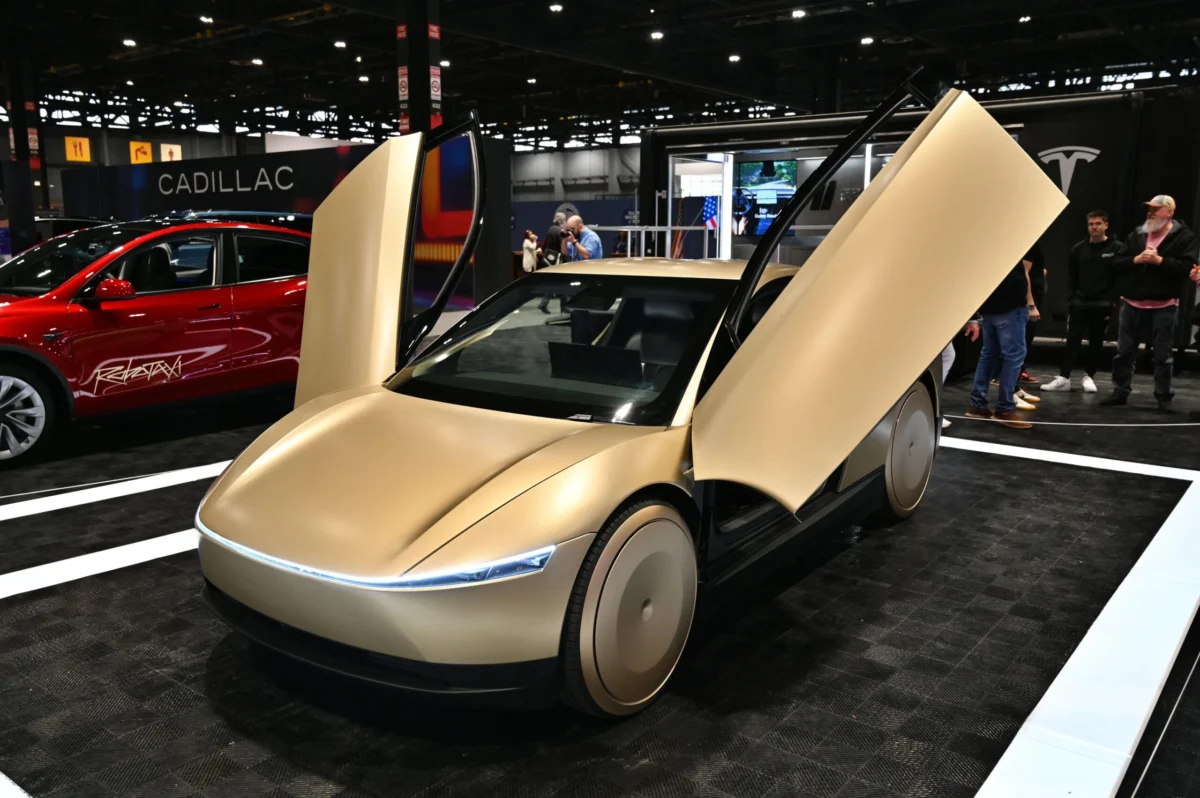
Matte gold, sleekly sloped, and conspicuously devoid of a steering wheel or pedals, the Tesla Cybercab is less of an automobile and more of a rolling manifesto. It is a vehicle designed not just for transportation, but for disruption—a deliberate, provocative aesthetic choice intended to signal the end of the human-driven era.
As Tesla prepares to host a high-stakes event at its Austin, Texas, headquarters this Thursday, the automotive world holds its breath. This unveiling marks a critical inflection point: the official introduction of the Cybercab into the company’s burgeoning ride-hail service. For Tesla, which has spent the better part of a decade promising a self-driving revolution, the moment is a test of whether it can transform from a manufacturer of consumer vehicles into a dominant force in autonomous robotics.
The Main Facts: A Bold Bet on Autonomy
The Cybercab is the centerpiece of Elon Musk’s long-term vision to pivot Tesla away from mass-market passenger vehicle sales and toward a service-oriented model centered on artificial intelligence. Following its initial debut on the Warner Bros. studio lot in 2024, the vehicle has moved from a flashy concept to a tangible, albeit controversial, reality.
Tesla has already begun integrating these vehicles into its pilot programs. Since last summer, a test fleet has been navigating the streets of Austin, with expansion plans already underway in Texas and Florida, and regulatory permits in hand for Arizona and Nevada. According to recent data, Tesla has added 51 Cybercabs to its Texas-registered fleet, operating alongside a support group of 263 Model Y vehicles.
However, the path forward is fraught with regulatory and technical hurdles. While Tesla pushes for autonomy, the legal landscape remains fractured. In regions like the San Francisco Bay Area, operating a robotaxi without a human driver behind the wheel remains prohibited, highlighting the deep divide between the company’s ambitions and the current legislative reality.
Chronology: From Promises to Pavement
The trajectory of Tesla’s autonomy dream has been marked by a series of aggressive, often shifting, timelines:
- 2016–2024: For nearly a decade, Elon Musk has asserted that Tesla vehicles in the hands of consumers were merely a "software update away" from full self-driving capability. These promises were repeatedly met with skepticism as the technology failed to reach the required level of reliability.
- 2024: Tesla officially debuts the Cybercab prototype at a Warner Bros. event, signaling a pivot toward dedicated autonomous hardware.
- June 2026: Tesla begins real-world testing of the steering-wheel-free Cybercab on public roads in Austin. These tests currently involve a human safety monitor in the passenger seat, ready to intervene at any sign of technical failure.
- Late 2026: Musk has publicly committed to selling the Cybercab directly to consumers by the end of the year, a move that would represent a radical shift in the company’s business model.
- Present Day: Tesla prepares for its Austin headquarters event, aiming to prove to shareholders and the public that the "Cybercab" is a scalable reality rather than a speculative toy.
Supporting Data: The Efficiency Dilemma
Success in the robotaxi sector is rarely about the car itself; it is about the "unit economics" of the operation. As J.D. Alexander, founder of AVFleetTech, notes, "These AV companies are spending so much money getting this technology in place, but in order to scale up the business, the economics come down to utilization."
To turn a profit, a robotaxi must be a workhorse. It requires a sophisticated infrastructure for charging, cleaning, maintenance, and fleet management. Tesla’s strategy, consistent with its "do-it-yourself" corporate culture, is to keep these processes in-house. While competitors like Waymo have entered into strategic partnerships—Avis manages their fleet logistics, and Lyft provides market integration—Tesla intends to leverage its existing network of service centers.
The company is even exploring automation for the maintenance cycle. A June 2025 architectural permit filed in Texas points to the inclusion of a "cleaning robot" at its primary hub, an effort to minimize human intervention. However, beyond a brief promotional video, the details of this automated cleaning system remain obscure.
Official Responses and Industry Skepticism
The reception to Tesla’s approach has been polarized. On one side, internal excitement is palpable. Ashok Elluswamy, Tesla’s head of AI software, recently posted on X that "the streets won’t be the same anymore." When a user questioned if the vehicles would "flood Austin," Musk replied with a succinct "Yes."
Conversely, the industry remains deeply skeptical of Tesla’s "camera-only" approach. While Tesla insists that its visual-based AI can navigate complex, chaotic urban environments, industry leader Waymo has been vocal in its dissent. In a recent blog post, Waymo stated clearly: "Cameras are incredible, but they aren’t enough." Waymo’s own fleet relies on a combination of lidar, radar, and cameras—a redundant, albeit more expensive, sensor suite that most experts argue is essential for safety.
Furthermore, the National Highway Traffic Safety Administration (NHTSA) remains a looming presence. Following a series of crashes involving the "Full Self-Driving" (FSD) system, the NHTSA opened an ongoing investigation into Tesla’s software. The agency’s scrutiny centers on the system’s performance in poor visibility conditions, a direct challenge to Tesla’s core premise that inexpensive cameras are sufficient for full autonomy.
Implications: The Shift from Hardware to Software
The fundamental question regarding the Cybercab is whether it is merely a ride-hail asset or a consumer product. If Tesla follows through on its promise to sell these units to individuals, it will create a complex legal and insurance quagmire. Who is liable in a crash when a vehicle operates without a steering wheel? How will states handle registration for a car that, by design, cannot be manually operated?
Seth Goldstein, a senior equity analyst for Morningstar, emphasizes that the hardware is secondary to the software. "Longer term, the software is the most important piece," Goldstein says. "This is a very important step, to put the Cybercab in production, but ultimately, it only matters if the software can allow a car to navigate safely."
The current FSD (Supervised) product serves as a cautionary tale. Despite the $99 monthly fee and the advanced features—such as lane changes and stoplight recognition—the company’s own manuals explicitly warn that drivers must remain attentive. The gap between "supervised" autonomy and the "unsupervised" future promised by the Cybercab remains vast.
Conclusion: A High-Stakes Unveiling
As Thursday’s event approaches, the Cybercab represents more than just a new vehicle; it is a declaration of intent. Tesla is betting its future on the idea that it can master the "chaos" of the road through software innovation and vertical integration.
If successful, the Cybercab could redefine urban mobility, effectively turning every Tesla owner into a potential fleet operator and every street into a data-gathering node. If it fails, or if the safety concerns continue to mount, the Cybercab risks becoming a gilded monument to the limits of AI-driven ambition.
For now, the Austin streets provide the testing ground. As the matte-gold prototypes continue to circulate, observers will be watching not just for the shine of the metal, but for the reliability of the "brain" beneath the hood. The promise of a world where one can hail a robotaxi at the touch of a button is seductive, but as the industry knows well, the distance between a prototype and a profitable, safe, and scalable service is measured in more than just miles—it is measured in the trust of the public and the watchful eyes of regulators. The streets may never be the same, but whether that change is a revolution or a malfunction remains to be seen.