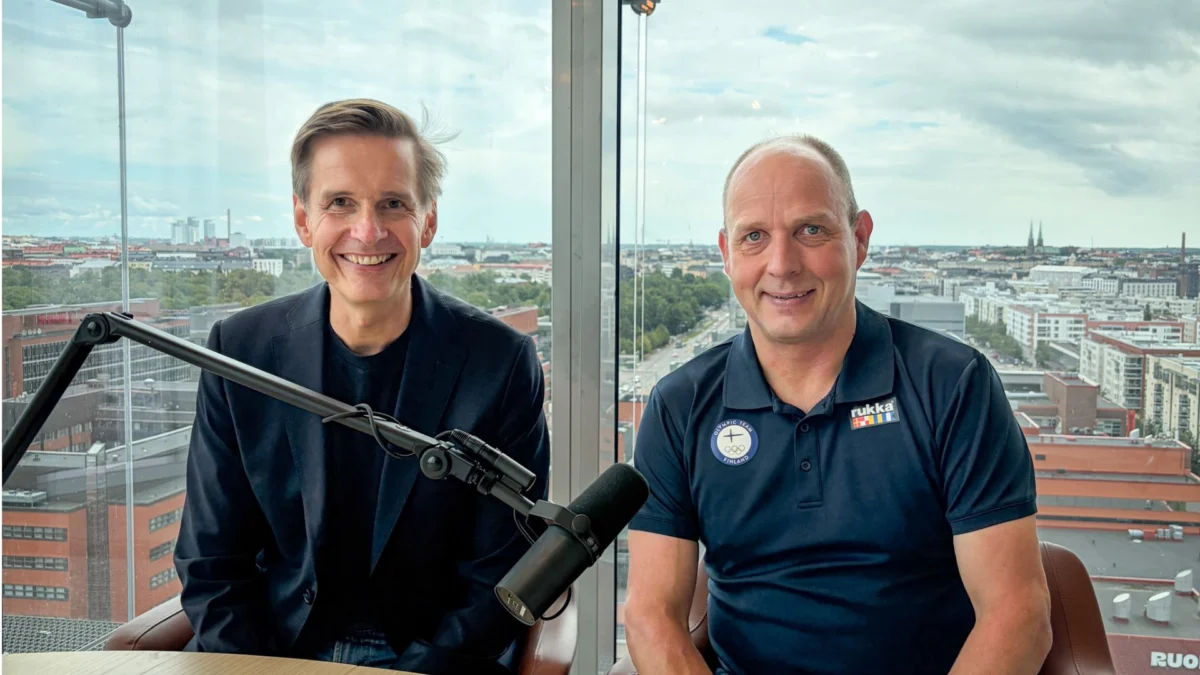
In the high-stakes world of professional sports, the margin between gold and obscurity is often measured in milliseconds. Yet, as the lines between elite athletics and corporate strategy continue to blur, experts are increasingly looking to the training grounds of Olympians to solve the stagnation plaguing modern business. In the latest episode of the Better is Possible podcast, host Sami Laine sits down with Janne Hänninen, the High-Performance Director at the Finnish Olympic Committee, to dissect the mechanics of success, the anatomy of motivation, and the cultural shifts required to foster true innovation.
The Core Thesis: Beyond the Podium
The conversation between Laine and Hänninen arrives at a critical juncture for Finnish industry. A 2026 report commissioned by Deloitte and Demos Helsinki—which surveyed 20 international executives leading Finnish firms—highlighted a systemic "growth trap." These leaders identified four primary brakes on Finnish organizational growth: excessively modest goal-setting, a deep-seated aversion to risk, a cultural preference for consensus over healthy friction, and a tendency to prioritize operational efficiency over transformative renewal.
According to Hänninen, these are the same hurdles that separate a regional athlete from an Olympic champion. The transition from "good" to "great" is rarely about talent alone; it is about the structural alignment of dreams, goals, and the relentless, granular pursuit of improvement.
Chronology of Excellence: From Athlete to Architect
Janne Hänninen’s perspective is informed by a decorated career as an athlete followed by his transition into the administrative helm of Finnish sports. His journey offers a unique roadmap for understanding how high-performance mindsets are developed.
- The Formative Years: Hänninen notes that in the early stages of an athlete’s career, the focus is almost exclusively on skill acquisition and physical adaptation. The "dream"—such as winning an Olympic medal—is a distant beacon, not an immediate operational target.
- The Tactical Shift: As an athlete progresses, the focus shifts from general improvement to specific, measurable outcomes. Hänninen emphasizes that goals are not static; they must evolve in tandem with the athlete’s capacity and the competitive landscape.
- The Leadership Phase: As High-Performance Director, Hänninen has moved away from the "command and control" model. He argues that in both sports and business, the leader’s role is to cultivate an ecosystem where the best ideas win, regardless of their source. This evolution of leadership—from dictating tactics to facilitating a high-performance culture—is the defining challenge of his current role.
Supporting Data: The "Growth Brakes" of Finnish Leadership
The Deloitte-Demos report provides a sobering look at why Finnish businesses often struggle to scale globally. The data suggests that the "consensus culture" often lauded as a strength in social policy becomes a liability in a fast-moving market.
The Four Brakes on Growth:
- Modesty in Ambition: Goals are often set to be achievable rather than aspirational.
- Risk Aversion: A cultural tendency to wait for certainty before acting, which often results in missing the market window.
- Consensus Over Friction: The avoidance of "difficult" conversations, leading to a sterile environment where innovation is stifled by a desire for harmony.
- The Efficiency Trap: Prioritizing the optimization of current processes at the expense of reinventing the business model.
Hänninen aligns with these findings, noting that in elite sports, "consensus" is often the enemy of progress. If a coach and an athlete agree on everything, it usually means the athlete is not being challenged enough to reach their full potential.
The Philosophy of "Daily Improvement"
One of the most compelling aspects of Hänninen’s interview is his distinction between a goal and the process. "A dream is a direction; a goal is a target; but the daily grind is the engine," he explains.
The Mathematics of Success
In elite sports, results are visible and binary—you either win or you don’t. However, Hänninen insists that focusing on the result is a rookie mistake. Instead, he advocates for an obsessive focus on the "performance indicators" that lead to the result.
"If you want to shave a tenth of a second off a sprint, you don’t just ‘try harder,’" Hänninen says. "You break the movement down. You measure the angle of the push-off, the recovery time of the muscles, and the nutritional intake. You optimize the variables that sit behind the performance."
This, he argues, is where corporate leaders fail. They focus on the quarterly earnings report (the result) rather than the cultural and operational variables (the process) that determine those earnings.
Official Responses and Strategic Implications
When asked about how to change the culture of an organization, Hänninen points toward the Norwegian model of elite sports development. Unlike the siloed nature of Finnish sports, where each federation often acts as an island, Norway utilizes a "70-20-10" learning model:
- 70% Learning through doing: Real-world problem solving in the field.
- 20% Mentoring: Knowledge transfer between veteran and junior staff.
- 10% Formal training: Traditional education and seminars.
"The Norwegians don’t hold ‘strategy days’ to decide how to innovate," Hänninen notes. "They force collisions. They create environments where the expert in cross-country skiing is forced to sit in the same room as the expert in sports medicine and data analytics. Innovation happens in the friction of those daily encounters."
The Call for Radical Honesty
For corporate leaders, the implication is clear: you cannot achieve greatness while protecting people’s comfort. Hänninen argues that true teamwork requires the ability to point out failures and "ugly truths" without personalizing them.
"In the locker room, we have a rule: you can be as tough as you want about the performance, as long as you are respectful to the person," he says. "In business, I see too many leaders who treat the work as an extension of their ego. If the work isn’t good, they take it as a personal attack. That fear of conflict is the single greatest inhibitor of growth."
Conclusion: A New Blueprint for Leadership
The synthesis of Hänninen’s insights and the 2026 growth study points to a fundamental shift in how we define management. The "Corporate Athlete" is not someone who works 80 hours a week—that is a recipe for burnout, not performance. Rather, the Corporate Athlete is someone who:
- Embraces the "Growth Mindset": Viewing every failure as a data point for improvement rather than a character flaw.
- Prioritizes Healthy Conflict: Actively seeking out dissenting opinions to ensure that the "best idea" is the one that survives, not the one that was suggested by the highest-paid person in the room.
- Masters the Micro-Process: Understanding that large-scale success is merely the sum of thousands of small, perfectly executed daily tasks.
As Hänninen concludes, "We are in the business of human potential. Whether you are on an ice rink or in a boardroom, the principles of growth remain the same: you must be brave enough to set a target that scares you, honest enough to admit where you are failing, and disciplined enough to do the work that no one sees."
By adopting these principles, Finnish organizations—and indeed any organization—may finally be able to shed the brakes that have kept them from the global podium. The path to growth is not found in seminars or high-level strategy decks; it is found in the grit of the daily grind and the courage to demand better from one another.