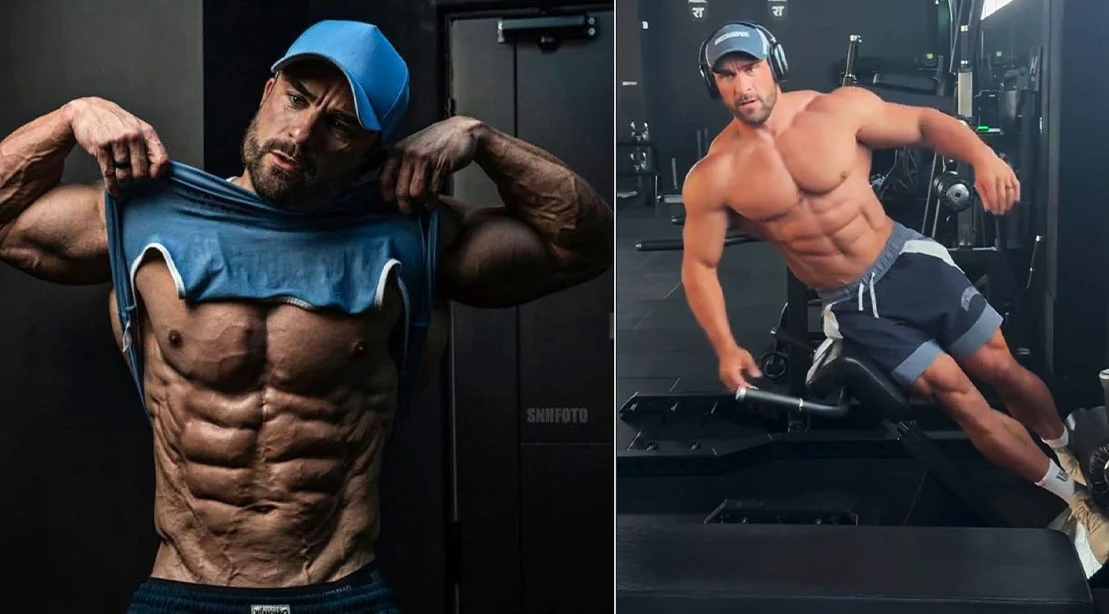
With less than ten weeks remaining until the 2026 Olympia stage in Las Vegas, the pressure is mounting for the world’s elite bodybuilders. Among them, three-time Olympia Men’s Physique Champion Ryan Terry stands as a beacon of consistency and aesthetic perfection. Known for maintaining a jaw-dropping physique year-round, the British icon has recently signaled that his preparation has entered its most critical phase. As he eyes a fourth consecutive title, Terry has pulled back the curtain on his refined training protocol, specifically emphasizing a new, grueling morning routine designed to chisel his midsection into a state of championship-grade definition.
The Morning Protocol: A New Standard for Core Hypertrophy
In a recent reveal to his 2.6 million Instagram followers, Terry announced the implementation of “AM Abs” workouts. For a veteran athlete like Terry, this is more than just a training adjustment; it is a psychological and physiological signal that the countdown to Las Vegas is reaching a fever pitch.
“I’m introducing AM abs workouts,” Terry stated. “This is the point where I know things are getting serious.”
By shifting high-intensity core work to the morning, Terry is prioritizing his most aesthetic muscle group during a fasted state, a strategy often utilized by professionals to enhance metabolic demand and ensure that the session is completed before the fatigue of the day sets in. For Terry, this represents a shift from general maintenance to the razor-sharp precision required to defend a world title.
Chronology of Excellence: From Challenger to Reigning Icon
Ryan Terry’s journey to the top of the Olympia podium has been defined by a relentless commitment to evolution. Unlike many athletes who oscillate between extreme bulk and extreme cut, Terry has maintained a reputation for a "stage-ready" look that remains remarkably consistent throughout the year.
However, even the best must iterate. Looking back at his career trajectory:
- The Early Years: Terry’s entry into professional bodybuilding was marked by a steep learning curve. He has openly admitted to past mistakes, including crash dieting in his early career, which led to significant muscle loss and metabolic instability.
- The Refinement Phase: Over the last several years, Terry moved toward a "slow and steady" approach. By prioritizing sustainable nutrition and controlled hypertrophy, he successfully built a denser, more symmetrical physique.
- The Current Cycle: Now, with the 2026 Olympia in his sights, Terry is layering his established foundation with specific, high-frequency abdominal training. The introduction of the AM routine marks the final phase of his pre-contest prep, where the goal is no longer just building muscle, but maximizing vascularity and deep-cut separation.
Technical Breakdown: Terry’s "Serious" Ab Workout
Terry’s approach to ab training rejects the common misconception that the core only requires high-volume, low-intensity crunches. Instead, he focuses on controlled hypertrophy—utilizing weight and resistance to ensure the rectus abdominis, obliques, and transverse abdominis are thick and well-defined. He maintains a rep range of 10 to 15, emphasizing slow, deliberate movements.
1. The GHD Reverse Crunch
Terry utilizes the Glute Hamstring Developer (GHD) to isolate the lower abdomen. By allowing his legs to drop behind the vertical plane of his torso, he creates a profound stretch in the negative portion of the movement. This "deep stretch" approach is essential for activating the lower rectus abdominis, a notoriously difficult area to develop.
2. Side Oblique Crunches
To frame the waistline and provide that coveted "V-taper" look, Terry incorporates targeted oblique work. By focusing on the muscles above the hip, he ensures a seamless transition between his lat spread and his midsection, creating the illusion of a smaller waist.
3. Incline/Decline Bench Sit-ups
Terry’s implementation of bench-based sit-ups—working against gravity—adds a layer of mechanical tension that floor-based crunches simply cannot replicate. By controlling the descent, he maximizes the time under tension, forcing the muscle fibers to repair and grow in thickness.
4. Bench Jack-Knives (V-Situps)
Perhaps the most demanding movement in his rotation, the bench-based jack-knife requires immense core stability. By using a bench as a base rather than the floor, Terry increases the range of motion for his legs and torso, forcing his hip flexors and core to work in tandem to stabilize his body throughout the movement.
The Nutrition Paradox: Why Training Isn’t Enough
Despite the intensity of his morning workouts, Terry is the first to remind his followers that no amount of training can compensate for a poor diet. The "six-pack" is arguably the most diet-dependent muscle group in the human body.
"The real job isn’t training your abs harder. It’s reducing overall body fat," Terry emphasized in a previous social media update. "That means eating slightly less than you burn and being patient with it. Not crash dieting."
Terry’s philosophy is a rebuke of the "fast-track" mentality that plagues the fitness industry. He argues that aggressive calorie deficits are the primary cause of muscle wastage—a lesson he learned the hard way. By maintaining a steady, slow reduction in body fat, he protects his hard-earned muscle mass while peeling away the layers of fat that obscure abdominal definition. This patience, he argues, is the secret weapon that has sustained his career at the highest level for over a decade.
Implications for the Industry and the Amateur Athlete
The success of Ryan Terry provides a blueprint for both the aspiring professional and the weekend warrior. His methodology underscores several key principles that are often overlooked in modern fitness culture:
- Periodization: Terry does not train at 100% intensity year-round. He understands the necessity of phasing his training, moving from foundational work to competition-specific specialization.
- Form over Function: Terry’s refusal to sacrifice form for weight is a vital lesson. For the rectus abdominis to "pop," the muscle must be stimulated, not just tired out.
- Sustainability as a Competitive Advantage: By avoiding the "yo-yo" dieting cycle, Terry has managed to keep his metabolic rate healthy and his muscle fullness intact. In the context of the Olympia, where judges look for a combination of size, conditioning, and aesthetics, this sustainable approach is exactly what separates the podium finishers from the rest of the pack.
Looking Toward Las Vegas 2026
As the bodybuilding world turns its eyes toward the 2026 Olympia, the focus remains on whether Terry can sustain this trajectory. His ability to balance the grueling physical requirements of a champion with a disciplined, intelligent approach to nutrition has made him an anomaly in the sport.
Whether one is looking to compete on the professional stage or simply improve their own fitness, Terry’s message is clear: There are no shortcuts. The path to a championship-grade midsection is paved with early mornings, slow and controlled repetitions, and the patience to let the body respond to a sustainable, well-planned strategy.
As Terry continues his journey toward a fourth title, the fitness community watches not just for the results, but for the methodology. In a sport often defined by extremes, Ryan Terry continues to prove that consistency is the most powerful tool in any athlete’s arsenal.
To keep up with Ryan Terry’s progress as he approaches the 2026 Olympia, fans can follow his daily updates and training insights on his official Instagram account.