The halls of the federal government, once symbols of stability and administrative permanence, are currently the site of a growing internal crisis. Approximately 1,600 employees from the General Services Administration (GSA) have been abruptly relocated to the Theodore Roosevelt Federal Building in Washington, DC, only to find themselves working in an environment that many describe as hazardous and demoralizing.
The relocation, intended to consolidate federal real estate footprints, has instead become a lightning rod for broader grievances regarding the state of the federal workforce. Employees arriving at their new desks have reported a litany of facility failures, including active pest infestations, compromised structural integrity, and questionable water quality. For a workforce already reeling from years of radical restructuring, this physical displacement represents the latest blow to both their professional dignity and their basic workplace safety.
A Chronology of Disruption: From Efficiency to Decay
The roots of the current situation trace back to early 2025, when the federal landscape was fundamentally altered by the Department of Government Efficiency (DOGE). Championed by billionaire Elon Musk, the initiative set out to streamline the federal government through aggressive, often controversial, measures.
The DOGE Era Begins (January 2025)
Following the establishment of DOGE, the federal government underwent a period of unprecedented volatility. The mandate was clear: reduce the federal footprint, slash overhead, and enforce a rigid return-to-office culture. The GSA—the very agency responsible for managing government real estate and IT—was among the first to be targeted. The department saw tens of thousands of layoffs, the implementation of zero-based budgeting, and a sweeping directive to sell off hundreds of federal buildings deemed "underutilized."
The Displacement (2026)
As part of this "government-wide effort to reduce underutilized space," GSA leadership, led by administrator Ed Forst, initiated a move of 1,600 employees from their F Street offices to the nearby Theodore Roosevelt Federal Building. The move was framed as a strategic consolidation with the Office of Personnel Management (OPM). However, the reality on the ground proved starkly different from the bureaucratic vision.
The Aftermath
By the time the move was complete, employees were greeted not by a modern, efficient workspace, but by a facility in a state of visible decline. The transition, intended to be a temporary solution while the F Street building undergoes renovations, is currently slated to last until December 2028.

The Physical Toll: Evidence from the Field
The conditions within the Theodore Roosevelt Federal Building have been documented extensively by the very employees forced to work there. Photographs obtained by WIRED reveal a troubling reality that challenges the standard narrative of "efficient consolidation."
Environmental and Structural Hazards
Among the most egregious reports are the structural failures of the building’s interior. On the third floor, a bathroom ceiling has partially collapsed, leaving debris scattered across the floor and exposing the infrastructure above.
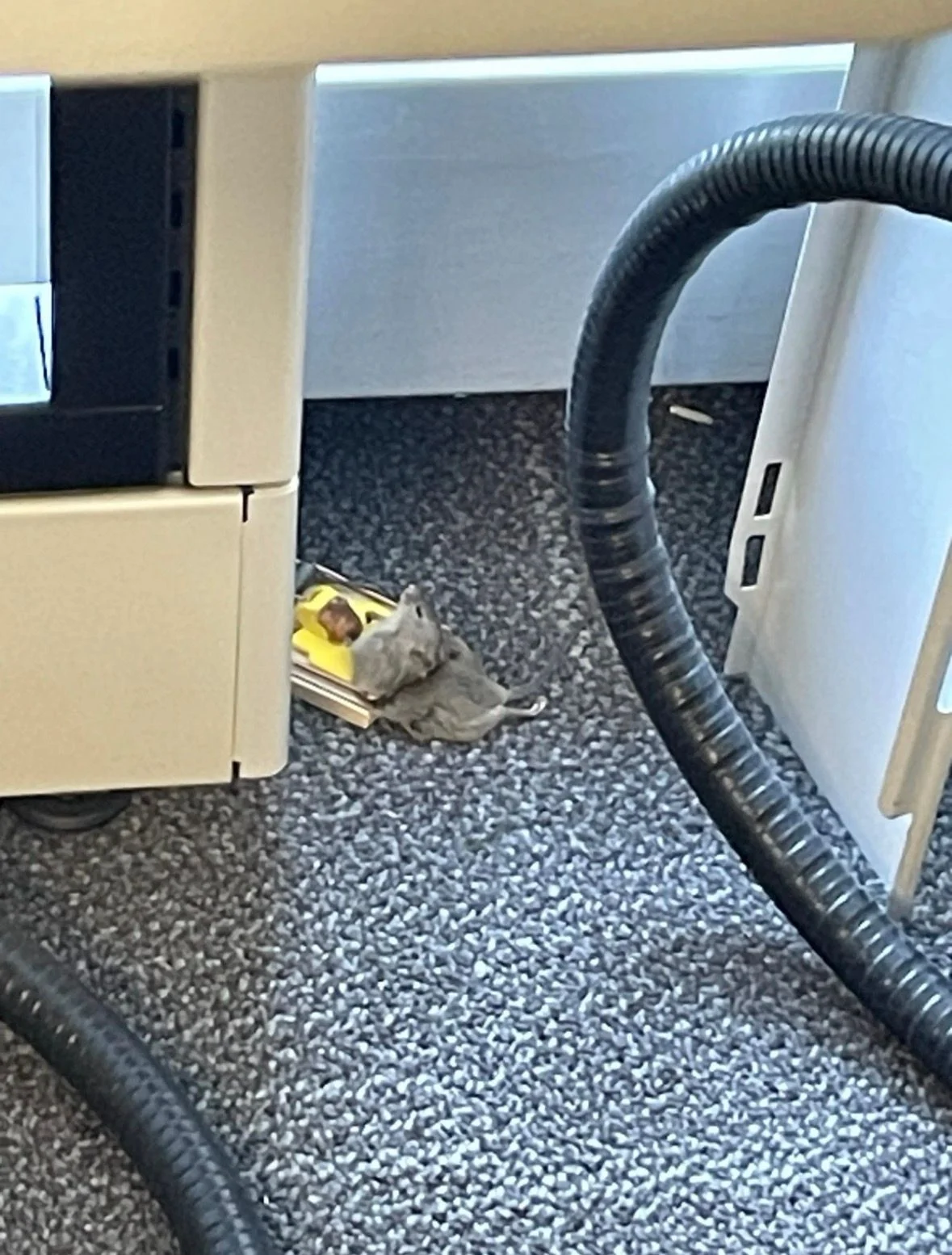
Beyond structural damage, employees have reported a persistent pest problem. Photographic evidence shows a dead mouse caught in a trap, an image that has become emblematic of the building’s lack of maintenance. While some employees noted that vermin are a common issue in aging DC infrastructure, the combination of collapsing ceilings and pest presence has reached a tipping point for many.
Water Safety Concerns
Perhaps the most alarming issue involves the building’s water supply. A sign posted in the office explicitly instructs staff to "run the water without your bottle for 5-10 seconds and wait for the water to run clear" before filling their containers. This advisory has fueled deep-seated anxieties among the staff regarding the long-term safety of the building’s plumbing and the quality of the water they are expected to consume throughout the workday.
Voices from the Cubicles: A Crisis of Morale
The human cost of this relocation cannot be measured in spreadsheets or square footage. For the employees involved, the move serves as a painful reminder of their perceived expendability.
"We’ve all been through a lot, but this really made me finally understand that they don’t care about us," says one GSA employee who spoke on the condition of anonymity due to fears of professional retaliation. "We’re left wondering what else is going to collapse or break—do we need to look at the ceiling before going to the bathroom? Can we actually trust the water is safe to drink?"

This sentiment reflects a broader malaise within the federal workforce. After a year of intense scrutiny, job losses, and top-down mandates, the psychological contract between the government and its civil servants is arguably at its lowest point in decades. The move to the Roosevelt building is seen by many not as a strategic maneuver, but as an indictment of the current administration’s disregard for the basic requirements of a functional, safe workplace.
Official Responses and Bureaucratic Stasis
Despite the severity of the complaints and the documentation provided by staff, the response from leadership has been characterized by silence. Requests for comment sent to both the GSA and the OPM have yet to be addressed.
The official line from the GSA remains rooted in the original press release: the move is a necessary step to "fortify the federal footprint." Administrator Ed Forst and his team maintain that the Theodore Roosevelt Federal Building is the designated hub for these agencies until the 2028 completion of the F Street renovations. Whether the agency plans to address the structural and sanitation issues remains unclear.
Broader Implications: The Future of Federal Real Estate
The crisis at the Roosevelt building is a microcosm of the risks inherent in rapid, ideologically driven infrastructure policy. As DOGE affiliates continue to push for austerity measures—often pivoting toward AI-driven efficiency and data-center management—the day-to-day reality for the civil service remains tied to the physical buildings that the government is simultaneously trying to divest from.
The Paradox of Efficiency
There is a profound irony in the GSA’s current predicament. Tasked with managing the government’s real estate assets, the agency is now managing its own decline. The plan to sell off hundreds of buildings, while theoretically reducing costs, has left agencies shuffling staff into older, poorly maintained facilities that require immediate and expensive repairs.
The Talent Drain
Furthermore, the climate of neglect poses a significant threat to talent retention. While the GSA recently announced plans to hire approximately 400 new employees to offset previous losses, the ability to recruit top-tier talent in an environment characterized by physical decay, job insecurity, and a lack of leadership support remains a major challenge.

Private Sector Migration
As the DOGE experiment continues to evolve, many of its architects have moved on to the private sector, specifically into AI and manufacturing. This "revolving door" has left behind a federal bureaucracy that is increasingly understaffed, demoralized, and physically fragmented. The shift toward AI-based policy and austerity has not yet translated into the "efficiency" promised; instead, it has resulted in a degradation of the public sector’s physical capacity to perform its duties.
Conclusion: A Call for Accountability
The situation at the Theodore Roosevelt Federal Building is more than just a case of poor facility management. It is a symptom of a larger, systemic failure to balance the desire for lean government with the necessity of providing a safe and dignified workplace for those who carry out the daily operations of the nation.
For the 1,600 GSA employees caught in this transition, the coming years are marked by uncertainty. Whether the building will be brought up to code, whether their prior office will truly be ready by 2028, and whether they will remain in the federal service long enough to see it happen are all open questions.
Until leadership addresses these basic infrastructural concerns with transparency and action, the move will continue to be viewed as a symbol of broken promises. The federal government’s attempt to "fortify its footprint" has, in this instance, resulted only in the erosion of its most valuable asset: the people who keep the machinery of the state running.