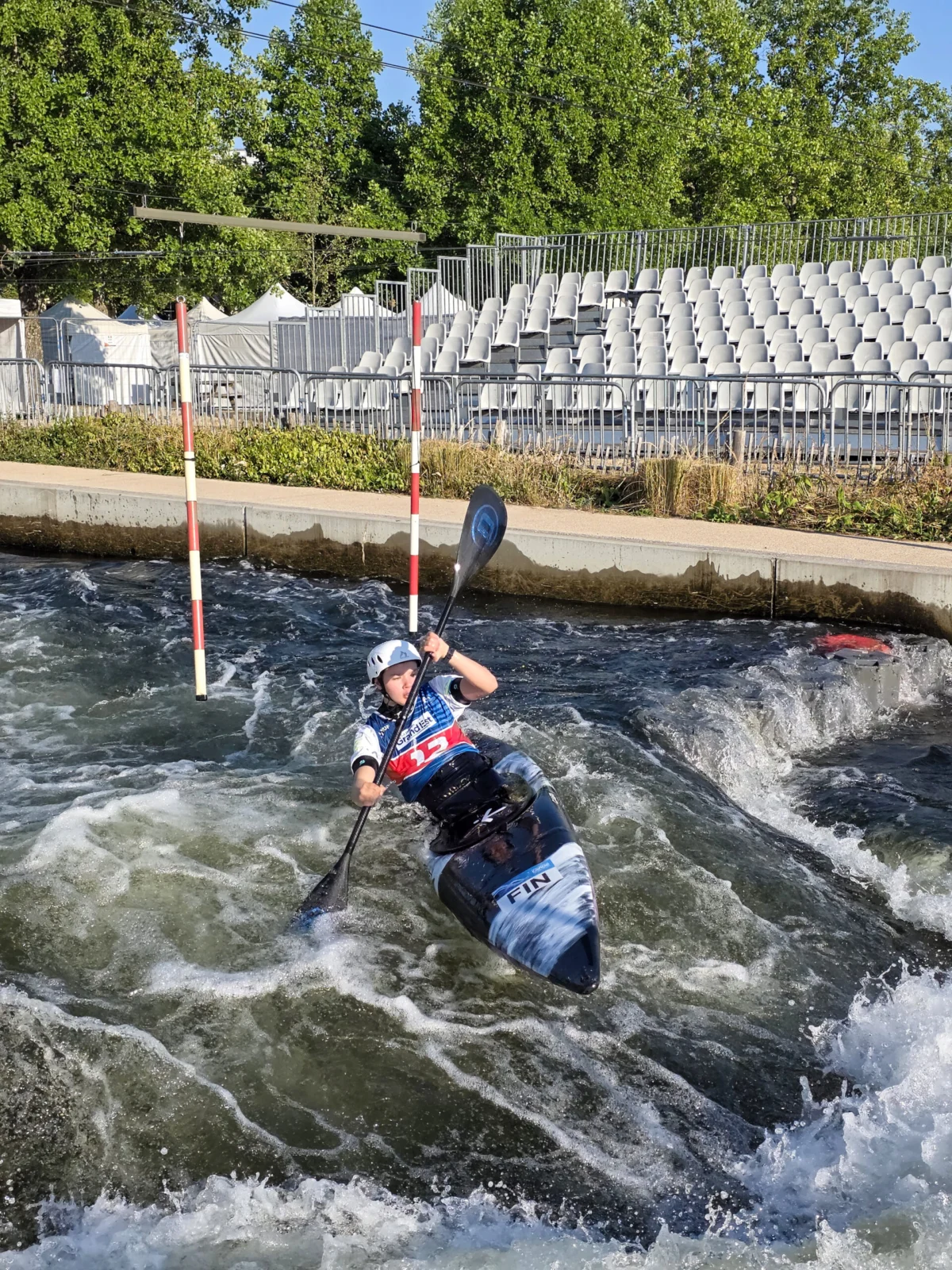
Epinal, France – Aada Lindeman, a promising 16-year-old athlete from Tampereen Vihuri, stands on the cusp of a significant milestone in her burgeoning career as she prepares to compete at the Junior European Whitewater Slalom Championships in Epinal, France. Her journey from casual paddleboarding to representing Finland on the international stage is a testament to her unwavering dedication and the strategic guidance of her coaching team. This event marks not only her debut at a major international competition but also a crucial step in her long-term ambition to excel in the demanding sport of whitewater slalom.
Lindeman’s participation in the European Championships is more than just a competition; it is a foundational experience designed to expose her to the intensity and competitive landscape of elite junior sports. With a rigorous training schedule and a clear focus on personal performance, Aada embodies the spirit of an athlete committed to continuous improvement, balancing the demands of high-performance sport with her academic pursuits.
Main Facts: A Rising Star’s European Challenge
Aada Lindeman, representing the Tampereen Vihuri club, is Finland’s hopeful at the upcoming Junior European Whitewater Slalom Championships in Epinal, France. At just 16 years old, Lindeman has rapidly ascended through the ranks of Finnish paddling, securing her place in the national squad for this prestigious U18 event. Her selection for the Finnish team, culminating in her qualification for the Youth Olympic Festival in North Macedonia in 2025, underscores her potential and marks a significant achievement in her young career.
Lindeman’s preparation for Epinal has been meticulous, reflecting her commitment to the sport. Her personal coach, Leo Janka, highlights her innate understanding of systematic training, while on-site coach Petri Voutilainen emphasizes the importance of mental fortitude and familiarization with the challenging course conditions. The championships, which commence for Aada on Wednesday, August 5th, are primarily viewed as a vital learning experience, setting the stage for future competitive seasons.
Chronology: From SUP to Slalom Success
Aada Lindeman’s journey into the thrilling world of whitewater slalom began rather serendipitously. Her initial foray into paddle sports started at the age of 10, sparked by a casual interest in stand-up paddleboarding (SUP). This recreational pursuit soon led her to a local paddling school, where the foundations of her future athletic career were inadvertently laid.
The pivotal moment arrived three years later when, at the age of 13, she was introduced to Leo Janka, who would soon become her long-term personal coach. Janka, recognizing Aada’s nascent talent and burgeoning enthusiasm, encouraged her to attend a junior whitewater slalom camp. It was at this camp that Aada discovered the exhilarating challenge and technical complexity of slalom, a discipline that combines speed, agility, and precision navigation through a series of gates on turbulent waters. This experience ignited a passion that transformed her casual interest into a targeted and ambitious training regimen.
Since then, Lindeman has committed herself wholeheartedly to the sport. Her progression has been swift and remarkable, characterized by consistent dedication and a relentless pursuit of improvement. The culmination of this dedicated effort arrived with her selection for the Finnish national team, an honour that led to her participation in the Youth Olympic Festival in North Macedonia in 2025 – an experience she describes as a significant and memorable highlight of her career thus far. Representing her country on such an international stage, even in anticipation, has profoundly shaped her perspective and fueled her aspirations.
Her journey to Epinal is a natural continuation of this upward trajectory, demonstrating her readiness to test her skills against Europe’s finest junior paddlers. Each step, from the initial paddle stroke on calm waters to navigating the dynamic currents of competitive slalom, has been a building block towards this significant international debut.
Supporting Data: The Demands of Elite Junior Slalom
Aada Lindeman’s commitment to whitewater slalom is evident in her demanding training schedule. She dedicates herself to between six and ten training sessions per week, a regimen that speaks volumes about her resolve and passion for the sport. This intensive program encompasses a variety of disciplines crucial for success in whitewater slalom. On-water training focuses on refining her paddling technique, mastering gate negotiation, and adapting to diverse water conditions. Off-water, her routine includes strength and conditioning exercises to build the physical power required to control the kayak in turbulent waters, as well as endurance training to maintain performance throughout demanding races. Mental preparation, including visualization and strategic planning, is also an integral part of her holistic approach.
Lindeman identifies perseverance (periksiantamattomuus in Finnish) as her greatest strength, a quality indispensable in a sport as physically and mentally taxing as whitewater slalom. The dynamic nature of the river means no two runs are ever exactly alike, demanding constant adaptation, problem-solving, and the mental resilience to recover from errors. Her ability to consistently push through challenges, both in training and competition, sets her apart.
Balancing such a rigorous athletic schedule with academic responsibilities presents a significant challenge. Aada acknowledges the necessity of excellent time management skills to navigate her dual commitments. Following her participation in the European Championships, she will transition to a specialized sports high school, a move designed to provide a more flexible academic framework. This environment will allow her to tailor her studies around her training camps and competitions, and potentially focus more on subjects that genuinely interest her, rather than adhering to a rigid curriculum. The nature of her sport often necessitates meticulous advance planning for school assignments and, at times, the completion of online courses to ensure she keeps pace with her education while traveling and competing.
Beyond the intensity of training and studying, Aada finds solace and balance in her leisure activities. She enjoys reading books, which offers a mental escape and a change of pace, and playing the guitar, a creative outlet that provides a different form of focus and relaxation. These personal pursuits highlight her well-rounded character and the importance of maintaining a life outside the demanding world of elite sport, crucial for preventing burnout and fostering overall well-being.
Official Responses: Coaching Perspectives and Expectations
Aada Lindeman’s journey is meticulously guided by a dedicated team of coaches who provide both long-term strategic planning and immediate tactical support.
Leo Janka, Personal Coach: The Architect of Development
Leo Janka serves as Aada’s primary personal coach, taking responsibility for the overarching structure and planning of her training. He closely monitors her slalom-specific sessions, actively participating in several weekly practices when Aada is in Finland. During intensive training camps and competitions, the coaching responsibilities are shared with experienced mentors like Petri Voutilainen and Toni Fohlin, ensuring a comprehensive support system.
Janka speaks with immense pride about Aada’s understanding of the sport’s fundamental principles. "Aada understands very well that long-term and systematic training is the foundation for all development," Janka emphasizes. "She approaches her daily work with purpose and commitment." This insight highlights Aada’s maturity and her grasp of the incremental, consistent effort required to reach elite levels.
The current season marks a significant developmental leap for Aada, as it represents her first true season competing and training in demanding whitewater conditions. "This season, we’ve been able to shift training to previously more challenging whitewater environments," Janka explains. He notes the successful transfer of her technical foundation, built in smaller, more controlled rapids, to stronger, more powerful waters. "The technical foundation built in smaller rapids has transferred beautifully to more powerful water, which indicates excellent development." This progression is crucial for an athlete aiming for international success, as competitive courses often feature complex and robust water features.
Regarding the upcoming European Championships, Janka maintains a pragmatic and long-term perspective. He views this inaugural U18 international competition primarily as an invaluable learning opportunity. "Aada’s actual U18 years will be in 2027 and 2028, so this summer’s competitions offer a good chance to see what physical and technical areas need improvement in the future," he states. Janka also acknowledges the immense mental demands of the sport: "Whitewater slalom is mentally challenging because the river itself is a dynamic and changing element." Therefore, his primary satisfaction will come from Aada performing at her established level: "I will be very pleased if Aada can paddle at her own level in her first U18 major competition."
While Janka will be closely following the races from Finland, he expresses full confidence in the on-site coaching team. "Aada is in good hands under Petu’s [Petri Voutilainen’s] coaching, so I want to give them peace to work," he affirms. "Of course, I will follow the competitions closely and anxiously watch her performances from home."
Petri Voutilainen, On-Site Coach: Guiding Performance Under Pressure
At the competition venue in France, Petri Voutilainen takes charge of Aada’s immediate coaching needs. His role is critical: to provide technical and tactical support from the final training sessions leading up to the race, and crucially, during the competition itself. Voutilainen’s responsibilities encompass everything from analyzing course conditions and gate sequences to providing psychological support and ensuring Aada is in the optimal state for performance.
Voutilainen describes a strong and trusting relationship with Aada, built on open communication. "There’s no need to build up the race feeling for Aada separately," he notes, implying Aada’s inherent competitive drive. He sees his most important task as helping her focus on the critical elements for a successful run, both before and during the race.
The Epinal course, while not considered among the most difficult globally, presents its own unique set of challenges. As a modern artificial course, it incorporates several "stoppers" – features like eddies, waves, and hydraulic holes – that demand precise technique and strategic navigation. Voutilainen’s preparation strategy focuses heavily on familiarizing Aada with every nuance of the course. "In the training sessions before the race, we paddle different variations so that the course becomes as familiar as possible," he explains. Particular emphasis is placed on gates and gate combinations that Aada identifies as challenging.
Immediately preceding the competition, Voutilainen’s primary objective shifts to maintaining Aada’s composure. "Just before the competition run, the coach’s most important task is to keep the athlete calm," he states. He believes that by this point, all the hard work is done: "All the work has already been done. The course, the paddling lines, and the necessary solutions are ready in the athlete’s mind." During the actual race, his role transitions to observation, encouragement, and allowing Aada to execute her best performance.
Echoing Janka’s long-term perspective, Voutilainen stresses that the main goal for this competition is not a specific placement, but rather a successful execution and the invaluable experience gained. "Aada is only at the beginning of her career, and this competition is one important step on the path to becoming an international-level whitewater slalom paddler," he elaborates. He acknowledges that significant development still requires several more years of high-quality training, making specific placement targets premature at this stage. "If Aada can paddle at her best level and utilize her skills to their fullest, we can be very satisfied with the competition."
Implications: Building a Foundation for Future Success
Aada Lindeman’s participation in the Junior European Whitewater Slalom Championships carries significant implications, both for her personal athletic journey and potentially for the broader development of whitewater slalom in Finland. For Aada, this event is a critical benchmark. It provides her with firsthand exposure to the competitive intensity, the technical standards, and the psychological pressures inherent in international-level junior sports. This experience, regardless of the immediate outcome, will serve as an invaluable learning curve, allowing her to identify specific areas for technical refinement, physical conditioning, and mental strategy.
The coaches’ emphasis on "paddling her own race" and focusing on a "successful performance" rather than a specific ranking highlights a sophisticated understanding of athlete development. In a sport where experience in dynamic conditions is paramount, the lessons learned from navigating a challenging European course under competitive pressure far outweigh the immediate results. This approach fosters a growth mindset, encouraging resilience and a long-term vision that extends well beyond a single competition. The feedback gained from Epinal will directly inform her training plans for the coming years, particularly as she enters her prime U18 years in 2027 and 2028.
Furthermore, Aada’s journey to the European Championships and her selection for the Youth Olympic Festival in 2025 can inspire other young Finnish paddlers. Her dedication and the systematic support she receives from her club, Tampereen Vihuri, and the national federation, Melonta- ja Soutuliitto (Finnish Canoeing and Rowing Federation), showcase a pathway for aspiring athletes. Success stories like Aada’s are crucial for raising the profile of whitewater slalom, attracting new talent, and securing continued investment in coaching and infrastructure.
The strategic decision for Aada to attend a sports-focused high school also has broader implications for athlete development in Finland. It underscores the growing recognition of the need to provide flexible educational pathways that allow talented young athletes to pursue both academic excellence and sporting ambitions without undue compromise. This integrated approach is vital for nurturing well-rounded individuals who can thrive in both arenas.
Ultimately, Aada Lindeman’s debut in Epinal is more than just a race; it is a foundational moment in a career that holds immense promise. It represents the culmination of years of dedicated effort, strategic coaching, and unwavering personal commitment. As she navigates the gates and currents of the French course, she is not only competing against her peers but also laying the groundwork for a future that could see her rise to the very pinnacle of international whitewater slalom. The entire Finnish paddling community will be watching with anticipation, knowing that this experience is a vital stepping stone on her path to becoming a world-class athlete.