Introduction: The Unforgiving Reality of Winter Spill Response
Inland spill response is inherently complex, but when the mercury drops and waterways freeze, the operational environment shifts from difficult to life-threatening. For environmental responders, the winter season introduces a volatile set of variables that demand a fundamental reassessment of risk management. Unlike the relatively predictable nature of spill containment in temperate seasons, winter operations—specifically those involving river ice—present a dynamic, high-stakes battlefield where the environment itself acts as a primary adversary.
Responding to hazardous material releases in cold weather requires more than just standard spill-containment gear; it necessitates a rigorous adherence to specialized standard operating procedures (SOPs). The overarching directive remains consistent: avoid working on ice whenever possible. However, the operational reality of recent years has seen an uptick in incidents requiring direct intervention on frozen surfaces, including active river channels. When a responder steps onto ice covering a moving river, they are entering one of the most unforgiving environments on the planet. Unlike lake ice, which is generally static, river ice masks a subterranean flow that can instantly turn a minor slip into a catastrophic, life-threatening entrapment.
The Chronology of Risk: From Assessment to Execution
Effective winter response follows a non-negotiable chronological flow. Skipping steps or rushing the initial assessment phase is the most common precursor to responder injury.
Phase 1: The Initial Size-Up
No personnel should set foot on ice until a comprehensive safety plan has been established, reviewed, and signed off by the site safety officer. The initial size-up must be systematic:
- Hydrological Assessment: Determine the speed and volume of the current beneath the ice.
- Depth Profiling: Understanding the water depth is critical; shallow areas may have ice frozen to the riverbed, while deep channels present higher risks of currents pulling a submerged person away from the breach point.
- Ice Integrity Analysis: A thorough assessment of ice thickness, crystalline structure (quality), and consistency.
- Mathematical Validation: Calculating the load-bearing capacity using the established engineering formula: P = 50 × T² (where P is the load-bearing capacity in pounds and T is the thickness of the ice in inches).
Phase 2: Procedural Assessment
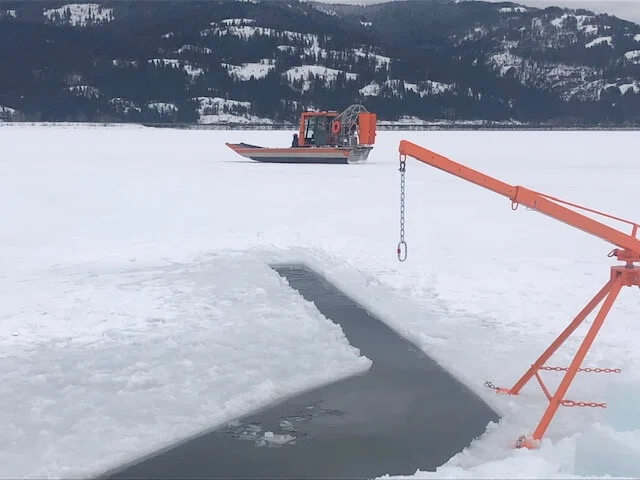
Once the data is gathered, the team must drill a series of test holes starting from the shoreline and working progressively outward. This must be done under the supervision of an ice rescue instructor. During this phase, responders must be belayed, operating from a stable platform such as an airboat or by utilizing 4×8 sheets of plywood to distribute body weight evenly across the surface.
Phase 3: Operational Deployment
Once the zone is deemed "safe" (relative to the specific mission parameters), operational procedures shift to minimizing the number of personnel on the ice. Access points should be reinforced with anti-slip measures, and constant communication must be maintained with belayers positioned at safe anchor points—ideally on the riverbank or via inflatable rescue craft.
Supporting Data: Understanding Ice Dynamics
The ability to identify the type of ice present is not merely an academic exercise; it is a critical safety skill. Responders must be trained to differentiate between the following:
- Lake Ice: Often clear and reflective; formed during rapid temperature drops, this is generally the most stable and strongest variety.
- Frazil Ice: A slushy, disk-shaped accumulation of ice crystals on the surface. It is an early-phase indicator and is notoriously weak.
- Candled Ice: A dangerous, deteriorated state characterized by a whitish-gray appearance. While it may appear thick, it lacks the structural integrity to support weight.
- Snow Ice: Opaque or milky, this forms when snow freezes on top of an existing ice sheet. It is significantly weaker than clear ice and often hides structural flaws.
- Anchor Ice: Forms on submerged debris or the riverbed. In rivers, this can create ice jams, which unpredictably alter water flow and ice thickness nearby.
Load-Bearing Guidelines (General Estimates)
- 2 Inches or less: Immediate danger; stay off.
- 4 Inches: Sufficient for ice fishing or skating.
- 5-6 Inches: Capable of supporting snowmobiles or ATVs.
- 7-8 Inches: Minimum for a medium-sized truck.
Note: Always reduce these estimates by 15% to account for current-induced weakness and by an additional 50% for snow ice.
Official Protocols and Safety Infrastructure
The safety of responders is predicated on the presence of a "Warming Tent" or mobile command unit. This facility must be equipped with hypothermia-wrap kits, AEDs, medical-grade oxygen, and portable heaters. Every responder on the ice must be outfitted with a specialized PPE kit, including:
- Drysuits with high-visibility markings.
- Rescue PFDs (Personal Flotation Devices) rated for cold water.
- Ice awls (for self-rescue) and ice cleats (for traction).
- Integrated communication headsets to ensure that if a worker falls, they can immediately alert the team.
The Buddy System and Self-Rescue
The buddy system is the absolute minimum requirement. Workers must be within reach or immediate visual contact of a colleague at all times. In the event of a breakthrough, the self-rescue protocol is immediate:
- Avoid Panic: Control the respiratory response to prevent the "gasp reflex," which leads to aspiration of water.
- Stabilize: Extend arms to the side to prevent being pulled under the ice shelf.
- Extraction: Utilize ice awls to gain purchase and kick horizontally to distribute weight until the torso is back on the solid surface.
Implications: The Wind Chill Factor
One of the most significant environmental hazards in winter spill response is not the ice itself, but the wind chill. The Wind Chill Temperature Index is a vital tool for the Incident Commander. It represents the combined cooling effect of wind speed and ambient temperature on the human body.
As wind speeds increase, the rate at which a body loses heat accelerates exponentially. Exposed flesh can freeze in under one minute in extreme northern climates. This necessitates strict rotation schedules for personnel working in exposed environments. A responder might be perfectly warm at a 10°F temperature in calm air, but if the wind picks up to 30 mph, the effective temperature drops to -12°F, drastically reducing the duration a responder can safely remain on-site.
Wind Chill Temperature Reference
(Reference data indicates that at 15°F with a 30 mph wind, the "feels-like" temperature is -5°F. At these levels, frostbite can occur in as little as 10 minutes.)
Implications for Long-Term Response Strategy
The implications of these winter conditions extend beyond immediate rescue. Spill containment booms, for instance, are notoriously difficult to deploy in icy waters. They can be damaged by floating ice or become frozen into the surface, rendering them ineffective. Consequently, environmental agencies are increasingly turning toward the use of airboats and drone-based monitoring to assess the plume of a spill without putting human lives at unnecessary risk.
Furthermore, the legal and ethical responsibility of the Incident Commander is heightened in winter. Every decision to deploy a team onto river ice must be documented, justified by the urgency of the spill, and supported by a robust evacuation plan. If the risk to human life outweighs the environmental benefit of immediate containment, the decision must be to wait—or to utilize remote-operated equipment.
Conclusion: A Culture of Preparedness
Inland spill response during the winter is a test of organizational discipline. It requires a synthesis of engineering, medical preparedness, and tactical restraint. As climate patterns become more volatile, the likelihood of responders encountering these "unforgiving environments" increases. By adhering to rigorous assessment protocols, maintaining high-standard equipment, and respecting the raw power of moving ice and frigid winds, agencies can protect their most valuable asset: the responders themselves.
Safety is not an obstacle to be cleared; it is the foundation upon which every successful response is built. In the frozen landscape, the margin for error is non-existent, and the only way to ensure a successful outcome is to treat every piece of ice with the caution it demands.