Even for the most decorated icons of professional bodybuilding, retirement from the stage does not signal an end to physical excellence. For two-time Figure Olympia champion Erin Stern, who dominated the sport in 2010 and 2012, the transition from competitive athlete to wellness coach has been defined by a fundamental shift in philosophy: from maximal muscle hypertrophy to functional longevity.
In a recent, viral Instagram feature, Stern unveiled a high-impact, bodyweight-centric training regimen designed to combat the inevitable physical decline associated with aging. By prioritizing agility, mobility, and explosive power, Stern is proving that one does not need a rack of dumbbells or a heavy barbell to maintain the physique and physical capabilities of a prime athlete.
The Core Philosophy: Why We Lose Our "Bounce"
As we navigate the aging process, the body naturally undergoes physiological changes that often lead to a reduction in fast-twitch muscle fiber efficiency, joint stiffness, and a diminished mind-muscle connection. Stern identifies four specific pillars that serve as the foundation of her longevity program: agility, mobility, bounce, and core stability.
"Agility, mobility, bounce, and core—these are the traits that we lose with age," Stern remarked in her recent training guide. "The solution is to intentionally integrate exercises that ensure you will continue to move with speed, flow, and control, regardless of your birth year."
Stern’s approach challenges the common misconception that "longevity training" must be low-intensity or strictly focused on cardio. Instead, she advocates for a hybrid model—one that incorporates the biomechanical demands of explosive movement while respecting the recovery needs of an aging nervous system.
Chronology of a Longevity Session: A Step-by-Step Breakdown
Stern’s protocol is designed to be accessible, requiring minimal equipment—often just a cable machine, a plyometric box, and a floor mat. The structure follows a logical progression from hip mobilization to explosive reactivity, finishing with restorative spinal work and core bracing.
1. Hip Flexor Health: The Cable-Assisted High Knee
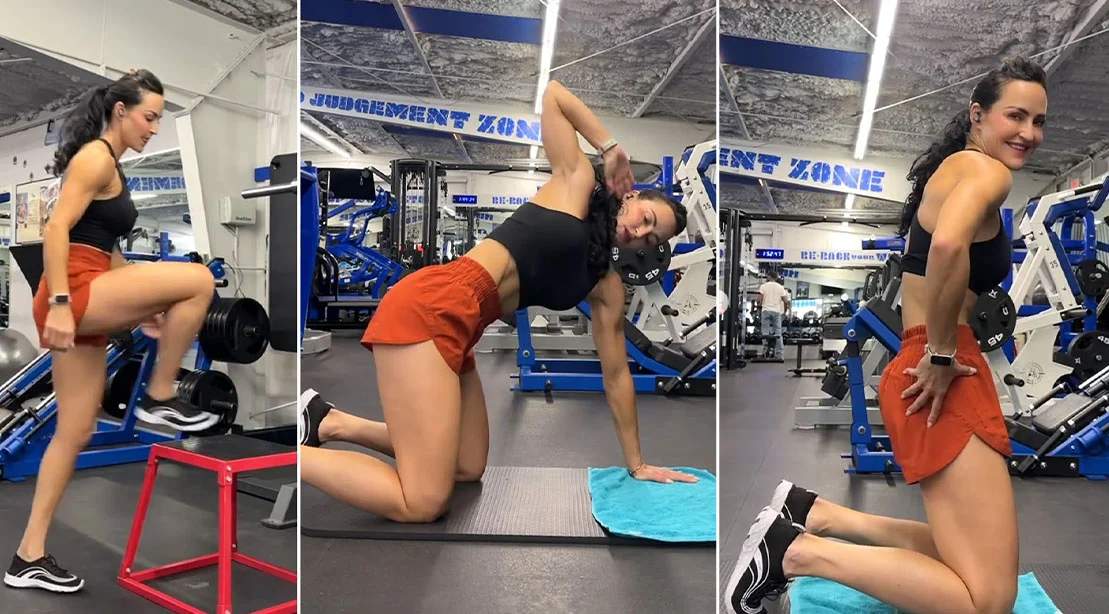
Stern initiates her training with cable-assisted high knees. By using a cuff attached to a low-pulley cable station, she adds a controlled resistance to the hip flexor. This movement is not about maximal weight but about the repetitive, controlled flexion of the hip joint. This strengthens the psoas and rectus femoris, which are crucial for walking mechanics and preventing the "shuffling" gait often associated with sedentary aging.
2. Fast-Twitch Preservation: Pogo Box Jumps
The second phase involves Pogo box jumps. This is a targeted effort to maintain bone density and fire up fast-twitch muscle fibers. Stern emphasizes the importance of landing mechanics—ensuring both feet strike the box simultaneously to maintain symmetry and balance. "Pogo jumps are for fast-twitch muscle and bone density," she explains. By keeping the ground contact time minimal, she encourages the tendons to act like springs, a vital adaptation that typically atrophies without specific training.
3. Neurological Adaptability: Depth Jumps
Building on the pogo jumps, Stern incorporates depth jumps to improve reaction time. These movements force the central nervous system to prepare for an impact, teaching the body to absorb force effectively. This is a critical component for fall prevention in older populations. By learning how to land under pressure, the trainee effectively "future-proofs" their joints and ligaments against the unexpected trips and stumbles that can lead to injury later in life.
4. Spinal Integrity: T-Spine Rotations and Cat-Cow
Once the explosive work is complete, the focus shifts to the thoracic spine. Stern utilizes T-spine rotations to counteract the "hunch" that can develop from office work and gravity-induced compression. By staying on all fours for the cat-cow yoga pose, she transitions into a gentle, restorative flow that promotes blood flow to the vertebrae and releases tension in the lower back—a common pain point for athletes and the general public alike.
5. Core Control: The Vacuum Technique
Stern concludes the session with stomach vacuums. While often associated with the "Golden Era" of bodybuilding for aesthetic purposes, Stern highlights their functional utility. "Vacuums are for core control, strength, and a smaller waist," she notes. By engaging the transverse abdominis, she stabilizes the lumbar spine from the inside out, providing a muscular "girdle" that supports the torso during daily tasks.
Supporting Data: The Science of Movement After 50
The fitness industry has long debated the efficacy of free weights versus bodyweight training for older adults. While free weights remain the gold standard for maximal strength and bone density, research published in journals such as The Journal of Strength and Conditioning Research suggests that incorporating plyometric and agility-based movements—like those in Stern’s routine—significantly improves functional capacity in older adults.
The integration of "bounce" (plyometric reactivity) is particularly vital. A study on aging athletes found that those who maintained explosive movement patterns retained a higher percentage of Type II (fast-twitch) muscle fibers, which are the first to disappear as we age. By providing a structured way to practice landing, jumping, and rotating, Stern’s routine mitigates the risk of osteopenia and sarcopenia (the loss of muscle mass) without the high barrier to entry of a heavy lifting program.
Expert Perspectives: Why Coaches Are Following Suit
Prominent trainers, such as Chad Landers, have noted that the definition of strength training is rapidly changing. The focus is no longer just on "how much can you lift," but rather "how well can you move under load?"
Stern’s methodology aligns with this shift. By emphasizing the "control" aspect of her workout, she encourages a mindfulness that is often absent in high-intensity weightlifting. This "slow and steady" approach allows for the development of kinesthetic awareness—knowing where one’s body is in space—which is perhaps the most important predictor of longevity in human movement.
Implications for the Fitness Community
The implications of Stern’s training style are far-reaching. For the average gym-goer, the transition from a heavy-lifting phase to a mobility-heavy phase is often viewed as a "downgrade" in intensity. Stern flips this narrative, suggesting that mobility is the ultimate athletic challenge.
Key Takeaways for Practitioners:
- Breath is Paramount: Stern stresses that as you transition into these movements, you must focus on your breathing. This lowers cortisol levels and ensures the nervous system remains in a parasympathetic state during restorative work.
- The Warm-Up Hybrid: For those who cannot let go of their barbell squats or deadlifts, Stern suggests using her routine as a comprehensive warm-up. By priming the hips and spine before hitting the heavy weights, athletes can ensure better form and reduced injury risk.
- Longevity is Aesthetic: By combining functional movements with core-strengthening vacuums, Stern proves that you do not have to sacrifice the "buff" aesthetic to train for health.
Conclusion: Designing a Future-Proof Body
Erin Stern’s career, which spanned the heights of the Olympia stage and now occupies the space of digital mentorship, serves as a blueprint for the modern athlete. Her message is clear: longevity is not something that happens to you; it is something you build through consistent, intentional movement.
Whether you are a retired competitor or someone simply looking to stay active as you age, the "bounce" is there to be reclaimed. By stepping away from the heavy iron occasionally and focusing on the mechanics of the human machine, one can maintain a level of athleticism that defies the traditional aging curve. As Stern continues to share her expertise on platforms like Instagram, her focus remains on the ultimate goal: not just living longer, but moving better for every day of that life.
For those ready to begin, the prescription is simple: slow down, focus on the breath, and start building the bounce back into your daily routine.