In the high-stakes world of outdoor gear, marketing materials often lean heavily on technical specifications. Manufacturers tout the hydrostatic head of their 210-denier ripstop nylon or the abrasion-resistant properties of specialized laminates, leading many consumers to believe that their backpack is an impenetrable fortress against the elements. However, in the backcountry, the reality is far more nuanced. A backpack is not a sealed dry bag; it is a complex assembly of panels, seams, zippers, and attachment points.
While fabric specs offer a glimpse into durability and potential resistance, they are frequently misleading when used as a proxy for total pack performance. This article explores the disconnect between laboratory fabric testing and the visceral experience of a sustained mountain deluge, introducing a standardized "shower test" methodology designed to peel back the layers of pack construction and reveal how moisture actually finds its way into your gear.
The Myth of the Waterproof Pack
To understand why even the most expensive packs fail in the rain, one must first dismantle the myth of the "waterproof" backpack. In the industry, "waterproof" is a term often used loosely, if not deceptively. While a fabric might be rated to withstand 10,000mm of hydrostatic pressure, that rating becomes irrelevant the moment a needle punctures the material to create a seam.
Water ingress in backpacking packs is rarely a failure of the base material. Instead, it is a failure of architecture. Moisture exploits the path of least resistance: stitch holes that haven’t been taped, zipper teeth that provide a capillary wick, hydration ports that act as funnels, and roll-top closures that are folded incorrectly or stressed by overstuffing. Even with high-performance materials like Dyneema Composite Fabrics (DCF) or ultra-lightweight sil-nylon, the structural integrity of the bag—the "system"—is only as strong as its most permeable component.
Developing a Standardized Protocol: The Shower Test
For years, outdoor enthusiasts have relied on anecdotal evidence to judge gear. "My pack stayed dry in a drizzle" is the common refrain, yet it fails to account for the intensity of the precipitation or the specific points of failure. To move toward a more empirical understanding, we have developed a controlled, repeatable "shower test."
This methodology does not attempt to replicate the chaotic variables of a real-world storm—such as high-velocity wind, the compressive force of shoulder straps against a damp shirt, or the abrasive nature of trekking through wet brush. Instead, it provides a "controlled baseline." By standardizing the environment, we can isolate construction flaws that would otherwise remain hidden until a mid-trip failure.
The Testing Protocol
The test is intentionally accessible, designed to be replicated by gear reviewers and serious enthusiasts alike. The setup requires three primary components:
- The Pack: Packed to a realistic volume using soft gear to maintain a structural shape.
- The Witness: A dry, white cotton pillowcase placed inside the main compartment. Cotton is highly absorbent and provides an immediate visual indicator of even the slightest moisture ingress.
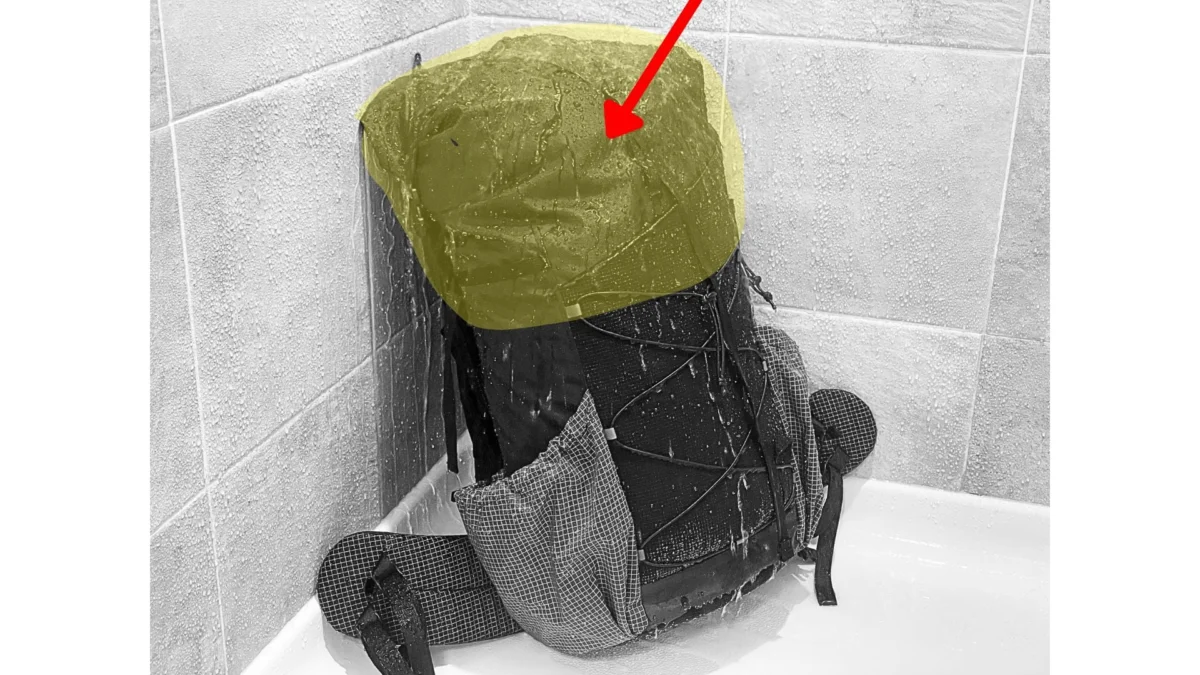
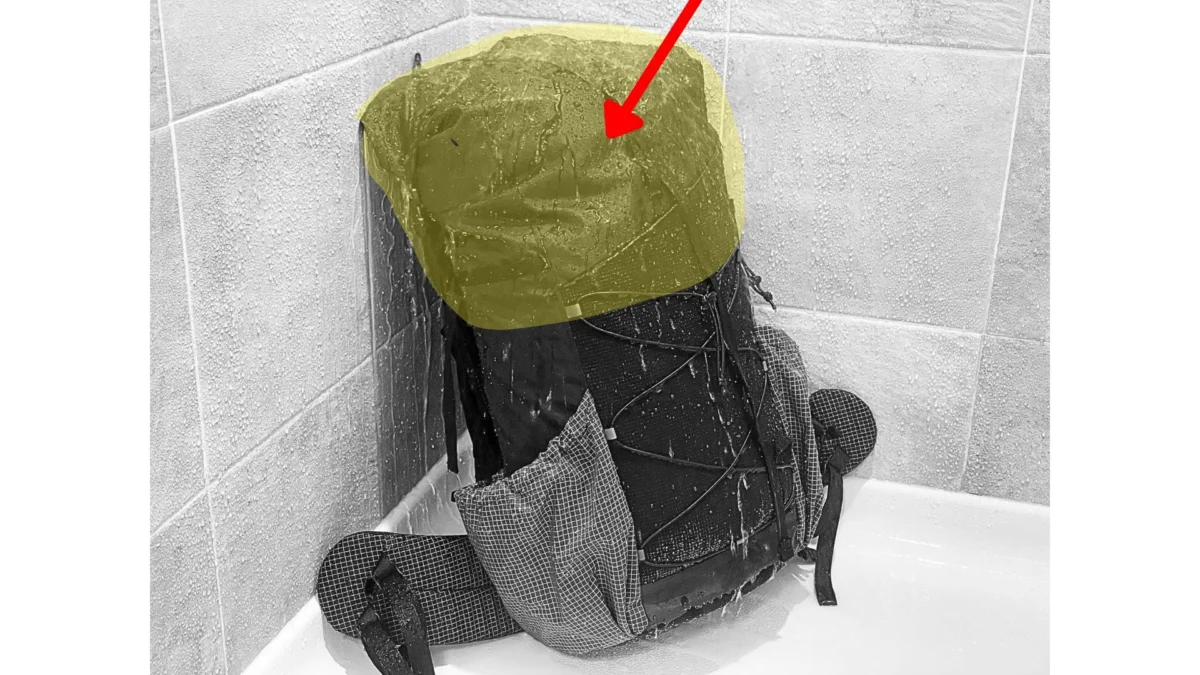
- The Environment: A standard household showerhead providing a sustained, moderate-intensity spray for 30 minutes.
By weighing the pillowcase before and after the test, we can quantify water ingress with precision. This allows for a direct comparison between a "lightweight hiker" pack and a "heavy-duty expedition" pack, revealing that sometimes the most robust-looking packs perform the worst due to complex, seam-heavy construction.
Chronology of Moisture Migration
Understanding how water enters a pack is as important as knowing that it enters. Through repeated testing, a clear chronology of moisture migration has emerged.
Phase 1: The Initial Saturation (0–5 Minutes)
During the first few minutes of exposure, surface tension is the primary defense. DWR (Durable Water Repellent) coatings on the exterior fabric shed the majority of the water. In this phase, the pack remains largely dry, provided the seams are factory-taped.
Phase 2: Seam and Zipper Breach (5–15 Minutes)
As the duration of the "storm" increases, the limitations of the construction become apparent. Zippers are the first to succumb. Even "water-resistant" zippers—often polyurethane-coated—are prone to leaking when exposed to sustained spray. Water tracks along the zipper tape and eventually finds its way through the interlocking teeth. Simultaneously, stitch holes in non-taped areas begin to weep.
Phase 3: Structural Saturation (15–30 Minutes)
By the 20-minute mark, the saturation of the pack’s structural components—such as the webbing anchors, hydration ports, and roll-top collar—reaches a tipping point. If the pack is designed with a drawcord collar under a lid, water that collects in the "puddle" created by the lid often gravity-feeds into the main compartment via the cord port. This is the stage where the cotton pillowcase transitions from damp to saturated.
Supporting Data: Why Design Matters More Than Material
In recent trials, we compared two packs: one constructed from high-end 400D laminate fabric with dozens of external pockets and complex seam lines, and another constructed from basic 210D sil-nylon with a minimalist, roll-top design.
Counterintuitively, the 400D pack—despite having "superior" fabric—saw 40% more moisture ingress than the minimalist pack. The reason? Complexity. The 400D pack featured external daisy chains, multiple compression straps, and intricate paneling that required hundreds of additional stitches. Each stitch was a potential entry point. The minimalist pack, relying on fewer panels and a simple, effective closure, proved to be significantly more weather-resistant. This data underscores a fundamental truth: Complexity is the enemy of water resistance.
Implications for the Industry
The findings from these controlled tests have significant implications for both manufacturers and consumers.
For the Manufacturer
The industry must move away from marketing "fabric specs" as a shorthand for "pack performance." There is an ethical imperative to be transparent about the limitations of a pack’s construction. If a pack is designed for fast-and-light alpine climbing, where weight-saving measures preclude seam-taping, the marketing should explicitly state that the bag is not intended for sustained wet-weather use without a secondary liner.
For the Consumer
The takeaway for the outdoor community is twofold. First, stop relying on the pack itself to be your primary line of defense against water. Even the best-constructed pack will eventually fail in a prolonged, multi-day deluge. Second, adopt a "redundant system" mindset. Using a waterproof pack liner (such as a trash compactor bag or a dedicated dry bag) is the only way to guarantee that your sleep system and spare clothing remain dry.
The Future of Pack Testing
As we look to the future, the goal is to standardize these testing methods to create a "Water Resistance Rating" for backpacks, similar to the IP (Ingress Protection) ratings used in the electronics industry. While a pack will never be an IPX7-rated submersible device, a standardized scale—ranging from "Light Drizzle Resistant" to "Storm-Ready"—would provide consumers with the information they need to make informed decisions.
The shower test, while simple, serves as a wake-up call. It reminds us that our gear is not magic; it is engineering. And like all engineering, it is subject to the laws of physics. When the sky opens up and the clouds break, the difference between a miserable, gear-soaked night and a warm, dry sleep is not the marketing brochure of your backpack—it is the understanding of its limitations and the preparation to mitigate them.
In conclusion, the next time you are shopping for a pack, ignore the denier count and the "waterproof" claims. Look for the seams, count the zippers, and assume the water will get in. When you build your kit around the expectation of moisture, you remove the element of surprise, ensuring that your time in the wilderness remains focused on the journey rather than the struggle against the elements.