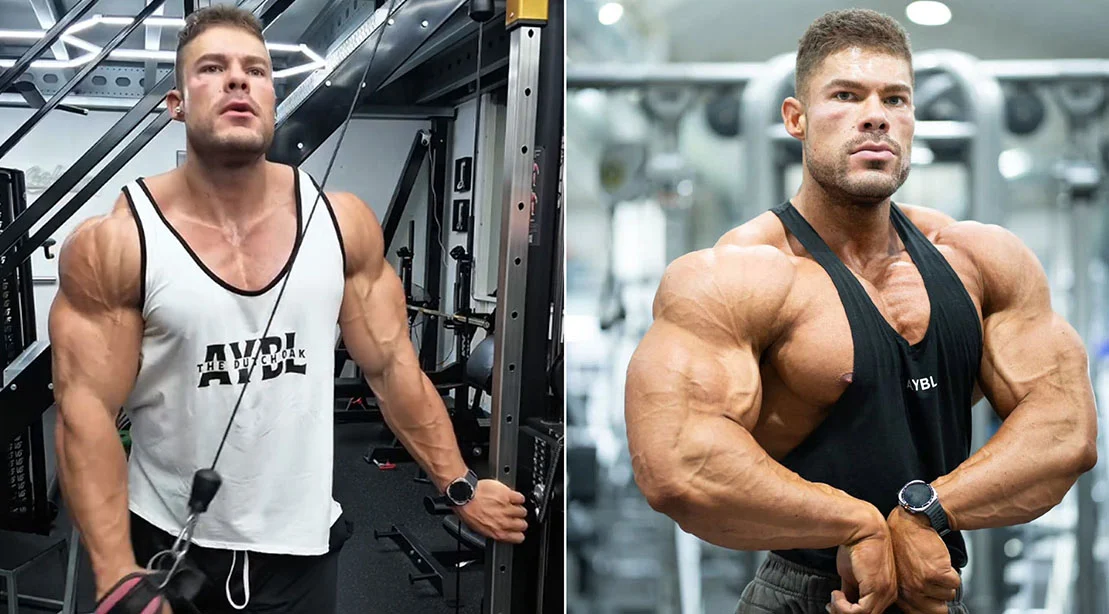
In the high-stakes world of professional bodybuilding, few athletes have captured the imagination of fans quite like Wesley Vissers. Known globally as "The Dutch Oak," Vissers has transitioned from a promising talent to a legitimate titan of the Classic Physique division. Following a career-defining victory at the prestigious Arnold Classic, Vissers has set his sights on the ultimate summit: the 2026 Mr. Olympia title.
To achieve this, Vissers is not merely relying on genetics; he is obsessively refining his training methodology. In a recent, highly anticipated social media breakdown, the Dutch sensation shared a straightforward, high-intensity upper-body routine designed to sculpt the dense, aesthetic musculature required to dethrone the current kings of the Olympia stage. This article dissects his training philosophy, the mechanics behind his preferred movements, and the implications of his roadmap toward the 2026 championship.
The Philosophy of "The Dutch Oak": Efficiency Over Complexity
For many amateur lifters, the path to size is often clouded by "program hopping" and the inclusion of overly complex, flashy movements. Vissers takes a diametrically opposed approach. In his recent Instagram breakdown, he emphasized that his training plan "isn’t that difficult to master" because every movement is curated specifically to match the biological requirements of muscle hypertrophy.
Vissers’ training philosophy is rooted in the "big three" of hypertrophy: mechanical tension, metabolic stress, and muscle damage. He argues that if an exercise does not directly serve the goal of building quality tissue, it is essentially wasted energy. However, he warns that while the exercises themselves are fundamental, the execution is where the true test lies. To replicate his success, one must be prepared to endure significant physical discomfort, pursuing deep stretches and full-range contractions with heavy loads. It is a no-nonsense, grit-heavy approach that mirrors the stoicism for which Vissers is known.
Chronology of a Champion: The Training Routine
To understand how Vissers constructs his physique, one must examine the specific sequence of his upper-body training. He prioritizes compound movements to establish a foundation of mass before moving into isolation exercises that polish the detail of his deltoids and triceps.
Phase 1: The Chest Foundation
Vissers begins his session with the seated chest press. This movement serves as the primary driver for heavy load-bearing. By utilizing a machine, Vissers can safely push to failure without the neurological tax of stabilizing a free-weight barbell. His focus here is twofold: move significant weight to trigger myofibrillar hypertrophy, but maintain a deliberate tempo to ensure a full, muscle-tearing contraction at the peak of the movement.
Phase 2: Targeted Hypertrophy via Incline
Once the chest is primed, Vissers transitions to the Smith machine bench press set to a slight 20-degree incline. This is a critical tactical choice. A standard 45-degree incline often shifts the stress heavily onto the anterior deltoids, potentially neglecting the clavicular head of the pectorals. By dropping the angle to 20 degrees, Vissers targets the upper chest while simultaneously hitting the shoulders and triceps. Furthermore, this position limits the tendency to excessively arch the back, forcing the pectoral fibers to stretch through a greater range of motion, which is essential for that "full" chest look favored by judges.
Phase 3: Isolation and Exhaustion
The third movement is the pec-deck fly. Here, Vissers shifts from compound power to pure isolation. By focusing on horizontal adduction, he exhausts the chest fibers that were previously stimulated by the presses. At this stage of the workout, Vissers stresses the importance of the mind-muscle connection, ensuring that the tension remains entirely within the pectorals rather than being transferred to the deltoids.
Supporting Data: Deltoids and Triceps Refinement
A classic physique is defined by the "V-taper"—wide shoulders narrowing down to a tight waist. Vissers understands that the shoulders and arms are the frame of that taper.
The Side Delt Priority
Vissers holds a firm belief that "you cannot ever have big enough side delts." By training them immediately after his chest routine, he benefits from the fact that his shoulders are already fully engorged with blood. He utilizes the cable lateral raise with a cuff attachment. Unlike dumbbells, which lose tension at the bottom of the movement, cables maintain constant tension throughout the entire range of motion, ensuring that the lateral head of the deltoid is under load from the first inch to the last.
The Triceps Sweep
The triceps are the largest part of the arm, and Vissers targets them with precision. He begins with side triceps pushdowns, again utilizing the cable cuff. This movement isolates the lateral head of the triceps, providing the horseshoe shape essential for a high-scoring physique.
Finally, he incorporates seated dumbbell overhead triceps extensions. This is a functional necessity for the "long head" of the triceps. By raising the arm overhead, the long head is placed in a stretched position—a prerequisite for maximal muscle growth. The combination of these movements ensures that the triceps are hit from every angle, providing the thickness required for the side-chest and back poses.
Training Tips: The Vissers Protocol
To derive the maximum benefit from this program, Vissers recommends a specific volume structure:
- Seated Chest Press: 3 sets (warm-up and heavy working sets).
- All Subsequent Exercises: 2 sets performed to absolute failure.
- Rep Range: 8 to 12 reps per set.
The key, Vissers notes, is not the volume of sets, but the intensity of the sets. "Dig deep," he advises. The goal is to reach a point where the muscle can no longer perform the movement with proper form. This requires mental fortitude, as the final reps in a Vissers-style session are rarely comfortable.
Implications for the 2026 Olympia
Wesley Vissers’ rise in the IFBB professional ranks is not an accident; it is the result of a calculated shift toward a more scientific, yet traditional, approach to bodybuilding. His training routine, while accessible to the general fitness enthusiast, is calibrated to address the specific aesthetic criteria that define the modern Classic Physique division.
By focusing on the "full stretch and full contraction" model, Vissers is effectively increasing the sarcoplasmic volume of his muscles, giving him that "3D" look that separates champions from contenders. If he maintains this trajectory, the implications for the 2026 Olympia are significant. The current landscape of the Classic Physique division is incredibly competitive, with titans like Chris Bumstead having set the bar to near-mythical heights. However, Vissers is proving that with a disciplined, high-intensity training regimen and a focus on muscle fiber exhaustion rather than ego-lifting, the gap at the top is narrowing.
The Dutch Oak is not just preparing for a show; he is preparing to define an era. For the average gym-goer, following this program offers a window into the mind of a man at the top of his game. For his competitors, it serves as a warning: Vissers is getting stronger, his muscle maturity is increasing, and his strategy for the 2026 Olympia is as sharp as his physique.
Conclusion: The Path Ahead
The road to the Olympia stage is littered with athletes who burned out or failed to adapt their training to the rigorous demands of the sport. Wesley Vissers, however, continues to show the consistency and intellectual depth required to sustain elite-level success. By sharing his routines, he remains transparent with his fanbase, inviting them into the process of building a championship physique.
Whether you are looking to add mass to your own chest and triceps or simply looking to understand the mechanics of elite bodybuilding, the Vissers protocol provides a blueprint for success. As we look toward the 2026 Olympia, one thing remains clear: "The Dutch Oak" is not slowing down. He is, in his own words, just getting started on the work that will define his legacy in the history of the sport.
For those looking to follow the journey of The Dutch Oak, Vissers continues to provide updates and training insights via his official Instagram channel, offering a rare look at the daily discipline of a professional athlete chasing greatness.