In the hyper-competitive world of professional bodybuilding, innovation is the currency of champions. For Brandon "The Prodigy" Curry, the 2019 Mr. Olympia winner, maintaining a world-class physique requires more than just heavy lifting—it requires a tactical reimagining of biomechanics. With his sights set firmly on the 2026 Mr. Olympia stage in Las Vegas, Curry has recently unveiled a training methodology that shifts the focus from raw weight to extreme mechanical intensity: the "Mechanical Dropset."
By manipulating angles, leverage, and time under tension, Curry is proving that one does not need to move mountains to build them. His latest leg-day routine, which has sent shockwaves through the fitness community, offers a masterclass in how to extract maximum fiber recruitment from the quadriceps while minimizing the need for ego-driven heavy loads.
The Core Philosophy: Why Mechanical Dropsets Matter
Traditional dropsets have long been a staple of hypertrophy training. The standard protocol involves completing a set to failure, immediately reducing the weight, and continuing to push until the muscle can no longer perform. While effective, this method is often limited by the logistical hassle of changing plates or the risk of injury when handling near-maximal loads.
Curry’s "Mechanical Dropset," however, flips this concept on its head. Instead of decreasing the weight, Curry decreases the mechanical disadvantage of the movement. He begins with the most grueling, gravity-defying version of a squat pattern and progressively transitions into movements where the body has more leverage. As he explains, "In the goal of making things harder, I have used, basically, a mechanical dropset—going from the hardest exercise to the easiest exercise."
By the time Curry transitions through his three-part sequence, his quads are screaming, yet the total weight on the bar remains constant or non-existent, depending on the phase. This allows him to push past neurological failure without the inherent dangers of heavy spinal loading.
Chronology of the Torture: A Step-by-Step Breakdown
Curry’s routine is not for the faint of heart. It is a continuous, three-minute battle against lactic acid buildup. To understand how the 2019 Olympia champion executes this, we must look at the specific architecture of his movement pattern.
Phase 1: The Full-Stretch Sissy Squat
The sequence begins with the most demanding movement: the full-stretch sissy squat. With a slight pause at the bottom of the movement to maximize time under tension, Curry forces the quads into a deep, agonizing stretch. "That pause hits you," Curry notes. "Let those knees shift down to a deeper stretch at the bottom." This initial phase is designed to recruit the distal fibers of the quadriceps, which are often undertrained in standard barbell back squats.
Phase 2: The Partial Sissy Squat
Once the legs reach the threshold of exhaustion, Curry transitions immediately into partial sissy squats. By stopping the descent at parallel, he removes the hips from the equation and places an intense, localized burden on the quads and the lower calf musculature. Because the range of motion is limited, he can sustain the output for a longer period, creating a metabolic "burn" that is essential for triggering hypertrophic signaling.
Phase 3: The Modified Hack Squat
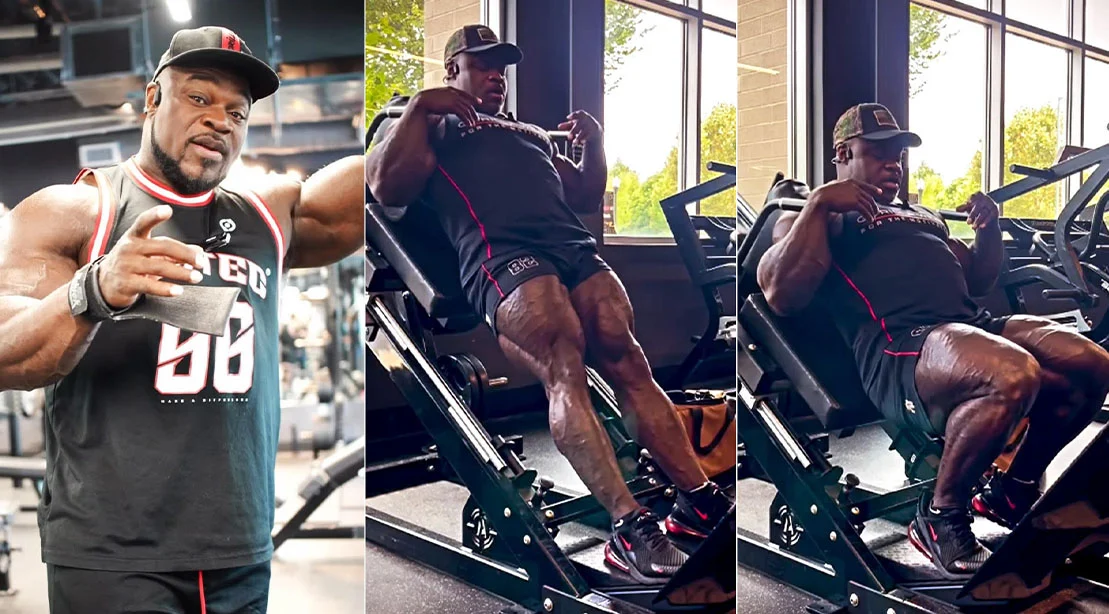
The grand finale involves the hack squat machine, but with a twist. Curry utilizes a wedge on the floor and a foam roller placed behind his shoulders. The wedge elevates his toes, forcing the knees forward and shifting the focus entirely to the anterior chain. The foam roller acts as a fulcrum, facilitating a slight forward lean that keeps the tension pinned on the quads throughout the entire range of motion. He completes this phase by maintaining a tight stance and performing full-range squats with a bottom-end pause.
Supporting Data: The Science of Mechanical Advantage
Why does this work? From a physiological perspective, Curry’s method is rooted in the principle of "Pre-Exhaustion" followed by "Extended Sets."
- Time Under Tension (TUT): By incorporating pauses at the bottom of each repetition, Curry increases the duration of the eccentric and isometric phases. Studies suggest that TUT is a primary driver of muscle hypertrophy, as it prevents the use of momentum and forces the muscle fibers to handle the load throughout the entire range.
- Reduced Spinal Loading: One of the most significant benefits of the mechanical dropset is the reduction of axial loading. Heavy squats are notorious for placing stress on the lumbar spine. By using bodyweight-focused movements (sissy squats) and the guided path of the hack squat machine, Curry can train with high intensity for years without the wear and tear associated with traditional heavy powerlifting.
- Fiber Recruitment: By changing the angle of the torso and the placement of the feet, Curry ensures that he is hitting the rectus femoris and the vastus lateralis from multiple angles. This leads to a more "3D" look to the quads, which is a requirement for winning the Mr. Olympia title.
Official Perspectives: The Prodigy’s Stance on Ego Lifting
Throughout his career, Curry has been a vocal opponent of "ego lifting." In an industry where social media influencers often prioritize the number on the plates over the quality of the contraction, Curry serves as a refreshing voice of reason.
"Does it have to be heavier? No," Curry stated during his recent social media breakdown. "My method makes things harder without going heavier."
This perspective is backed by decades of bodybuilding wisdom. The goal is to stimulate muscle tissue, not to move the heaviest weight from point A to point B. By lowering the weight and increasing the precision of the movement, Curry has managed to refine his physique even in his later competitive years. His approach suggests that as a bodybuilder matures, the path to growth lies in refining the "mind-muscle connection" rather than attempting to match the PRs of one’s younger self.
Implications for the 2026 Olympia
As the bodybuilding world turns its eyes toward the 2026 Mr. Olympia, the stakes have never been higher. The division is becoming increasingly defined by conditioning and detail. Curry’s willingness to experiment with these mechanical variables indicates that he is not resting on his laurels.
If he can successfully apply this "mechanical dropset" philosophy to other muscle groups—such as the chest or back—he could potentially unveil an even more refined, dense, and "granite-like" physique. For the amateur athlete, the implication is clear: you do not need a commercial gym’s entire weight rack to see progress. You need a wedge, a foam roller, and the mental fortitude to endure three minutes of continuous, high-intensity tension.
How to Integrate This Into Your Training
For those looking to adopt "The Prodigy’s" routine, Curry suggests a simple starting point:
- The Routine: Perform one set of each of the three movements (Full Sissy Squats, Partial Sissy Squats, and Hack Squats).
- The Rep Range: Aim for 8 to 12 reps per movement. However, if you are looking to push your limits, do not count the reps—go until you reach absolute mechanical failure.
- The Setup: Use a wedge for your toes and a foam roller for your back to ensure the knees remain the primary pivot point.
Brandon Curry’s training philosophy serves as a reminder that the most sophisticated piece of equipment in the gym is the human brain. By carefully manipulating how we apply stress to our muscles, we can bypass the plateau that traps many athletes. As Curry continues his quest for another Olympia title, his mechanical dropset stands as a testament to the fact that, in bodybuilding, the most intense growth often comes from the smartest movements, not the heaviest.