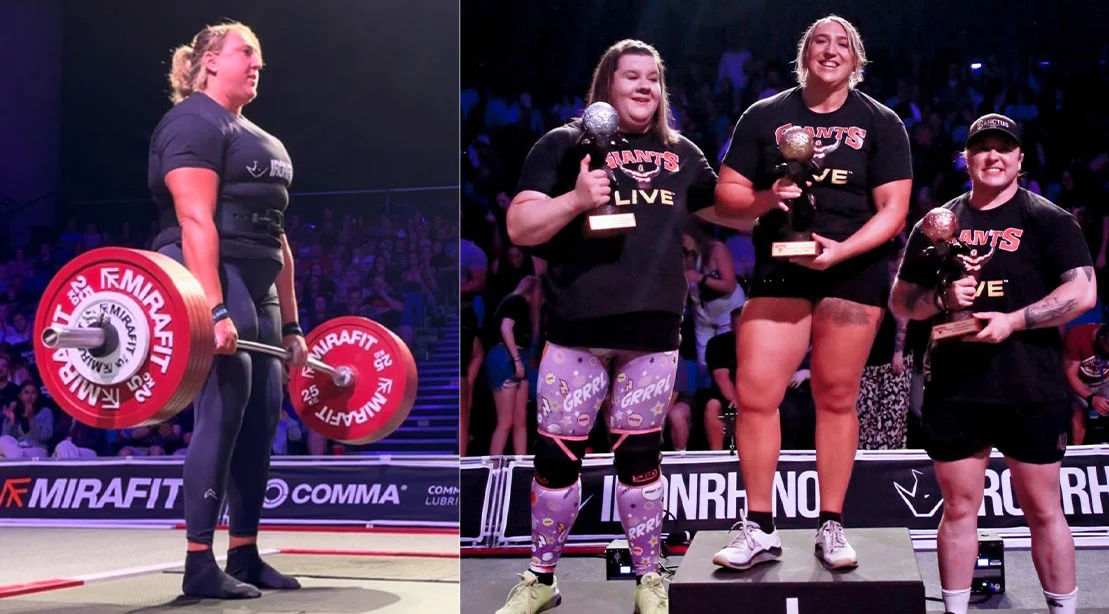
In the high-stakes, iron-clad world of professional strongwoman competition, few names carry the weight—literally and figuratively—of Lucy Underdown. On July 25, 2026, at the historic York Barbican, the 36-year-old titan cemented her status as a generational talent, securing her third consecutive "Britain’s Strongest Woman" title. In a display of tactical brilliance and raw, unbridled power, Underdown proved that she is not merely a competitor, but the undisputed queen of the British strength circuit.
For Underdown, who balances the grueling, high-pressure demands of life as a serving police officer in Kent with the rigorous training required of a world-class athlete, this victory was more than a trophy; it was a testament to the power of psychological fortitude. As she stood atop the podium, she wasn’t just celebrating a win—she was celebrating the culmination of a year defined by internal growth, physical refinement, and an unwavering commitment to her craft.
The Main Facts: A Commanding Performance
The 2026 Britain’s Strongest Woman championship was expected to be a tightly contested affair, with a field of elite athletes hungry to unseat the defending champion. However, Underdown’s performance effectively neutralized the competition early in the day.
Entering the event with the weight of expectation on her shoulders, Underdown remained composed, delivering a masterclass in event management. She secured outright victories in the marquee Deadlift event and the grueling Stone to Shoulder challenge. By the time the dust settled, she had amassed a staggering 4.5-point lead over her closest rival, the formidable Rebecca Roberts.
Underdown’s dominance was not a product of luck; it was the result of a calculated approach. While many competitors focus exclusively on brute strength, Underdown has evolved her game to incorporate a level of tactical awareness that allows her to thrive under the intense pressure of the spotlight.
A Chronology of Success: From Discus Circle to Strength Podium
To understand the trajectory of Lucy Underdown’s career, one must look beyond the barbell. Before she was crushing world records, Underdown was a high-level discus thrower, a sport that requires a unique combination of explosive power, rotational speed, and kinetic sequencing. She reached the No. 3 ranking in the United Kingdom, a background that clearly informs her current athletic prowess.
Her transition to strongwoman was seamless, though it required a shift in focus from the technical nuances of throwing to the sheer structural integrity required for heavy lifting.
- 2024: Underdown captures her first Britain’s Strongest Woman title, signaling her arrival as a force to be reckoned with.
- 2025: She successfully defends her title, proving that her maiden victory was no fluke.
- 2026: The "three-peat." By securing her third consecutive title, Underdown enters an elite tier of strength athletes, cementing her legacy in the history books of the sport.
Throughout this period, she has also become a global icon in the deadlift, holding world records with both the standard bar (717 pounds / 325 kilograms) and the elephant bar (701 pounds / 318 kilograms).
Supporting Data: The Mechanics of a Champion
The Deadlift has long been Underdown’s calling card, yet even she admitted that leading up to the 2026 competition, the training cycle was not without its hurdles. "Deadlift was where I come into my own," Underdown noted following her win. "Claire Myler was always going to lay down the gauntlet, and my deads weren’t always feeling great in training."
Despite these reservations, the performance on the day was surgical. Underdown executed a 280kg (617 pounds) lift for 4 repetitions with what she described as "loads left in the tank." This ability to perform under pressure—to turn "training-room anxiety" into "competition-day execution"—is what separates a great lifter from a champion.
The data suggests that Underdown is currently in the prime of her career. With 4.5 points of separation between her and the runner-up in a field of elite competitors, her current level of performance is significantly ahead of the current British standard.
Official Responses and Internal Reflections
In the aftermath of her victory, Underdown took to social media to provide a rare glimpse into the headspace of a champion. Her post-competition reflection was characterized by a sense of serenity that has eluded her in years past.
"What a great competition!" Underdown wrote on Instagram. "I knew exactly what I needed to do, and when it came down to the competition, I had a sense of calm I have never felt before. I knew each event, what was needed, and I executed everything perfectly."
She was quick to deflect the praise, highlighting the role of her support system. She specifically credited her coach, Shane Reece of MST Systems, for his guidance. "Thanks also to my coach @mstsystems for putting up with me for another year, and helping to keep me at the top of the game. We did it again."
This humility is a cornerstone of Underdown’s public persona. She has been transparent about the mental health challenges of the sport, including the anxiety that comes with high-level competition and the vitriol that can sometimes manifest in the comments sections of social media. By speaking openly about these struggles, she has become an inspiration to a younger generation of lifters who may also be grappling with the pressures of the modern digital landscape.
The Broader Implications: Redefining Strength
The implications of Lucy Underdown’s three-peat reach far beyond the gym or the competition floor.
1. The Professionalization of Strength
As a full-time police officer, Underdown represents a new breed of athlete—one who maintains a demanding, high-responsibility "day job" while simultaneously operating at the pinnacle of international sports. This serves as a powerful argument for the sustainability of a career in strongwoman competition, provided there is elite-level coaching and a disciplined approach to recovery.
2. The Mental Game
Underdown’s victory provides a case study in the importance of mental preparation. Her "sense of calm" is not an innate trait; it is a learned skill. By prioritizing her mental health and openly discussing her anxiety, she has helped de-stigmatize the psychological toll of elite sports.
3. Future Prospects
With three consecutive titles, the question for Underdown is no longer whether she can win in the UK, but how far she can push the boundaries of human performance on the global stage. Having already shattered records, her focus will likely shift toward maintaining this "perfect" execution in international arenas, where the competition is stiffer and the weight requirements continue to climb.
Conclusion
Lucy Underdown’s victory at the 2026 Britain’s Strongest Woman competition is a landmark moment in the sport. It is a story of grit, tactical intelligence, and the successful navigation of life’s competing demands. As she looks toward the future, one thing remains clear: whether she is in the uniform of the Kent Police or the gear of a world-class strongwoman, Lucy Underdown is a woman defined by her ability to lift the weight that others cannot.
For those who wish to follow the next chapter of her journey, her continued transparency and dedication to the sport promise to keep her at the forefront of the strength community for years to come. She has not only claimed the title; she has defined the era.