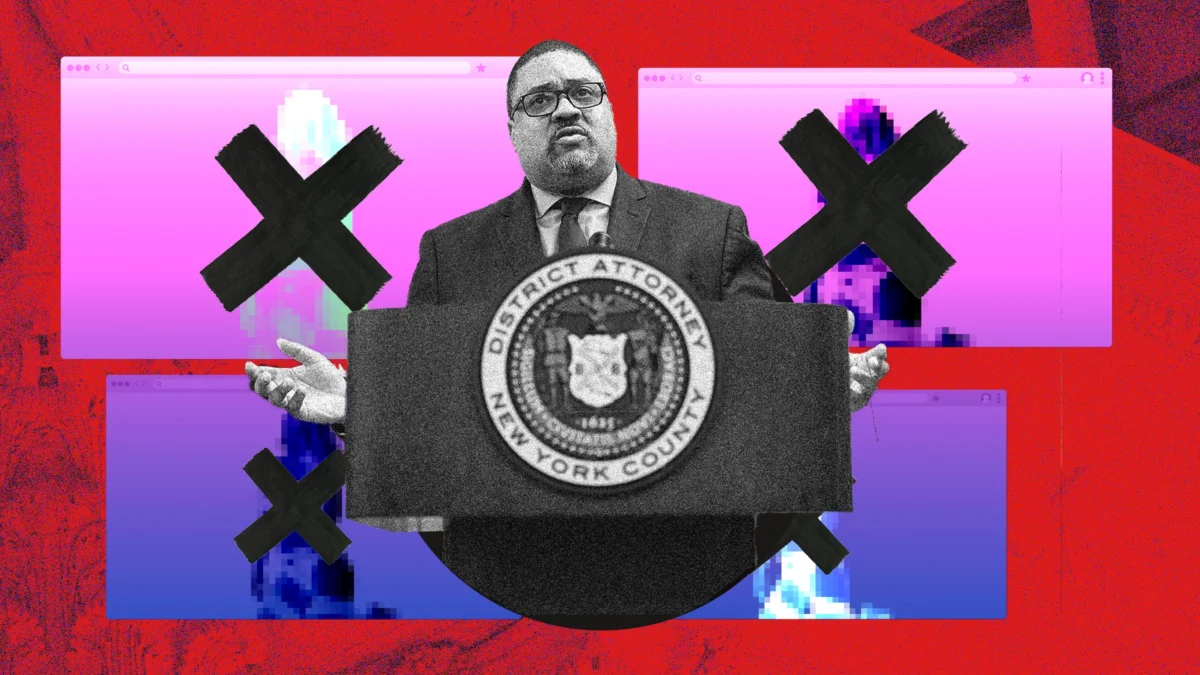
In a landmark move that signals a hardening stance against the proliferation of nonconsensual synthetic media, the Manhattan District Attorney’s Office has successfully seized 12 domains identified as central hubs for the distribution of explicit deepfake pornography. This coordinated law enforcement action, announced this past Monday, represents perhaps the most significant strike to date against the "dark industry" of AI-generated sexual exploitation—a sector that has operated with relative impunity since the technology first emerged in late 2017.
The operation, carried out under New York State criminal procedure laws, targeted websites that functioned as digital clearinghouses for thousands of sexually explicit videos. These platforms utilized sophisticated artificial intelligence to graft the likenesses of high-profile women—including celebrities, musicians, athletes, and politicians—onto pornographic content. The seizure underscores a growing recognition by authorities that these platforms are not merely hosting content; they are facilitating systemic, large-scale violations of privacy that inflict profound, lasting harm on their victims.
The Scope of the Operation: A Systemic Violation
The seized domains were not peripheral sites; they were high-traffic portals that had, in some cases, been operating for years. According to the Manhattan District Attorney’s Office, the platforms collectively hosted nonconsensual sexual imagery and videos depicting approximately 1,200 individuals.
The victims identified in this investigation represent a cross-section of public life: influencers, actors, activists, and, increasingly, political figures. The nature of the content was uniformly predatory. The sites functioned as repositories for "nudified" images and graphic videos, many of which were minutes long and meticulously engineered to mimic mainstream adult entertainment. By swapping the faces of unsuspecting women into pre-existing pornographic scenes, the operators of these sites commodified human likenesses without consent, profiting from the digital degradation of their targets.
Chronology: From Fringe Technology to Industrial-Scale Abuse
The trajectory of deepfake pornography reflects the rapid, often uncontrolled, advancement of generative AI.
- Late 2017: The public introduction of deepfake technology, originally rooted in open-source research, was almost immediately co-opted by bad actors to create nonconsensual intimate imagery (NCII).
- 2018–2020: The industry matured. Websites such as the now-notorious MrDeepFakes emerged, creating a centralized ecosystem where content could be uploaded, shared, and monetized. This era saw the transition from amateurish, "glitchy" edits to hyper-realistic, highly convincing videos.
- 2021–2024: The proliferation of "nudify" bots and automated apps accelerated the volume of content. Researchers began documenting an increasing trend of political targeting, with European and American politicians becoming frequent subjects of these manipulated clips.
- 2025–2026: Investigative reporting and advocacy efforts—including the unmasking of operators behind major platforms—began to apply pressure to law enforcement. Legislative efforts, such as the US Take It Down Act, provided a new legal framework for site seizures.
- Present Day: The Manhattan DA’s office successfully executes the seizure of 12 major domains, marking a shift toward aggressive, jurisdiction-based enforcement.
The Anatomy of a Digital Dark Industry
The technical infrastructure behind these sites is designed for resilience and monetization. Many of the seized domains employed names that explicitly targeted search traffic, such as "sex celebrity" or "real deepfakes," designed to lure users through search engine optimization.
Benjamin Shultz, lead researcher at the American Sunlight Project, notes that the ecosystem is highly interconnected. Much of the content found on the recently seized sites was re-posted from other, larger repositories. "Most videos took the shape of actual pornographic movies, manipulated to instead show targets’ faces," Shultz explains. The level of organization is chilling; on at least two of the seized sites, researchers discovered profiles for elected officials, complete with their name, professional position, and a grid-based menu of manipulated videos—a clear attempt to maximize the reach and impact of the harassment.
The monetization strategies are equally sophisticated. Many of these sites utilize affiliate marketing, ad-revenue sharing, and sometimes direct payment tiers, creating a self-sustaining cycle where profit incentivizes the constant creation of new, more realistic imagery.
Official Responses and the Legal Landscape
Manhattan District Attorney Alvin Bragg has been unequivocal in his condemnation of the industry. "These horrific violations of privacy follow victims into their careers and personal lives and take an immense toll on emotional and mental well-being," Bragg stated. The DA’s office is currently urging victims to come forward, as the investigation into the operators and those who uploaded the original damaging content remains ongoing.
The legal mechanism behind the takedown is noteworthy. By utilizing state-level seizure warrants under the New York State Supreme Court, prosecutors bypassed some of the jurisdictional hurdles that have historically plagued cross-border internet enforcement. Leonie Oehmig, a researcher at the Institute for Strategic Dialogue (ISD), highlights that the effectiveness of these seizures is amplified by the inability of users to bypass the blocks using VPNs. This suggests that for the first time, coordinated legal pressure is successfully outmaneuvering the technical evasions of site operators.
However, the legal landscape remains fragmented. While the Take It Down Act in the US has provided a more robust toolkit for law enforcement to secure the removal of NCII, the global nature of the internet means that a site seized in New York might technically be re-hosted in a more lenient jurisdiction.
The Human and Political Cost
The impact of deepfake pornography extends far beyond the screen. For a private citizen or a public figure, the existence of such content is a form of permanent, digitally-encoded harassment. Unlike traditional defamation, which can be refuted, synthetic media creates a visual "truth" that is difficult to purge from the collective memory of the internet.
The targeting of politicians is particularly concerning. Shultz’s research indicates that 56 European politicians and 16 US politicians have appeared on these platforms. This suggests that deepfakes are increasingly being used as a tool for political intimidation—a way to silence women in public office or damage their credibility through sexual humiliation.
Implications: The Path Forward
The recent takedown is a significant victory, but experts warn that it is only one battle in a much larger war. The "deepfake ecosystem" is built on multiple, interlocking layers:
- Creation: The AI models and bots that make creating NCII accessible to anyone with a browser.
- Discovery: Search engines and social media platforms that allow for the distribution and promotion of the content.
- Hosting: The technical infrastructure (servers, domain registrars) that keeps the content online.
- Monetization: The payment processors and ad networks that keep the industry profitable.
"Effective intervention needs to target the ecosystem at multiple points," says Oehmig. Future efforts will likely need to focus on these underlying technical and financial pillars. If the profit motive is removed, the sheer volume of production may dwindle. However, as long as the technology remains accessible, the demand for nonconsensual synthetic content is likely to persist.
The Manhattan District Attorney’s operation demonstrates that the law is finally catching up to the technology. While the 12 seized domains may be replaced by others, the message to the operators is clear: the era of consequence-free, industrial-scale digital exploitation is being brought to a close. For the victims, many of whom have struggled for years to get these images scrubbed from the web, these seizures offer a rare, tangible moment of justice in a digital world that has for too long favored the harasser over the harmed.