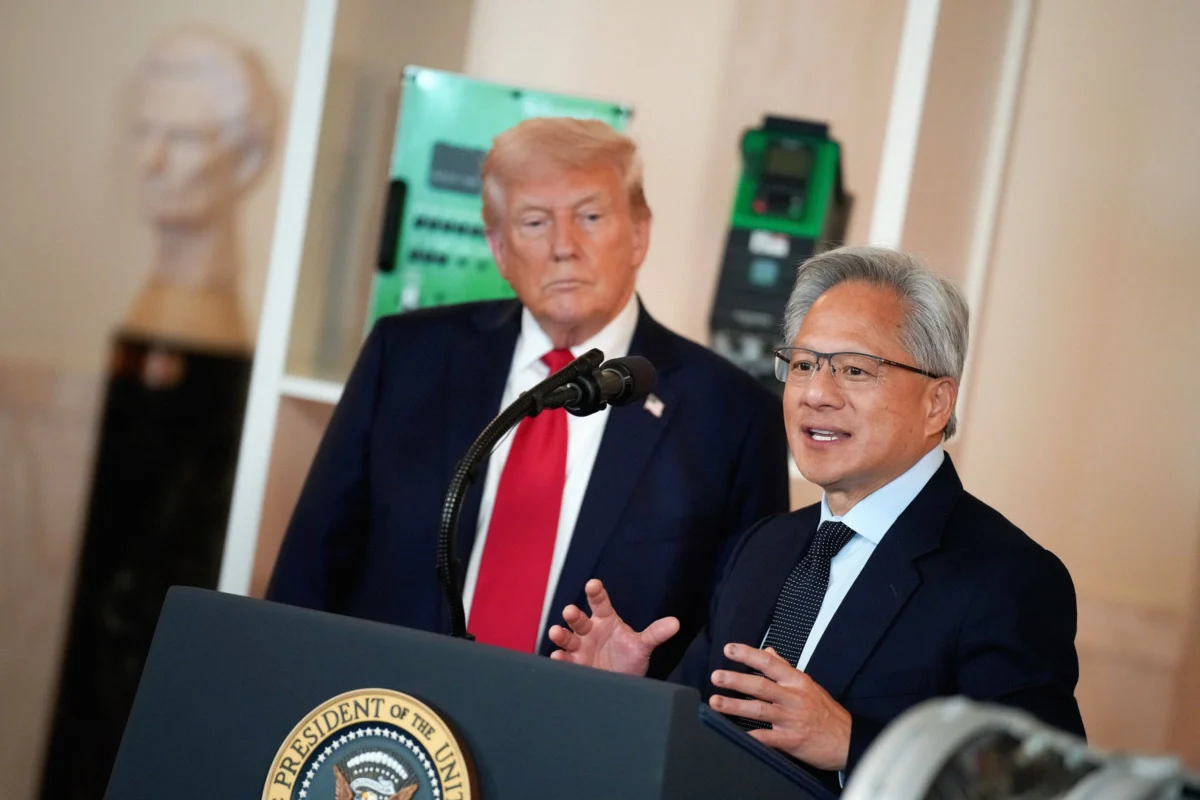
In a moment that blurred the lines between high-stakes corporate management and presidential politics, Nvidia’s all-hands meeting in Santa Clara was unexpectedly interrupted on Thursday morning by a direct telephone call from President Donald Trump to CEO Jensen Huang. The incident, witnessed by thousands of in-person and remote staff, has since ignited speculation regarding the deepening entanglement between the world’s most valuable semiconductor company and the executive branch of the United States government.
The Chronology of an Unscheduled Interruption
The Thursday morning all-hands meeting was, by all accounts, proceeding according to the standard cadence of Nvidia’s corporate culture. Jensen Huang, known for his hands-on approach to leadership, was on stage at the company’s headquarters in Santa Clara, California, addressing a packed auditorium of staff while simultaneously streaming to thousands of employees worldwide.
According to three sources familiar with the event, the session was abruptly paused when Huang received an incoming call on his mobile device. In a display of transparency that inadvertently became the highlight of the day, Huang stepped aside to take the call. Because he was still wearing his wireless microphone, the auditorium speakers projected the unmistakable, gravelly voice of President Donald Trump.
While the specific contents of the conversation remained inaudible to the audience, the breach of protocol was immediate. The interruption lasted less than a minute, after which a composed Huang returned to the center of the stage to resume the meeting as if nothing out of the ordinary had occurred. However, the corporate atmosphere had shifted; staff members were immediately abuzz, with the incident quickly becoming the primary topic of conversation across internal channels.
The Context: A Financial Juggernaut
The timing of the call was far from coincidental. Just one day prior, Nvidia had released its second-quarter earnings report, revealing a staggering $96 billion in revenue—a 106 percent increase compared to the same period in the previous year.
Later that same day, President Trump took to his Truth Social platform to publicly congratulate Huang on the company’s "incredible" financial performance and its optimistic forecast for the coming fiscal year. The public acknowledgment served to contextualize the private call, framing it as a nod to the economic engine that Nvidia has become. As the primary architect of the AI infrastructure boom, Nvidia’s financial health is increasingly viewed by the Trump administration as a bellwether for American technological dominance.
Supporting Data: The Rising Influence of the Chip Giant
The influence of Nvidia on the global stage is difficult to overstate. The company is currently navigating a period of intense transition as it attempts to solidify its dominance in AI hardware while simultaneously expanding its footprint in the software and data ecosystem.
The Birth of the Nvidia PAC
Perhaps the most significant development coinciding with the presidential call is the company’s recent launch of an employee-funded Political Action Committee (PAC). As reported by Bloomberg Law, this move signifies a strategic pivot toward aggressive lobbying in Washington. Given that Nvidia’s operations are heavily impacted by federal policy—ranging from export controls on advanced semiconductors to the oversight of AI development—the creation of a PAC suggests that the company is preparing for a long-term engagement with federal regulators and policymakers.
The Hugging Face Acquisition
Further complicating the landscape is the reported acquisition of Hugging Face, the central hub for open-source AI models and development tools. With a valuation estimated at over $13 billion, the acquisition would effectively grant Nvidia control over the primary repository for the AI engineering community. Such a move would undoubtedly invite intense scrutiny from the Federal Trade Commission (FTC) and other antitrust bodies, as it effectively consolidates the "picks and shovels" of the AI industry under a single corporate roof.
Official Responses and Strategic Silence
In the wake of the incident, Nvidia has maintained a position of strategic silence. A company spokesperson declined to provide a formal statement or comment on the nature of the presidential phone call. This refusal to engage with the media on the matter is consistent with Nvidia’s historically guarded approach to its executive-level dealings.
The White House, conversely, has utilized the public platform of social media to frame the interaction as a constructive dialogue. By focusing on the company’s financial success rather than the specific mechanics of the call, the administration is signaling its support for American tech leaders whose growth metrics align with the President’s economic agenda.
Implications: The Intersection of Policy and Profit
The interaction between Trump and Huang carries profound implications for the future of the technology sector, particularly concerning the regulatory environment.
1. The Regulatory Tightrope
Nvidia and the Trump administration have not always seen eye-to-eye. Their disagreements have primarily focused on the regulation of open-source AI models and the strict export controls imposed on advanced chips destined for Chinese markets. Huang, who frequently travels to Washington to lobby for the company’s interests, finds himself in a position where he must balance the need for global market access with the necessity of aligning with U.S. national security interests.
2. The Normalization of High-Level Access
The fact that a sitting President can reach the CEO of a $3 trillion company mid-meeting underscores the shift in how the government interacts with "Big Tech." It suggests a more direct, perhaps even informal, channel of communication. For investors and market analysts, this "hotline" relationship creates a new variable in assessing the risk and reward of investing in the chip sector.
3. Antitrust and Market Concentration
The acquisition of Hugging Face, if finalized, will become a litmus test for the administration’s stance on market consolidation. While the administration may be eager to see American companies win the "AI arms race," the sheer scale of an Nvidia-Hugging Face merger poses potential antitrust issues that could alienate the broader open-source developer community.
Conclusion: A New Era of Corporate Governance
The incident on Thursday was more than a technical mishap or an accidental broadcast. It served as a symbolic moment, illustrating the inextricable link between national power and corporate technological dominance. As Nvidia continues to expand its reach—from the silicon inside a server to the open-source libraries that define the modern AI landscape—the company will find itself increasingly at the center of the political stage.
For Jensen Huang, the challenge remains unchanged: to steer the world’s most critical technology firm through a complex web of geopolitical tensions, antitrust hurdles, and the intense scrutiny of a presidential administration that views Nvidia’s success as a matter of national priority. Whether the interruption was a calculated gesture of support or a spontaneous byproduct of a high-level lobbyist relationship, one thing remains clear: the barrier between the Oval Office and the boardroom has never been thinner.
As the regulatory debate around AI policy continues to heat up, the industry will be watching closely to see how this direct line of communication translates into future legislative outcomes, merger approvals, and, ultimately, the trajectory of the global AI revolution.