Introduction: The Unforgiving Reality of Winter Spill Response
Inland spill response is a high-stakes discipline, but when the mercury drops and waterways freeze, the risk profile shifts from demanding to potentially lethal. Managing hazardous material releases—particularly oil spills—on frozen rivers and lakes is one of the most complex challenges faced by emergency responders. Unlike open-water recovery, where traditional booms and skimming equipment are standard, winter operations require an entirely different tactical approach.
Responders often find themselves walking the razor’s edge between environmental stewardship and human safety. The presence of moving water beneath a sheet of ice creates a dynamic, unstable, and unforgiving environment. For incident commanders, the priority is clear: the safety of the responders must remain the primary objective, even as the environmental clock ticks to mitigate the spread of pollutants.
The Anatomy of the Risk: Why River Ice is Different
The fundamental danger in winter spill response lies in the distinction between lake ice and river ice. While lake ice remains relatively static, river ice is subject to the constant, kinetic energy of flowing water. This current can erode the underside of the ice sheet unevenly, creating "soft spots" that are invisible to the naked eye.
The Physics of Failure
A responder falling through ice on a still pond faces a severe cold-water immersion event. A responder falling through ice on a river, however, faces the added peril of being swept beneath the ice shelf by the current. Once trapped under the ice, the likelihood of survival drops precipitously, as the victim cannot reach the surface to breathe.
Because of this, the doctrine for winter response is absolute: Stay off the ice until a comprehensive assessment and safety plan have been established and verified. No spill is worth a life. The goal is always to work from the shore or from stabilized platforms, minimizing the need for personnel to set foot on the ice surface.
Chronology of an Ice-Based Response
A successful winter spill response follows a strict, non-negotiable operational timeline. Deviating from these steps invites disaster.
1. Initial Size-Up and Site Stabilization
Before a single piece of recovery equipment is deployed, the incident command must conduct a thorough "size-up." This involves assessing the river’s current speed, its depth, and the integrity of the ice.
- Drilling Strategy: Responders begin by drilling a series of test holes starting from the shore, moving outward into the response zone. This must be done using proper weight distribution—often via plywood sheets—and while the personnel performing the drilling are securely belayed.
- The Safety Perimeter: Once the ice is tested, the zone must be cordoned off. Protective fencing or clear visual markers are mandatory to prevent unauthorized personnel from entering unstable areas.
2. Establishing the "Safe Zone" and Infrastructure
Once the stability of the ice is verified, responders focus on establishing a secure base of operations. This includes:
- Access Improvement: Installing anti-slip measures on riverbanks and pathways to prevent falls.
- Warming Infrastructure: A dedicated warming tent or hut must be established immediately. This facility acts as the hub for medical support, including hypothermia wraps, AEDs, oxygen, and extra layers of personal protective equipment (PPE).
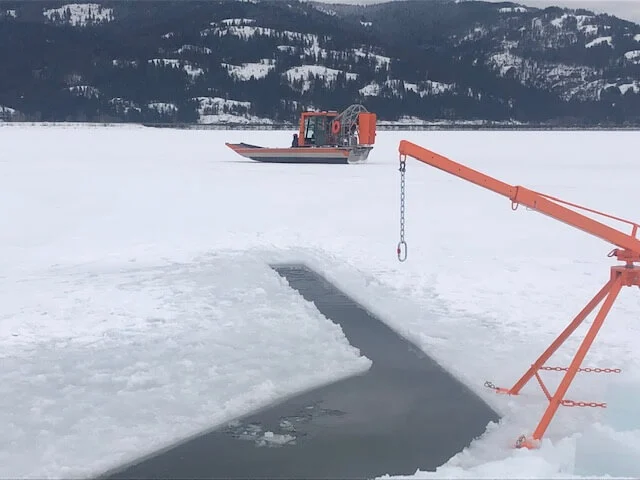
- Platform Deployment: If the ice cannot support heavy equipment, the operation must pivot to boat-based platforms, such as airboats or inflatable rafts, which can navigate both ice and open water.
3. Execution of Spill Recovery
With the site secured, the recovery phase begins. This is a rhythmic process of monitoring, adjusting, and executing. Because weather conditions change rapidly in winter, the command team must continuously re-evaluate the ice. If temperatures fluctuate, what was safe at 08:00 may be compromised by 14:00.
Supporting Data: Calculating Ice Strength
Mathematical certainty is the best defense against environmental hazards. Incident commanders should utilize the formula P = 50 x T², where P represents the load-bearing capacity in pounds and T is the thickness of the ice in inches.
- 2 Inches or Less: Absolute danger. Stay off.
- 4 Inches: Minimum for foot traffic (skating/ice fishing).
- 5–6 Inches: Sufficient for snowmobiles and ATVs.
- 7–8 Inches: Required for a single medium truck.
Critical Adjustments:
These figures are baseline estimates for high-quality lake ice. When working on rivers, responders must reduce these values by 15% to account for the weakening effect of the current. Furthermore, if the ice is "snow ice"—opaque, milky ice formed by freezing snow—its strength must be reduced by an additional 50%.
Official Protocols: PPE and Specialized Gear
The equipment list for winter spill response is extensive, reflecting the dual threats of chemical exposure and hypothermia.
Essential Personal Protective Equipment (PPE)
- Primary Gear: Drysuits are mandatory, paired with appropriate PFDs (Personal Flotation Devices), helmets, and ice cleats.
- Safety Tools: Every responder must carry ice awls for self-rescue.
- Environmental Protection: Specialized gloves and boots that provide dexterity while resisting chemical permeation are vital.
Operational Equipment
- Cutting and Access: Augers and chainsaws for creating recovery slots in the ice.
- Rescue and Recovery: Throwbags, pry bars, and belay lines.
- Medical: A fully stocked EMS kit and, if necessary, portable heaters to maintain the efficacy of medical supplies.
The Human Element: Hypothermia and Wind Chill
Environmental hazards are not limited to the ice itself. The wind chill index plays a critical role in the safety of the ground crew. The "feels like" temperature is a function of both ambient air temperature and wind speed. As wind speeds increase, the rate at which a human body loses heat accelerates, potentially leading to frostbite in minutes.
Wind Chill Safety Tips:
- Layering: Utilize moisture-wicking base layers to keep sweat away from the skin.
- Hydration and Nutrition: Cold weather increases the body’s metabolic demand. Responders must be fed and hydrated.
- Rotation: Implement strict work-rest cycles. No responder should remain on the ice for extended periods without a rotation into the warming tent.
Implications: The Future of Winter Response
As climate patterns become increasingly unpredictable, the frequency of winter spills—and the complexity of responding to them—is likely to grow. The "old school" methods of simply pouring manpower into a problem no longer suffice. Modern spill response relies on the integration of technology, data-driven safety assessments, and rigorous adherence to standard operating procedures.
Self-Rescue: A Last Resort
Every responder should be trained in ice self-rescue. If an individual falls through, the protocol is simple:
- Do not panic.
- Extend arms: Spread arms wide to prevent slipping entirely beneath the ice.
- Kick: Use a horizontal kicking motion to gain momentum.
- Roll: Once the upper body is on the surface, roll away from the hole to distribute weight.
Conclusion
The hazards of inland spill response in cold weather are significant, but they are manageable through discipline and preparation. By respecting the physics of river ice, strictly following the ice-assessment protocol, and prioritizing the health of the response team, organizations can mitigate the environmental impact of spills without sacrificing the lives of those on the front lines. The cold is a formidable opponent, but through informed, careful, and coordinated action, it is one that can be managed.